Additional Information
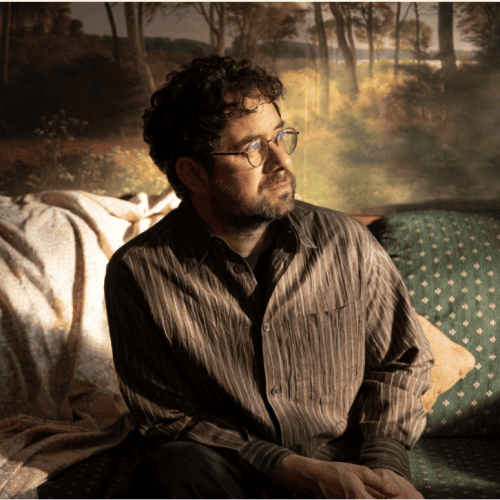
Adrian Quesada, a guitarist and producer based in Austin—the most musical city in Texas—isn’t very well known in our part of the world. Back home, he’s recognized as a musician who reinvented Texas Latin music, also known as Tejas, from the time when that territory belonged to Mexico.
“I’m binational—I have Mexican parents, but I grew up on the American side of the border. I’m bicultural and even multicultural, and that largely defines my sound,” Adrian Quesada tells me during our chat.
On June 27, Quesada performed an instrumental concert with his Trio Asesino, a new group created by the guitarist that has just released an album. The virtually unknown quartet found itself playing to an impressive crowd…who had come to see Angine de Poitrine two and a half hours later!
This is Adrian Quesada’s second appearance at the FIJM. The first time was with the legendary Austin band Grupo Fantasma, which formed in the early 2000s and occasionally performed with Prince.
“It’s a band that revitalized Latin music in the United States,” says Quesada. “There were ten of us, influenced by cumbia, salsa, African music, and rock. There was a lot of improvisation, a bit like in jazz. For me, those were very formative years.”
Grupo Fantasma still exists, but Adrian Quesada left the band more than a decade ago. He won the 2011 Grammy for Best Latin Rock Album. Back on the TD stage, Quesada and his trio of “killers” captivate the crowd with long instrumental pieces, during which the Black organist in a cowboy hat lets loose with some wild solos. The result is a cinematic sound that lifts you up, with influences from Latin, jazz, and rock. It’s not the microtonal rock of Angine de Poitrine, but the audience is tapping their feet.
Another musical project by Adrian Quesada is called Black Pumas. It’s a soul-oriented duo that sings in English, featuring vocalist Eric Burton (not to be confused with the British singer Eric Burdon).
“I’ve always wanted to make soul music; I’d written a few instrumental pieces, and someone introduced me to Eric Burton, who brought his songs, and that led to two albums,” Quesada said in an interview. The band’s success surprised Quesada. After two albums, released in 2021 and 2023, the band went on hiatus.
Adrian Quesada is involved in a variety of different projects. One such project, Boléros Psicodélicos, was formed and released two albums, in 2022 and 2025.
“At first, I wanted to pay tribute to Mexican bands from the ’60s and ’70s, who started blending Latin influences with rock and California surf music. Then I added my own compositions and brought in singers from both the United States and Latin America,” the guitarist explains in an interview. He adds that this project was conceived during the COVID-19 pandemic. I love these two albums.
“Psychedelic”—or “Psicodélico” in Spanish—is a term that often comes up when describing the Texan’s music. It serves as a sort of common thread, but this psychedelic sound is constantly updated with more contemporary influences.
Speaking about his recent project, which he presented to us on stage on Saturday, he told us: “I wanted to create a more intimate project featuring instrumental, cinematic music. I was listening to jazz trios and wanted to recreate that atmosphere a bit.”
The TD Stage, which was set to host Angine De Poitrine, may not have been the ideal venue for fostering a focused listening experience. Nevertheless, in the media area, this group sparked curiosity. We’ll have to wait and see what comes next.
Adrian Quesada hasn’t finished surprising us: his next album will be the result of a residency at London’s Abbey Road Studios. “It will be largely devoted to hip-hop, one of my passions since I was a teenager,” he admits. Why not?
I haven’t told you everything. Explore Adrian Quesada’s world, and you’ll find other gems. I had one more question before saying goodbye: What’s happening with Austin’s music scene? This city, historically known for its musical diversity, is experiencing rapid growth thanks to the many high-tech companies that are profoundly transforming the region.
“The music scene is still very much alive; the problem, of course, is the astronomical rise in rent. But people, including newcomers, continue to support music. And the music community looks out for one another.”
That’s good to hear. Good luck moving forward under the presidency of this man who doesn’t even deserve to be named.
Photo Benoît Rousseau