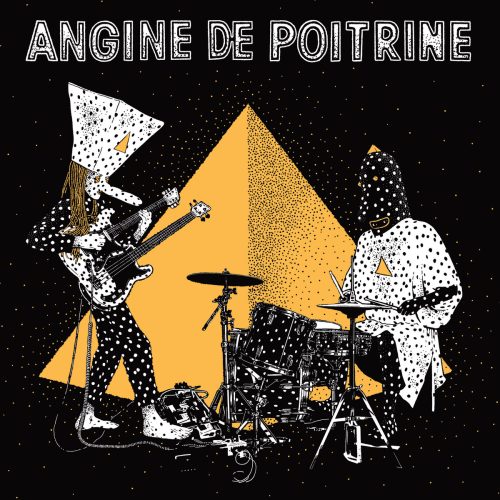
Everyone seems to be raving about Angine de Poitrine, especially about its avant-garde nature. I thought to myself that, being a subscriber to destabilising musical experiences (but not only, as you know if you follow the pace of my publications on all sorts of albums of all imaginable styles, or almost), I had to lend it an attentive ear. So, you see, to add my two cents as a “classical buff.” That said, if you don’t give a smurf about this, we’re not keeping you here.
In short, I listened to the Saguenay (Quebec) group that everyone is talking about. Well, I had a blast. Yes sir, ma’am, and everyone else. That said, my review will take the form of a two-part reflection. First, the music itself, then the buzz that is currently surrounding it.
Good music
The music: impressive, catchy, and wonderfully engaging riffs, with beautiful and solid meaty bass. The melodies are simple but well-crafted, and the microtonal nature is sufficiently pronounced to seem “strange,” but also muted enough to allow Roger, or Damien, or Marie-Josée, or Susan, or whatever to dive in without feeling overwhelmed by a visceral and metaphysical upheaval. In two words, here are some pretty irresistible and trippy tunes, cutting through the ambient mediocrity enough to substantially refresh the listening pleasure. It must be said that the bar for rock hasn’t been very high for, oh, about twenty years, let’s say. Nevertheless, it had to be done. Well done, guys (Khn and Klek).
Putting the buzz in context
I understand, therefore, the feverish buzz that is circulating on the web, everywhere in the pop/rock world, about the two unsettling clowns. But, and this brings me to my second point here, the global rock scene must really be deeply limited in sonic adventurousness, at least for about a generation, to be so completely blown away by the sounds heard on the two volumes of the Quebec duo.
Because, honestly, the science of microtonality is barely touched upon here, as if we were just dipping our toes into lukewarm water (to paraphrase my colleague Alain Brunet). It’s all friendly, at most a little surprising. But, to such an innovative and revolutionary extent? In contemporary rock (especially the radio-friendly/commercial type), perhaps, but in the infinitely broader world of music? Not at all!
Non-European music is teeming with microtonality, and has been for centuries, even millennia. Western classical music itself has been playing with this science since the beginning of the 20th century with increasing assiduity. Charles Ives (1874-1954) dove into it (much deeper than just dipping his toes) in 1925 with his Three Quarter-Tone Pieces. And the exploration never stopped in the 20th and now in the 21st century. One of my favourite works is Transitoires for orchestra, by Gérard Grisey (1946-1998). A continuous shimmer of micro, even nano-tonal and chromatic colours and textures.
OK, there’s no “fun” like the Angine’s riffs, but you must admit, whether you like it or not, that in terms of avant-gardism, we are frankly elsewhere.
The role of PanM360 to delve into the subject
This is absolutely not to belittle the phenomenon of Angine de Poitrine. Not at all. I said it, I have a lot, a lot of fun listening to these two guys. On the other hand, it allows me to tell you that, if you ever have that curious itch, that desire for discovery and exploration, it is here, at PanM360, that you will have a chance to satisfy your cravings for more. You won’t find that with the competitors. Competitors who seem to have no idea (or at least no desire to talk about) all the abundant richness, all the history, all the small and big innovations that have succeeded one another and ultimately allowed two guys from Saguenay to become Angine de Poitrine and make a (well-deserved) sensation in the somewhat impoverished world of contemporary rock/pop.
Here at PanM360, we will take you with us through the spectrum of possibilities that exist between Angina and Gérard Grisey. We will talk about it with passion and expertise. With the same love and respect for each and every one of them.
A crack in the ordinary
Angine de Poitrine managed, with brilliance, to open the blinders of the industry and an audience raised on a consensual beige-ness by just a few millimetres (but still).
In this universe outrageously dominated by companies or flat-earth billionaire individuals, it is therefore gratifying to see that the human need to assert a freedom always threatened by industrial shackles, even if it is rather gentle and respectful, is still alive and active.
On that note, enough brainwork, let’s go back to stomping (and headbanging) with Angine….