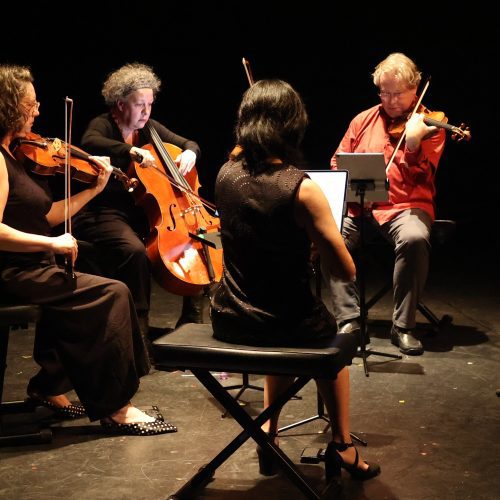
To celebrate its silver anniversary, the Quatuor Bozzini joined forces with three exceptional composers: Martin Arnold, Linda Catlin Smith and Michael Oesterle. The program emphasized the friendship and close ties that have united the quartet’s musicians with these avant-garde composers for 25 years. On a musical level, this friendship translated into ethereal sonorities in works with an essentially gentle, calm aesthetic.
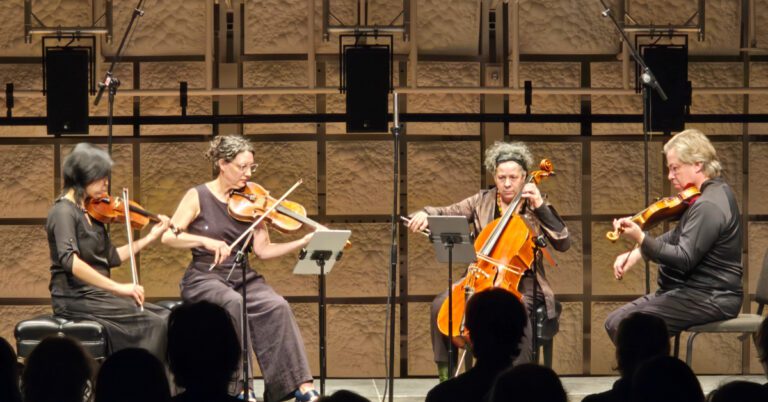
The first work presented was Martin Arnold’s 3-Way Cotillon, in its Montreal premiere. For the occasion, the members of Quatuor Bozzini (Isabelle Bozzini, cello; Stéphanie Bozzini, viola; Alissa Cheung, violin and Clemens Merkel, violin) were joined by violist Elisa Trudel and cellist Audréanne Filion, in a sextet formation. The harmonic environment is essentially diatonic. Among the many influences that characterize Arnold’s language, it was the use of folk-inspired material and the inspiration of early music that stood out for us. The musical inflections of the cotillion, a popular dance in 18th-century Europe and America, bear in some respects the sonic stamp of an Aaron Copland. The piece evolves with sporadic interventions of string lines, which are played dispersedly by the instrumentalists. There is a general evolution in the texture and timbre of the piece, starting from the treble and moving quietly into the lower strings throughout. As the work progresses, the jumbled, spaced-out material contracts over time, eventually coming together to create a coherent, interrelated whole.
Linda Catlin Smith’s Reverie, composed expressly for the occasion, echoed this same spirit of plenitude, but with a more stable melodic construction defined by thematic sections clear to our ears. We begin with long bow strokes exposing pure notes, while the sounds melt into each other timbrally. Midway through, a harmonic carpet supports dissonant melodic passages played above it, in an expressive, ominous half-tone character. Further on, in a tonal calm with a melancholy atmosphere, a recurring modal theme is expressed and repeated several times, creating a feeling of weightlessness and temporal elasticity. We fully understand the artistic choice to follow these two works, given their difference from the last piece of the concert and their strong aesthetic similarity. But, at a certain point in the sound treatment, one had the impression of hearing a kind of continuation of Martin Arnold’s piece in Linda Catlin Smith’s, despite a very different musical treatment and narrative language.
Keeping the listener’s senses alert is a challenge, and can be a double-edged sword in such an arrangement. The final work of the evening was Michael Oesterle’s String Quartet No. 4, and was, in terms of texture, the most varied. It thus balanced the dreamlike character of the works in the first half. After an introduction worthy of a 19th-century musical line, the central parts of the work explore different instrumental timbres, with extended playing techniques to create bursting sonorities, from string rubs to high notes. For example, in Oesterle’s quartet, the interaction between violinists Clemens Merkel and Alissa Cheung’s swift motives, over which energetic pizzicato interventions were brushed, or the thematic superimposition that initiates the work’s conclusion, which reintroduces the opening theme.
The highly focused acoustics of the MMR at McGill University meant that the sound didn’t travel far, but remained anchored. For the repertoire played, this hall was ideal, as it gave us a detailed appreciation of the interpretation of each of the instrumentalists, whose act of supporting these pieces with these long-developing musical lines demands sonic constancy and mastery of sound, as well as sensitive and precise listening to the various changes in dynamics. An attentiveness that echoes the friendly ties that bind the musicians together.