renseignements supplémentaires
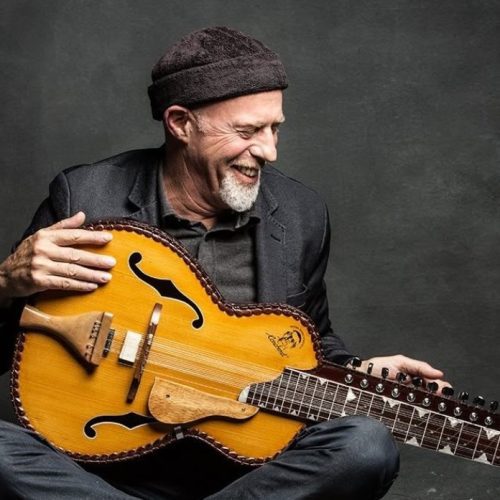
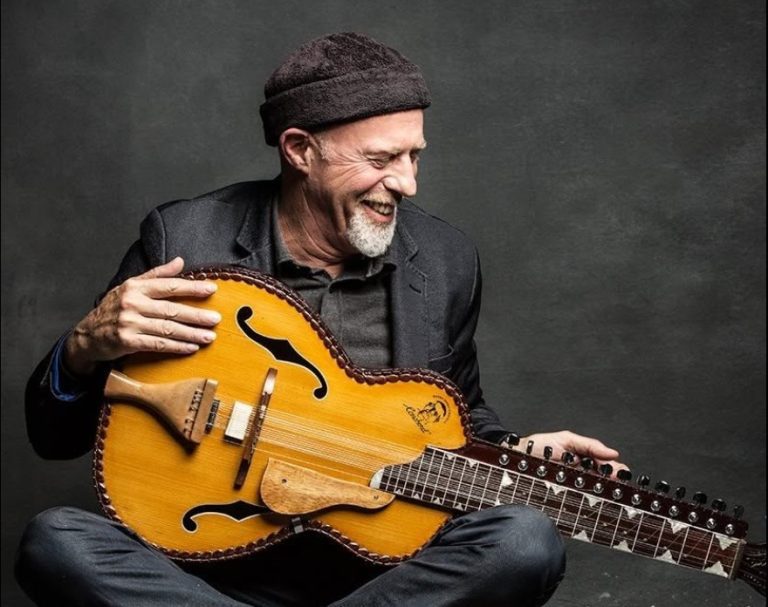
Discovered by Québécois at the FEQ a quarter-century ago, Harry Manx returns to the Palais Montcalm with the Guitar Bazaar tour and a new album under his belt, Falling Upwards. The artist is known for his profound humanity, his guitar prowess, and his connection to South Asia, where he lived for a dozen years before launching his international career at the beginning of this century.
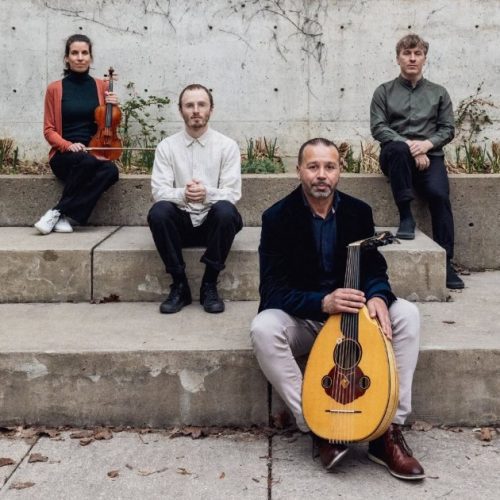
Serving as the perfect bridge between Americana and Hindustani musical traditions, the Canadian singer-songwriter will perform with a diverse lineup: guitarist Kevin Breit—who played a central role on the late Cassandra Wilson’s album “New Moon Daughter”—will be joined by Quebec artists guitarist Simon Godin and singer and keyboardist Geneviève Jodoin.
Reached while on tour, he pulled over and generously agreed to an interview, during which he spoke as much about creative music as he did about reflections on life in his seventies.
PAN M 360: Well, I know your craft since the beginning of your travels in Quebec a few decades ago. Yeah. Yeah, I started at the Festival d’été de Quebec because of my friend Jean Beauchesne who was the artistic director a that time. I think he was the first to invite you in Québec.
Harry Manx: Yeah, he was, that’s right ! And that must have been like 2001 or 2002.
PAN M 360: Something like that. Yeah ! So you’re based on Vancouver Island or close, aren’t you ?
Harry Manx: Yeah, my house is on Saltspring Island, though I don’t get there so much. I seem to have gotten really busy in this last year. Since August, I’ve done 65 shows, so i’ve been really on the road a lot.
PAN M 360: So you’re always on the road these days, but you don’t go back home sometime ?
Harry Manx: Once in a while. I’m saving that for when I’m old haha!
PAN M 360 : Yeah, well, same with me ! We’re probably from the same generation.
Harry Manx: Yes, I think so.
PAN M 360: Well, I listened to your most recent record. How do you see it? Can you tell what you’ve achieved on this specific project?
Harry Manx: Well, you know, I have been doing an album every year, a recording every year for about 20 years. But then just before the pandemic, I realized I didn’t have much more to say, so I left it out. And then during the pandemic, some songs started to come again, and I started to think about recording.
But I didn’t have a place at home to record, so I built a studio on my property. I did it myself, you know, with a hammer and nails and four months of hard work. I built the studio, and then I realized I could make the record. So I started recording in there. And I have to say this record took a lot more energy than the ones in the past, which just flowed by themselves. But this one, I had to work at it. I’m not sure why. Maybe it’s because I’ve spent many of the musical ideas I had on the previous records. Maybe I’m at a state where I don’t have so much to say anymore. I do more listening. So maybe I’ve changed, anyways it was harder to make that album.
PAN M 360: How did you change?
Harry Manx : Oh, you know, I’m 71. As you grow older, you mellow out a bit. And you start to understand what is important and what is not. And life changes you if you don’t try to change yourself still. Life changes you. When I started out, I had so much to speak about, about love and life and death and pain and joy. But now I don’t have much to say about it.
PAN M 360: Now you acknowledge that you don’t understand life deeply.
Harry Manx: Thank you. Thank you very much.
PAN M 360: When we get to this stage, we may get humble.
Harry Manx: There it is.
PAN M 360: And we start to listen and to watch.
Harry Manx: There it is. You said it for me. I appreciate that. I couldn’t put it into words what changed, but I feel like I realized what I don’t know. And there’s a lot of that.
PAN M 360: But at the same time, you’re still an artist and you have to express yourself, you got to generate some new creative stuff.
Harry Manx: That’s true. You cannot stop. I realized that, that you have to stay in motion creating and the people will follow you, will stay with you if you stay in that mode. If you plateau, then yeah, that’s kind of the end of your creativity.
PAN M 360: But you can express this feeling of being more and more humble and more and more contemplative, I would say.
Harry Manx: Yes, that’s why I wrote that song, This Joy. It’s like a little prayer. It’s very different than the other songs because I’m speaking about something which there isn’t much language for it. It’s about a sense of having something precious in your life, whether that’s a child, a lover, a teacher, anything. And that’s what that song is about.
PAN M 360: So can you just pinpoint a few other songs that you wrote recently ?
Harry Manx: Yeah, I took that old gospel song, God’s Gonna Cut You Down. Yeah. I kind of put a spin on that. I added this woman from Portugal who sings mantra, like mantra songs for Indian devotional music. And I put her on there and she had no idea what she was gonna sing to. I just played some chords and gave her a rhythm. And then later on, I mixed her into the song. And I thought that was a nice collaboration of East and West right there.
And of course, I had Kevin Bright playing on there, who’s like the world’s best unknown guitarist. He’s played with Nora Jones and the late Cassandra Wilson.
PAN M 360: Yeah, I know him, I saw him perform with Cassandra a long time ago. He’s an excellent musician.
Harry Manx: And he just jumps in there, of course, and adds his two cents worth, which is more like 98 cents worth.
PAN M 360: And also, you did a cover version of a Bob Dylan song, Gonna Have To Serve Somebody. That was written during his Christian period.
Harry Manx: You see, somebody was asking my agent if I had converted to Christianity because of this song. That’s just coincidental.
PAN M 360: Yeah, you’re not a Christian believer anyways.
Harry Manx: No, I’m not a religious guy. But I kind of like the sentiment of that song. It goes deep.
PAN M 360: Well, yeah, it’s universal. Whether we believe in God or not, we can have a sort of connection with the universe and its forces. And we, agnostics or atheists, cannot go further than that. It doesn’t mean we are not spiritual.
Harry Manx: That’s powerful to hear that. Yeah, it’s true. I’ve always considered the spiritual path my path. I’ve been a meditator, and I watched my mind. And this is the depth of my spirituality. But I’m not a big believer. And you know what? I don’t have any problem with people who are into it. And in fact, I play in a lot of churches these days.
PAN M 360: Well, if those people are respectful with us for what we are, we have to respect those guys and their beliefs.
Harry Manx: Totally. And sometimes their religion has a great effect on them and they become really beautiful people.
PAN M 360: If this vision of the world gives them joy and peacefulness, we gotta respect them.
Harry Manx: Yeah, yeah. I started to play in a lot of churches just because I like to promote my own shows and I rent churches and I just put on a show. And I find the architecture of a church brings people into a certain open space to listen to.
PAN M 360: That’s true. The space itself has something to do with the meditation. I understand that you’ve always been involved between East and West ways of thinking. Well, you know, it’s starting with your instrument, with the sympathetic strings that we find on sitar or sarod.
Harry Manx: Yeah. It’s been a great influence on me in my life, Indian music. It’s still there. Yeah, and still is. And it comes through everything I do, though I don’t study it anymore and I don’t practice it, but it became part of me. So whatever comes out, you know.
PAN M 360: Yeah, and for you it seems to be a sort of textural approach in your craft, and the way the violin is played and the mantras of some backup singing that you bring in folk, blue, bluegrass or gospel. We don’t expect any fast rhythms or fast guitar solos. It’s more about the chords and the harmonics.
Harry Manx: Yeah. I never was big on trying to play really fast to impress people. That’s one way to be with music. And I love the people that do that, John McLaughlin, people like that. It’s amazing, but my path is not that virtuosic, you know.
PAN M 360: Well, you write songs and sing them. You’re not doing instrumental music.. You don’t need to be fast. Virtuosic music with great songwriting is not fitting well most of the time.
Harry Manx: I know. That’s a good point. And, you know, my teacher, Vishwa Mohan Bhatt , he was a student of Ravi Shankar, and Ravi told him the heart of the music is the alaap, the beginning. And if you play that well, you know, the rest is just for enjoyment, dynamic enjoyment. But really, that’s the heart of the raga right there. And that’s what I like to focus on, bringing out those sounds that sort of remind people of the East.
PAN M 360: You were more interested with the music from the North of India, Hindustani, isn’t it ?
Harry Manx: Yes, that’s where I was in Rajasthan in Jaipur, the pink city. You know, Vishwamohan Bhatt’s family, they were court musicians in Jaipur. They’re actually the very high caste they relate to.
PAN M 360: Brahmans?
Harry Manx: Brahmans, yeah. And Rajasthan was quite rich with music and also with folk music.
PAN M 360: And the architecture is fabulous in this area.
Harry Manx: Oh, yeah, the pink city. I was there for so many years. I ate the same meal three times a day. So I spent 12 years in India. And I was about seven years in Jaipur. And I was about five years in Pune, living in the ashram there. I still participate in some spiritual gatherings, you know, meditations. I go on retreats in Europe in an ashram, where you live in a 10 by 10 hut, no electricity.
PAN M 360: And where is it?
Harry Manx: In Portugal. And I spend like a month there or two. I do it every year pretty much. And it just reminds me of some deeper sense of life, you know. Because we become very accustomed to everything every day. And there seems to be no mystery anymore. So that always is a little break from the day to day. And I always wake up a little brighter after that.
PAN M 360: And how do you present your craft on stage now?
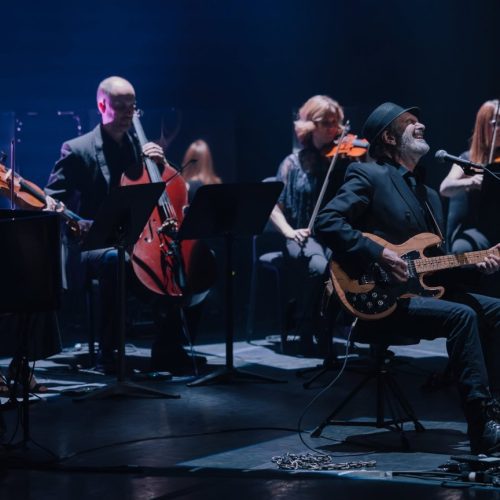
Harry Manx: Well, I’ve been working a lot with a keyboard player from Australia, Clayton Doley. He does my keys generally. But he’s gone now, he went back to Australia. And then I was working with Kevin Breit, we just did 10 shows in Ontario. So for the show in Quebec City, I’m going to have Kevin Breit and two Québécois, Geneviève Jodoin, a wonderful backup singer who used to be on the Belle & Bum TV show. There is also Simon Godin, who’s been on many shows in Quebec, and he is an amazing, underrated, guitar player. He teaches at McGill University. And he’s never played with Kevin Breit. And I’m sure the two of them are just going to have an amazing conversation.
PAN M 360: So are you going to play mostly the new album and other classics from you?
Harry Manx: You know, I’m going to play about, let’s say, half the album. Because what I find when I make a recording is not all the songs work well live. That’s true. You know, some of them are more like songs you would listen to in the background or whatever. But live, they need to have a certain thing that attracts people. So I’ll do about half the album with these guys. And then I play some of my songs I’m known for, like Tijuana and my own version of Summertime.
PAN M 360: Gershwin music ! Well, you know, it’s interesting because you obviously know jazz music and blues, bluegrass, folk or gospel. And sometimes you are knowledgeable with Eastern music.
Harry Manx: There’s been so many great songs written. Sometimes I feel a bit guilty what I do to songs, you know, like Summertime’s a good example. I’ve added a raga that’s, you know, has the quality of death. It’s a heavy raga, Gurjari Todi. It’s for late at night. And I mix that with Summertime and it seems to me to fit well and to feel good, but I feel a little guilty sometimes that I’ve messed with someone else’s creativity. And when I meet George up in heaven, I’m going to have to ask forgiveness for that one.
PAN M 360: Okay. Say hello to him ! Well, I don’t know if you will meet. I’m not sure of that at all. The only thing I’m sure about is that our parts will remain somewhere.
Harry Manx: If there is an afterlife, I’ll come back and tap you on the shoulder. Don’t worry!
PAN M 360: Haha ! I’ll do the same to you if it happens but I doubt it.
Harry Manx: Do you ever get the feeling now that there’s so much we don’t know? I sometimes have a sense of the unknown. And in fact, you know, I find that the unknown is sort of always where the energy is, you know, whatever you do on a regular basis, you get to know it, but the excitement really comes when there’s some unknown. And it’s a bit like that for me, musically.
Once I did a workshop for musicians at the Banff Center and I said to the participants, if I could give anybody any advice, I would say, if you feel like you’re hitting the roof with your music, you don’t know how to expand or where to go or it’s frustrating, forget the music and look at yourself. Because your life and the joy that you feel or the passion you feel, that’s what’s going to be reflected in the song. Yeah, you reach yourself the roof. So you have to think about how to get out of it, not only with music, but in your own life.
PAN M 360: Yeah, it’s not just art. It’s a reflection of you.
Harry Manx: That’s totally true. When I see people come to tears when I play some songs, I feel good because I feel like I’ve put the emotion into the song, the emotion that I originally felt was there and it was driven by sadness. And when I play the song and I see the response, I feel like some completion is there. It touched them the way it touched me.
PAN M 360: This is elevation, this is falling upwards, indeed. Many thanks, Harry.