renseignements supplémentaires
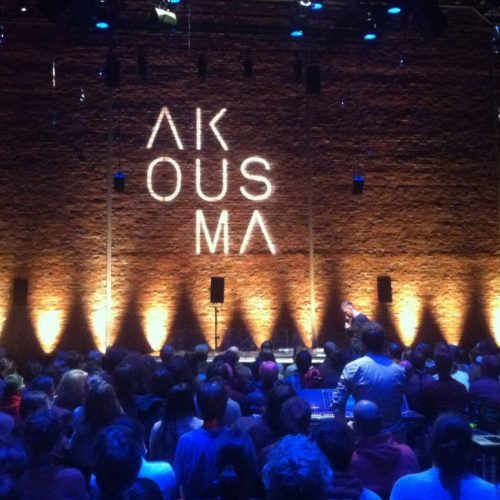
In the atrium of the Conservatoire de Montreal, I had a conversation with the electronic musician and composer Francesco Giomi concerning the concert that would take place in an hour. This concert was a dedication to the late Luciano Berio on what would have been his 100th birthday.
PAN M 360:Firstwhatbringstothisworkwithtemporeale
Francesco Giomi : The concert is a monographic concert dedicated to the music of Luciano Berio but the first is not by Luciano Berio it is a sort of homage we realised by using some of the material taken from Luciano Berio’s musique. It is called In-naturale, it is a paraphrase of the title of Berio’s piece Naturale which is a piece that includes a very famous Sicilian singer, together with viola and percussion. Which is an example of Berio’s interest in ethnic music because he was very interested in music from traditional cultures.
So the concert includes 4 pieces, the first is this ‘In-natural hommage, which gives an idea of some of the creative work of tempo reale. By taking material from the archive and reorganizing this material. In Europe we use this word: ‘reactivating’ the archive. We did this several times, its interesting way to interpret an archive. Then there are 3 pieces by Luciano Berio: Thema, Chant Parallèle and Visage 3 pieces around this idea of voice.
They give another idea of the activity of tempo reale concerning the idea of the performance or interpretation of fixed media music, Music on tape. Especially Thema and Visage are presented here for the first time in [North America] in a very new version realized in an Ambisonics environment. Ambisonics is a technique to create music in space. We spent time in Florence to develop these versions. […] We use Artificial Intelligence to separate things in the piece and then to move things in space. It is a piece created 10 days ago.
Thema and Visage are pieces strongly linked to Cathy Berberian, Luciano Berio’s first wife, but first of all she was a very important singer, a very important woman and fantastic performance. He collaborated with her for several years. I think he realized with her some of his most important pieces of his repertoire.
PAN M 360: Would you say ambisonics goes beyond a re-spatialization process?
Francesco Giomi: Well ambisonics is a new technique.
PAN M 360: Is this developed by tempo reale?
Francesco Giomi: No, no ambisonic is a standard. […] Everyone can use it and we use it for this project but also for other pieces.
PAN M 360: Does your work, In-Naturale us this technology?
Francesco Giomi:It uses a more traditional technique of spatialization. [However] ChantsParalèlle, which is the third piece, uses a technique that is completely manual. So in one concert there are 3 kinds of moving sounds.
PAN M 360 :Beyond his interest for voice, how do you find his interest in various traditional cultures is reflected in his work?
Francesco Giomi : This is only in In-Naturale there are fragments from different cultures, because we use not only fragments from berio’s music but also fragments from berio’s archive. Because during the 60s Berio went around to record things, so in his archive we find music from Yemen, music from jewish people, music from Sicily – voices from Sicily. Berio’s music is very ‘accogliente’(welcoming). So, sound is considered material and the composer can reorganize it, giving it form, giving it musical structure. This is the modernity of Berio’s music because now, in my opinion, there are many many of the interestings aspects in the music from other cultures, in cultures different from western dominant culture. You can find interesting sources of sound in African music, in Asian music, in particular regional music. If I think [of] Italy where traditional music is still alive; Sardinia, Sicily, julia. I imagine it happens in france, in spain, in grease, even in Mexico. Maybe less in the USA [laughs]
PAN M 360 :Do you think the use of voice in his work and the welcomingness of his music coexist?
Francesco Giomi: For Berio, voice is very important to Berio. He once described the voice as ‘the house of the music’ or perhaps ‘music home’. Voice is the first expression tool for everyone. He used voice all his life but I think his meeting with Cathy Berberian was the most important for his research. If you work with voice you can [welcomes] new types of voice, many types of vocal expression; Text, words, but also preverbal sounds, invented languages, so on and so on.
PAN M 360 :Like in visage, Berio described it as a pre-radio play.
Francesco Giomi : Exactly, brava, brava, in Visage you can [hear] invented languages or invented fairytales. So Cathy Berberian [is playing] a completely invented fairytale without any real words.
PAN M 360 :I’ve heard Berio described as a surrealist composer, do you think that is a fair description?
Francesco Giomi : I don’t know, perhaps in his younger period. Because, for example, during the 60s he collaborated with this radical poet Edoardo Sanguineti. So the collaboration between them was really surprising, fantastic. Laborindo II which is one of the most important pieces by Berio and A-ronne which is a piece for voices.
PAN M 360 :So those were both with Edoardo Sanguineti, this was a kind of composer-librettiste relationship.
Francesco Giomi: Keep in mind that Sanguineti is one of the most important poets in the [1900s] of Italy.
PAN M 360 :And you think he brought a more radical edge or expansive perspective to Berio’s music.
Giomi : Well, berio in some music was very radical, less in some, but in folk songs, rendering and sinfonia was very radical, and was very deep in investigating some boundaries of musique, some limits of musique. But anyway I’m not a musicologist, I’m not allowed to speak on the life and musique of berio, I am musicien.
[…]
Part of my work is to preserve the legacy work concerning live electronics. […] Part of the work of tempo reale is to perform in the original way Berio’s music. To try to give the future the possibility of knowing how Berio’s music with live electronics should be performed. So we realized the scores of Berio’s work with electronics which would allow Berio’s work with electronics. [these are scores] that allow [anyone] to perform them without us, without me. This is important because a written score you can archive , you can transmit it to the future possibly more easily than electronics. So we try to translate our knowledge about Berio’s live electronics into written scores. So we [created] these four scores (Euphonime, Altra voce, Outis, and Cronaca del luogo). It’s important because I don’t care if someone else can perform Berio’s music. I can give her or him the possibility of performing a piece without me.
PAN M 360 :So you’re making sure it can last into the future…
Francesco Giomi : Yeah sure, because also an orchestra piece can be performed by a conductor or another conductor. This is normal in music, its interpretation. This could be valid for live electronics. You can listen to the piece performed by me, or performed by another and say “a giomi is worse” thats normal.[laughs]
PAN M 360 :So you’re allowing performance to be a part of electronic music. Were these created while Berio was alive?
Franscesco Giomi: Yeah Berio [created] before the written score before and then [created] with me or other people the live electronics part. Normally this happens for a particular performance or concert, then after the concert the score remains and we continue to perform the piece. These electronic parts were written during Berio’s life, from 1999 to 2003.
[…]
PAN M 360:SoChantsParalèlleisoneoftheseelectronicpiecesthatisperformed?
Francesco Giomi:ChantsParalèlleis my [… checks italian translation…] batt horse or battle horse. It’s an expression, that means it is a piece I regularly perform – I am very good at performing it.
Derived from the fact, many centuries ago, if you go into battle you choose the best horse. Anyway, this piece was a little hidden, he [created] this piece during his period at IRCAM in Paris but he created it at GRM, another center for electronic music. I [heard] this piece for the first time in Paris in 1987 and I decided to study it. And I started to perform it and I have many
many times. It is an interesting piece where Berio used a transformed voice with synthetic sounds. You can’t even recognise the presence of voice. It is also a piece with a tonal center.
PAN M 360 :Was this the first piece by Berio you worked on?
Francesco Giomi:yes, well I did already know all of his electronic work, but I performed them after our meeting in Paris in 1997. Especially great for me because my life changed completely.
PAN M 360 :I wanted to ask if this was one of the first presentations of In-Natural ?
Francesco Giomi : No no, but it is the first time in the americas. But you know Montreal for electronic musicians is a sort of [… checks italian translation…] Toy Land, it’s a quotation from Pinocchio. In the best way of course, there are many academic structures for electronic music, it is very rich. Like here (Conservatoire de musique de Montréal) there is a fantastic venue for electronic music, UdeM, McGill; we are surrounded by electronic music structures. So I try to get my students to come here for exchanges because you breathe a very interesting air for electronic music. In Italy, we have a lot of interest in electronic music. There are thousands of people practicing, but the structures and the funds [are lacking]. We are lacking buildings, venues, speakers, studios and so on.
PAN M 360 :But tempo reale is doing that work no?
Francesco Giomi:Yes, during the 90s there were several centers for electronic music in Italy but with the economic crisis of early 2000s many of them disappeared but tempo reale remained and it is the biggest now but still small in comparison to France or to Canada, well to Quebec.