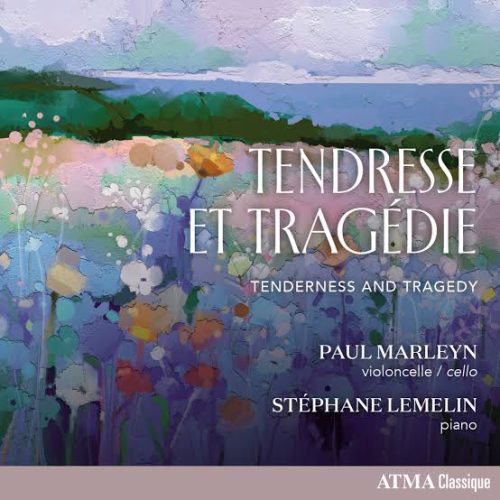
It is an album of very beautiful discoveries (and a proven masterpiece) that cellist Paul Marleyn and pianist Stéphane Lemelin offer us here. There is indeed the Sonata for Cello and Piano No. 2 in G minor, Op. 117 by Gabriel Fauré (a commission from the French Republic to mark the centenary of Napoleon’s death) on the program, but it is especially the Grand Dramatic Sonata for Cello and Piano “Titus and Berenice” by Rita Strohl (1865-1941) that captures attention.
This work of vast dimensions was written in 1892. Strohl is a creator that we have been rediscovering at a rapid pace for the past few years. Rightly so, because her talent was well-developed and refined. This Grand Sonata was for a long time the work that kept Rita Strohl’s reputation somewhat on the fringes of music history. Now that her music is being played more and more, the richness of the original construction of this score is appreciated with even greater acuity.
Indeed, the Grand Sonata is based on a dual architecture: one formal and the other narrative. Strohl, somewhat like Liszt in his Dante Sonata, harnesses the traditional sonata form to also make it a dramatic programmatic vehicle. Here, it is Racine’s tragedy Bérénice that serves as her expressive inspiration. In Racine’s play, we are told the adventures of the Roman Emperor Titus, who fell in love with a Jewish princess (Berenice), at a time when the Hebrews were driven out of Israel/Palestine for the next almost two thousand years. An impossible love, because the Romans could not stand that their emperor was involved with a foreigner. Movie material, or rather stuff for artistic tragedy!
On this basis, Strohl constructed a powerfully expressive score of about 35 minutes in four movements, each an episode that summarises the passions conveyed by Racine’s text and the dramatised tale of this love worthy of Romeo and Juliet.
The first movement evokes the ambiguity of the passion felt by Titus and Berenice and the heartache associated with the state reason that denies them any lasting fulfilment of their union. Strohl accompanies their mutual outpourings with a poignant cello melody, which evolves throughout the movement, the longest in the work at around 13 minutes. The piano supports the dramatic soul-searching of its companion with comments that are sometimes contrasting, sometimes compassionate, through rich writing.
The second movement, titled Berenice’s Apartments, is a scherzo that hints at the tensions between the characters. The cello serves as the voice of the protagonists, shifting from softness to muscular phrasing, while the piano unfolds sophisticated orchestral colours. That said, the atmosphere that emerges is neither dark nor stormy. A pleasant, luminous lightness emanates from it.
The third movement, Lento tristamente (Bérénice knows everything), serves as the emotional climax. It is a powerful lament, made of expressive intensity and final resignation. The cello is brought to its peak of dramatic force.
The final movement (The terrible moment approaches) allows Strohl to construct a lively and athletic conclusion, one of separation, bathed in sometimes tense colours, but which ends in a finale where the composer wanted to showcase her expressive abilities with a curtain fall that one can imagine being followed by a well-deserved round of applause.
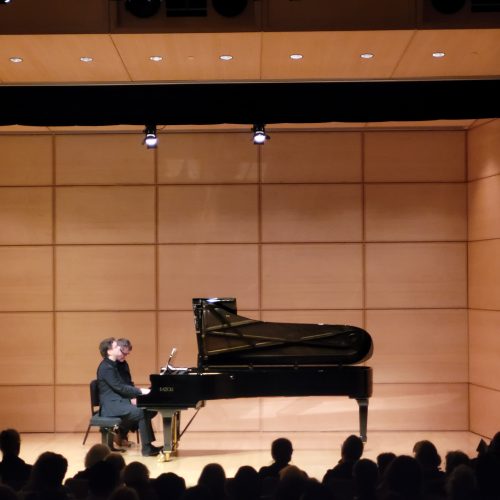
Paul Marleyn and Stéphane Lemelin deliver an incandescent performance, with a very high level of technical and especially emotional conviction. The melodies of Rita Strohl imprint themselves in our minds thanks to the powerful and authentic playing of the two musicians.
Two pieces by Fernand de la Tombelle (1854-1928) follow, bringing a welcome contrast of intensity. Less fiery passion here, and more elegance and colour. The Andante espressivo indeed offers a melody full of tenderness, which seems to hover above the piano arpeggios.
The Variations in the form of a chaconne, by the same composer, are a successful exercise in playing with a form that crosses between variations and the chaconne. The exercise has been a pillar of the art of composition since the Baroque period. It is here articulated around some basic material that Tombelle manipulates intelligently in its multiple forms, during a relatively short construction for this type of piece, but nonetheless optimised in its expressiveness. There are moments of pure delight in this music, a true hidden treasure. Moreover, this is apparently the very first time this piece has been recorded, and we are greatly indebted to Messrs. Marleyn and Lemelin for it.
Fauré’s Cello Sonata No. 2 in G minor, Op. 117, a masterpiece of late Romanticism, is a construction of exceptional concentration and ideal synthesis. Fauré’s melodies, themes, and phrases (the ideas) have indeed evolved, and in this final creative period, they seem to reinvent themselves while defying the clichés of the traditional structure of a romantic sonata. The ideas are born from one another, intertwine, and combine with renewed originality, bringing us to the threshold of a modernity that will express itself with more harmonic dissonance, but not necessarily with more architectural vision.
Marleyn and Lemelin dive into it headfirst, full steam ahead, delivering a confident performance, also marked by very beautiful passages of exquisite subtlety. A complicity between the two artists that somewhat reminds me of that of Steven Isserlis and Jeremy Denk, in one of the very beautiful versions of this music.
An album that dares to shed a favourable light on lesser-known works, while offering an elevated vision of a proven masterpiece.