Additional Information
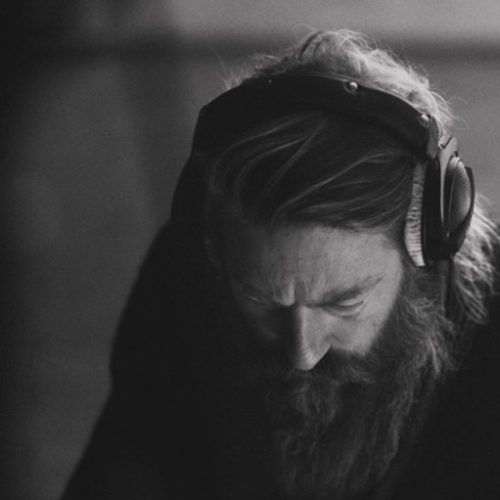
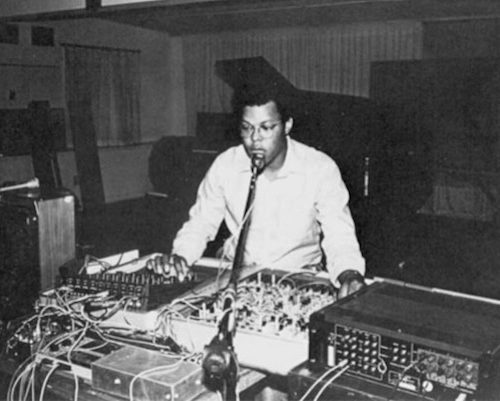
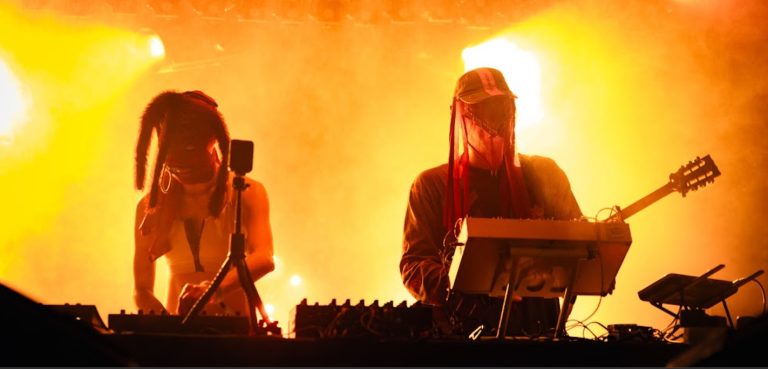
The Istanbul Ghetto Clab stuff is considered as an absurdist blend of acid bass, techno, punk attitude, modular synthesis and traditional instrumentation, Berlin’s masked duet have captured global attention after being active in the urban underground with their vibrant live performances based on modular synths, also saz playing and a whole lot of live energy. Their debut album, SOME TALES TO BOOST YOUR UNNECESSARY MIND ACTIVITY Istanbul Ghetto Club are having a super impact on the global dancefloor, and Montreal didn’t make an exception on Thursday at Esplanade Tranquille, Experience 3 Series. Before the MTL live set, Julius Cesaratto could talk with the duet, who (obviously) remains anonymous as does Angine de Poitrine, a band that you may know…
PAN M 360: This will be your Canadian premiere. What does it mean for your group to bring your live show to MUTEK, and what can Montreal audiences expect
that they haven’t seen from you before?
IGC: MUTEK is a brilliant festival we’ve been following for a very lengthy period. While being invited here is a source of joy for us, it’s a huge loss for MUTEK. We already feel sorry for the poor people of Montreal. They’ll never be the same again.
PAN M 360: Your sound fuses acid techno, modular synths, and the Turkish saz. How
did that combination first come together ?
IGC: People ask this question a lot, and when we give an honest answer, no one believes us, so let me say this right off the start: it wasn’t our idea. It was October 2012. There were twelve of us in the studio. I remember the number because I asked everyone individually afterward. In the afternoon, a bright shape appeared on the wall above the modular synthesizer. It was somewhat round, with a single line on it. The interesting thing was, the curtains were closed. All twelve of us saw it, and that’s important, because if I’d been alone, I would have doubted myself too. We didn’t understand what it was. We stared at it for hours. Someone said, “It’s a reflection,” so we turned off the light, but it remained. Someone took a photo, but it didn’t show up in the picture. As evening approached, everyone went home, and I stayed behind. When I fell asleep that night, I saw someone in my dream, a person with a round yellow face who was constantly smiling. He showed me the same shape. Then he reached out, grabbed the filter knob, and turned it, turned it, turned it… The knob began to melt. A few words came out
of his mouth: “If you do this, you will win” I ask ‘win what?’ He said ‘I don’t know’.
In the morning, I went to the studio and set all the knobs on the synthesizer to that position. None of the twelve people argued, because they’d seen it too. The saz was already there, sitting in the corner; no one was playing it. We played it that day. I’ve never touched that knob again. On tour, the technicians ask every time, “Should we calibrate it?” I say, “No.” People think this is a stylistic choice. It’s not. It was given to us, we just added the saz to it.
PAN M 360: You perform masked and remain anonymous as a collective. What does
that anonymity give you creatively that performing under your own names
wouldn’t?
IGC: It is difficult enough for a person to step away from everything that has been piled upon them since birth, their family, their language, the knowledge accumulated over generations, and create something new. We haven’t overcome this challenge. It had simply been overcome before us, and we are following the rule. In the tradition of the “aşık”, the poet does not write his own name; he leaves his pen name in the final verse. It has been this way for centuries. Whether Pir Sultan Abdal was a single person or several is still debated in academic circles; the poems attributed to him span different periods, and the language is inconsistent. The debate
continues because no one knows the answer. We somehow know, but it’s not our place to intervene in the debate. As for the question of what it adds to us: nothing. The mask doesn’t add anything. It simply removes what was added before us. Whatever remains is what plays out.
PAN M 360: Your live sets have been described as mischievous, at times absurdist,
or even satirical. How do theatrics play into your storytelling when you’re building a set? Does story come first, or does it emerge from the musical improv itself?
IGC: A bird knows how to fly; a fish knows how to swim. People know how to act spontaneous but they have forgotten how.Is it a play ? Not sure. Things can go very wrong on stage, and we don’t fix them, that’s all there is to it. It’s up to others to figure out what leads to what. The story isn’t the first thing. The story is what the people in the room say happened afterward.
PAN M 360: Your bio talks about improvisation and instinct leading the way. How much of an Istanbul Ghetto Club set is composed in advance, and how much is genuinely being invented in the room?
IGC: Seven things are predetermined before you step inside. We don’t say what those seven things are, because then the engineers would try to fix them as well. Everything else happens inside the room. A sentence works the same way: Before you speak, you know the words, but you don’t know the sentence. The machine reacts, the person next to you reacts, and ometimes the reaction is silence in the middle of a flood. We know many languages. They’re all just variations of the same sound.
PAN M 360: You’ve played for a very wide range of crowds (Berlin Atonal, Nuits Sonores, Fusion Festival, VENT Tokyo). How does the show change from one context to the next, and what are you curious to test in front of a MUTEK crowd specifically?
IGC: The show experience doesn’t change from city to city. We can’t change it on purpose. It changes on its own anyway, and we usually don’t notice it until later. No matter what we’re testing, we’d test it in an empty room as well.
PAN M 360: Your name nods to both Istanbul and the ghetto/club lineage of underground electronic music. How do you see your work engaging with cultural identity without being pushed into the “exotic, foreign music” silo, something you’ve pushed back on with the track title : Top 10 Oriental Ideas to Make Your Music Sound Really Culturally Appropriate.
IGC: The saz was in the room, nobody was playing it, we played it. Being from somewhere isn’t technique. The track title was a joke we made once. That’s how we finish with a subject.
PAN M 360: Looking beyond MUTEK, what’s next for Istanbul Ghetto Club? New material, new format for the live show, or new collaborators being brought into the fold?
IGC: There are some things we’re working on. If we were to explain them now, they’d only become explanations, and then we’d have to settle for the explanation instead of the actual thing. There’s one more knob. That’s all.
.