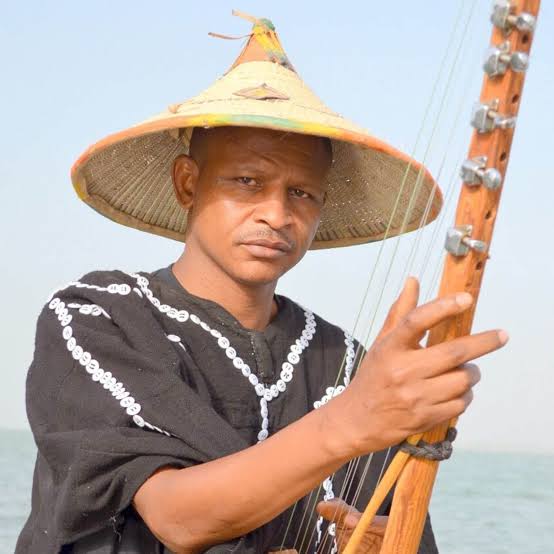
Dicko Fils: on the road to modernity for the Fulani people

Interview by Frédéric Cardin
Genres and styles : Afropop

Additional Information

His name is Moulaye Dicko, but we know him as Dicko Fils (Dicko Jr). In a career spanning some 20 years, this musician from Burkina Faso, who plays the kora and the n’goni, has produced twelve albums, including the very recent La route (the road). A star in his homeland and in a large part of West Africa, the artist nevertheless had to take the path of exile and settle in Montreal. Because, you see, this rather shy man has will and courage underneath: since 2016 he has been committed to a humanist cause, that of combating certain ancestral traditions such as forced marriages of young girls, excision, and the refusal to educate girls to confine them to the role of housewife. This courageous commitment in a society that is still very attached to these customs has led to problems with opponents. These problems were serious enough to force him to move to colder climes, which are more forgiving for this kind of activism. 

So it was in Montreal that Dicko Fils put the finishing touches to La route, the twelfth album of his career. It’s an album that follows in the same footsteps as his previous ones, adapting the rhythms, instrumental colours and melodic characteristics of traditional Fulani music to modern times. Both through the cohabitation of traditional and modern instruments (guitars, drums, electronic instruments), there is also the contribution of stylistic facets imported from other musical genres that allow Dicko’s music to tie in with that of other stars of West African music. Salif Keita and Oumou Sangaré spring to mind. Here again, according to Dicko, this modernization has not always been easy. Some criticised him for ‘spoiling’ the Fulani tradition. But he continued on his way, earning appreciable dividends such as the appreciation and admiration of a new generation of Fulani musicians who are now following in his footsteps. 

READ THE REVIEW OF LA ROUTE

When I ask him to make an assessment of his career, these 20 years of music and the results of which he is proud, he tells me that it is the message of peace between peoples that has been heard by thousands and thousands of his compatriots that makes him think that there is reason to be positive. But all the same, he had to go into exile. The fight can’t stop yet, and he says he’s ready to fight it from here on in. 

Many festival representatives attended the launch concert at Balattou on March 8, 2025, resulting in Dicko’s commitments for the next season from Quebec to Hamilton, via Ottawa and Halifax (and Montreal, of course). 

I asked him how his relocation went. He doesn’t lie: it’s been difficult. He was on tour when serious threats were made. So the exile was very sudden, without much thought or preparation. But Dicko already had a good network in Quebec. Montreal has long been a city visited by the artist on his many tours. Productions Nuits d’Afrique and other friends helped him land relatively smoothly. There’s no doubt that the positive reception he’s received is helping him to absorb the shock and concentrate on pursuing his mission and his career (the two are now intimately linked). 

It’s a well-crafted, beautifully produced Afro pop album with all the qualities needed to stand out on the stages where Dicko Fils will be performing, and in playlists everywhere. Already, he confirms, he has received calls from elsewhere in the world to present it in concert. So, the road is ahead, not behind.
Latest 360 Content

Mundial MTL 2026 | Orbital Ensemble : steeped into vintage, but with an ear in the present

Mundial MTL 2026 | Orbital Ensemble : steeped into vintage, but with an ear in the present

FMA 2026 | Al Qahwa: The Coffee of Cultures, The Rhythm of Encounters

FMA 2026 | Al Qahwa: The Coffee of Cultures, The Rhythm of Encounters

Mundial MTL 2026 | Where We Come From, Who We Become: An Interview with Tara Moneka

Mundial MTL 2026 | Where We Come From, Who We Become: An Interview with Tara Moneka

Caprice Ensemble at the 9th Floor : Hallelujah or the Jewish Colours of Baroque Music

Caprice Ensemble at the 9th Floor : Hallelujah or the Jewish Colours of Baroque Music

FMA 2026 | Le Livre des Reines : Dialogues between Inspiring Women from Europe and Persia, from Yesterday till Today

FMA 2026 | Le Livre des Reines : Dialogues between Inspiring Women from Europe and Persia, from Yesterday till Today

Salle Bourgie | Mike Bruzzese, inspired by his grandfather’s poetry

Salle Bourgie | Mike Bruzzese, inspired by his grandfather’s poetry

Salle Bourgie | Jordan Bak : ”I wish to be excited on stage and with the audience”

Salle Bourgie | Jordan Bak : ”I wish to be excited on stage and with the audience”

FMA 2026 | Walaa Al Jundi’s Beautiful Voice, Craft And Refinement… Despite Deep Suffering In Her Region

FMA 2026 | Walaa Al Jundi’s Beautiful Voice, Craft And Refinement… Despite Deep Suffering In Her Region

Palais Montcalm | Harry Manx about “Falling Upwards”, contemplation, humility, wisdom

Palais Montcalm | Harry Manx about “Falling Upwards”, contemplation, humility, wisdom

Voces Boreales | Tempus Fugit, “to experience time differently”

Voces Boreales | Tempus Fugit, “to experience time differently”

Trio Helios and the aesthetics of ugliness

Trio Helios and the aesthetics of ugliness

Festival du Monde Arabe 2026 | MaqaMorphose, or the dream of an oriental chamber music

Festival du Monde Arabe 2026 | MaqaMorphose, or the dream of an oriental chamber music

FMA 2026 | Amin Reihani: Making Music a Language of Peace

FMA 2026 | Amin Reihani: Making Music a Language of Peace

Can You Hear the Birds ? The art of the trio according to Gentiane MG

Can You Hear the Birds ? The art of the trio according to Gentiane MG

Judith Fliedl, invited by Le Vivier: I love producing sounds that are not “normal.”

Judith Fliedl, invited by Le Vivier: I love producing sounds that are not “normal.”

Guillaume Côté’s A Midsummer Night’s Dreams: the choreographer talks about his intimate relationship with music

Guillaume Côté’s A Midsummer Night’s Dreams: the choreographer talks about his intimate relationship with music

Akousma| Felix Deufel introduces us to the uncharted sonic richness of the Arctic

Akousma| Felix Deufel introduces us to the uncharted sonic richness of the Arctic

Akousma | Les Artefacts sonores de Roxanne Turcotte

Akousma | Les Artefacts sonores de Roxanne Turcotte

Akousma | The Audréanne Filion and Myriam Bleau Duo: Where Reality and the Virtual Merge

Akousma | The Audréanne Filion and Myriam Bleau Duo: Where Reality and the Virtual Merge

Akousma | Exzald S, la violence du calme

Akousma | Exzald S, la violence du calme

Akousma | Melanie Zhou: Shaping Sound, Expressing Emotion

Akousma | Melanie Zhou: Shaping Sound, Expressing Emotion

Akousma | Alex Brisson et l’exploration musicale du feedback

Akousma | Alex Brisson et l’exploration musicale du feedback

Mois du Créole 2026 | David Bontemps: Between the Piano and Dessalines’ Legacy

Mois du Créole 2026 | David Bontemps: Between the Piano and Dessalines’ Legacy

Ensemble Caprice at the 9th: Dialogue with Carnatic India

Ensemble Caprice at the 9th: Dialogue with Carnatic India

Subscribe to our newsletter

Inscription
Infolettre

"*" indicates required fields

Type of Suscribers