Additional Information
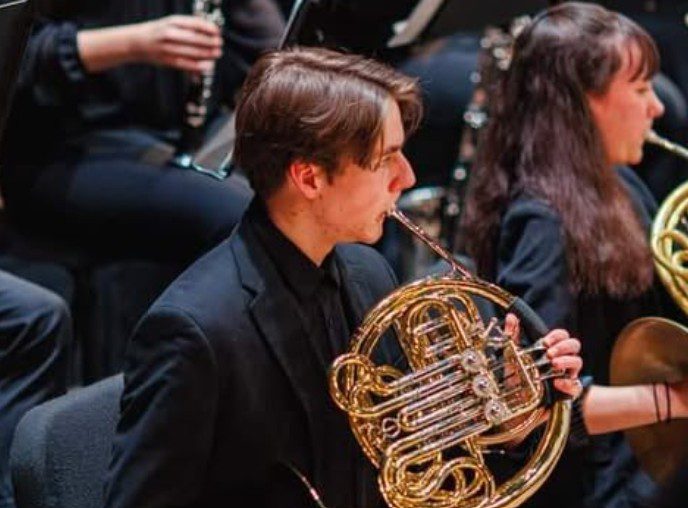
To launch its upcoming season, the Orchestre de l’Université de Montréal invites audiences to the Festival Vibrations for a journey into the heart of Romantic brilliance, featuring Dvořák’s Symphony No. 8 in G major, Augusta Holmès’ symphonic poem La nuit et l’amour, Lalo’s “Ouverture” from the opera Le Roi d’Ys, and Strauss’ Horn Concerto in E-flat major. Winner of second prize in the Orchestre de l’Université de Montréal (OUM) concerto competition, young horn player Noah Larocque will be the soloist performing this flagship work from the repertoire. In an interview with Alexandre Villemaire of PAN M 360, he discusses his attachment to the horn, the technical challenges of the instrument, and the transition from playing in an orchestra to performing as a soloist.
PAN M 360: Tell us a little about your background. What inspired you to pursue a career in music and, above all, to choose the horn as your instrument of choice?
Noah Larocque: I started playing this instrument in high school. It was the only instrument left in the bunch when all the other students in my class had chosen theirs. I had no idea what a horn was at first. So I was kind of forced into it at first, and then it was really difficult at first to understand how it worked. But eventually, I think I was charmed by the challenges the instrument presented. Towards the end of high school, I decided to continue studying music at CEGEP, where I fell in love with orchestral music. It was then that I decided to pursue this path at university.
PAN M 360: So it was pure chance that this instrument ended up in your hands. What attracted you to it, and what were the initial challenges you faced when you started playing it?
Noah Larocque: The horn is a truly versatile instrument that plays with all kinds of instrument families in the orchestra. Often, we play very loudly with the brass section and trombones, which can sound almost aggressive or violent. Sometimes, it’s much more contrasting. It almost sounds like a woodwind instrument at times when we play with the flutes and clarinets. Sometimes it’s more rhythmic with the strings. I think it’s that versatility that really drew me to this instrument. The challenge is that with a single fingering, with a single range of the instrument, you can create several notes. So it’s very easy to hit the note next to the one you want to play and therefore “crack” and make mistakes, as the notes are so close together. It requires a good ear and a lot of work.
PAN M 360: For the OUM’s first concert this season, as part of the Vibration Festival, you will be performing Richard Strauss’s Horn Concerto in E-flat major, a piece that earned you second prize in the OUM concerto competition last March. What can you tell us about this work and its place in the repertoire?
Noah Larocque: First of all, it’s a piece that’s very much part of the horn repertoire. In fact, it’s the most frequently performed romantic piece for solo horn, often accompanied by piano. Performing it with an orchestra is really great. It’s a piece I started playing in college, and I would say it’s very accessible. It’s Strauss, but it doesn’t wander harmonically like Strauss’s later works. It’s an early work. He was 18 when he composed it. It’s still very straightforward and well-defined, while being the Strauss we know, with moments of great intensity and moments that are very majestic and heroic.
It’s a piece that all young horn players who are seriously studying the instrument will perform at some point or another. I never imagined I would perform this piece with an orchestra. It requires a different kind of listening when you start working with an orchestra. Having this platform to perform it is really great.
Since it’s such a classic, I wouldn’t have been able to do it. It’s really great to have this platform to play it on.
PAN M 360: You are orchestra musicians, playing notably in the National Youth Orchestra of Canada, but this will be your first experience as soloists. How are you approaching this moment and what preparation have you had to do as soloists?
Noah Larocque: When you’re an orchestra musician, you’re used to following the conductor and listening to your colleagues around you to play with the other musicians around you. When you’re a soloist, you really have to have your own tempos in mind, your own speeds, and have a lot of leadership in those speeds and in your musical intentions. I would say that I have focused even more on this element, on how to convey my own musical ideas while being clear with the orchestra so that others understand me, so that the conductor understands me, so that my other colleagues in the orchestra understand me.
It’s really a different job in the sense that you become the leader of the orchestra and the musical ideas, the tempo, whereas in an orchestra, you follow much more and listen to your colleagues around you.
PAN M 360: How did the OUM concerto competition contribute to your development as a musician? Was it important for you to try this experience?
Noah Larocque: I really saw it as an experiment at first. I had only played in orchestras before, so for me it was really an attempt to try something new and set myself a personal challenge. My goal was to step outside the orchestral framework and explore other things. It seems that trying to be a soloist allows me to develop other skills and a different way of listening.
Honestly, I was really surprised to win the award. I was super happy, of course, but I guess I never saw myself as a soloist. I think it’s a great string to add to my bow. It’s a big personal challenge, but I see it as a personal challenge to try something new and gain more experience.
PAN M 360: What did you discover when you made this paradigm shift from the perspective of an orchestra musician to that of a soloist?
Noah Larocque: I would say that I discovered that versatility as a musician is extremely important. I had to do a different kind of work to prepare myself for all of this. When you study music, you often realize that it’s the orchestra, playing in an orchestra, that shapes what you learn in your classes. But we don’t really talk about what to do as a soloist. I think I discovered that in myself: this versatility and desire to innovate in my practice, to try other things. I really discovered that with the concerto competition.
PAN M 360: Besides Strauss’ horn concerto, what other favorite piece from the repertoire would you like to play during the rest of your time at university?
Noah Larocque: Strauss wrote two concertos. The first and the second about ten years apart. It would be a dream come true to play the second concerto with an orchestra. It’s completely different from the first. Once again, it brings together the heroic and very powerful themes typical of Strauss, but they are longer with a more elaborate harmonic progression. It’s really different. Having the chance to play it with an orchestra would be a great achievement.
Orchestre de l’Université de Montréal
Mathieu Lussier, direction
Noah Larocque, horn (2nd prize in the OUM Concerto Competition)
Édouard Lalo
Le Roi d’Ys – Ouverture
Augusta Holmès
La nuit et l’amour
Richard Strauss
Concerto pour cor no 1 en mi bémol majeur, op. 11
I. Allegro
II. Andante
III. Allegro
Antonin Dvořák
Symphonie no8 en sol majeur, op. 88
I. Allegro con brio
II. Adagio
III. Allegretto grazioso
IV. Allegro, ma non troppo
Saturday, October 18, 3 p.m. at Salle Claude-Champagne
Billet HERE