Additional Information
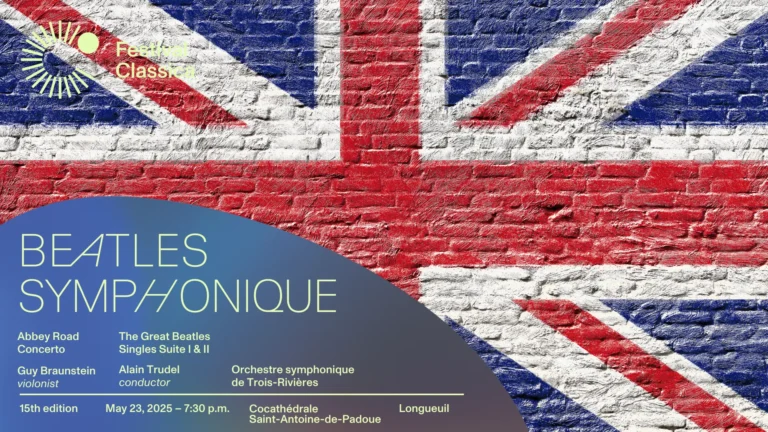
This week at Festival Classica, violinist, conductor, and composer Guy Braunstein brings a bold reimagining of the Beatles’ final studio album to Quebec audiences with the North American premiere of his Abbey Road Concerto. Scored for solo violin and orchestra, the piece reimagines material from the Beatles’ Abbey Road as a through-composed concerto—eschewing nostalgia in favor of transformation. Performed by the Orchestre symphonique de Trois-Rivières under Alain Trudel, the concerto offers a striking reinterpretation of beloved songs like “Come Together” and “Here Comes the Sun,” refracted through Braunstein’s distinctive symphonic language.
PAN M 360: Good morning, Maestro Braunstein. Is now a good time?
Guy Braunstein: It was—until you called me “Maestro.” Just call me Guy. My mother strongly recommends it.
PAN M 360: Well Guy, you must be very excited about the North American premiere of your Abbey Road Concerto. I know we all are.
Guy Braunstein: You bet.
PAN M 360: So how many times have you performed this concerto now so far?
Guy Braunstein: Around ten, maybe more. In several countries. I also recorded it for a CD, so yes—it’s got some miles on it.
PAN M 360: And how has the reception been?
Guy Braunstein: People go crazy. I’ve done a lot of transcriptions—Tchaikovsky, Dvořák, operatic stuff—but this is different. The audience reacts very differently compared to a standard violin concerto. It’s a whole other experience.
PAN M 360: You’ve said this isn’t just an arrangement, but a full-scale concerto. How did it all begin?
Guy Braunstein: Totally unplanned. About six years ago, my son—he was six at the time—got infected with Beatlemania. He discovered the Beatles and became obsessed. He’d keep asking me to play Beatles songs for him on the violin.
PAN M 360: So you started with a few sketches?
Guy Braunstein: Exactly. I made some short encore pieces, just for fun. But then the pandemic hit and suddenly I had a lot of time. I thought, “Why not make a proper arrangement of one Beatles tune—with piano accompaniment?” So I started listening to their late albums, and when I got to Abbey Road, I had a problem: I liked everything. I couldn’t choose.
PAN M 360: So what did you do?
Guy Braunstein: I said, “To hell with it—I’ll take the whole bloody thing.” And I started writing a full-blown concerto for solo violin and orchestra.
PAN M 360: Abbey Road already has a sort of symphonic architecture. Did that influence your decision to orchestrate it?
Guy Braunstein: Sure, it’s not just about loving the music. I love Led Zeppelin too, but I can’t do anything with their music on the violin. Abbey Road, though—I could hear how it could work orchestrally. It offered so much possibility.
PAN M 360: How did you approach arranging the album? What was your process?
Guy Braunstein: Normally I start with a full orchestral score and maybe make a piano reduction later. But this time, I began at the piano—just playing through the songs, exploring textures. Then I orchestrated. I had a plan, but I had to revise it constantly.
For instance, I added a bass trombone to mimic Paul McCartney’s powerful bass lines. Nothing else could replace that sound. The bass trombonist is going to be very busy tonight.
PAN M 360: The first half of the concert includes other arrangements of Beatles songs, right?
Guy Braunstein: That’s right yes. I haven’t heard that part yet.
PAN M 360: You’re not the first to orchestrate Beatles music—what sets your approach apart?
Guy Braunstein: I know I’m not the first. People have been arranging Beatles tunes since they were still active. But I’ve done this in a purely classical way. A few conductors have said it’s more classical than Rhapsody in Blue. It’s not a crossover piece—it’s a concerto.
And I’ll let you in on a secret: the violin part is brutally difficult. A couple of years ago, I played the Sibelius, Abbey Road, and Tchaikovsky concertos three weeks in a row. Sibelius and Tchaikovsky are tough, but Abbey Road was far more demanding.
PAN M 360: Did working so closely with the music change your relationship to it?
Guy Braunstein: I grew up in Tel Aviv in the ’70s. Everything got to Israel ten years late, so I basically grew up with the Beatles—listening to LPs, radio. It was already part of my musical DNA. But when you dig into something that deeply, you always rediscover it.
PAN M 360: I imagine you noticed details you’d never picked up before?
Guy Braunstein: Absolutely. After the first symphonic performance, I recorded it and went back to the studio. I made a lot of revisions. Technology can help you imagine things, but it doesn’t replace real people playing music. I’ve had the luxury of refining it after hearing it live, which is very much in line with how classical composers worked.
PAN M 360: I’ve been reading Geoff Emerick’s book—he talks about the Beatles’ studio experiments, like George Harrison’s discovery of the Moog synthesizer on Abbey Road. How it added such a rich, orchestral texture was a totally novel sound at the time.
Guy Braunstein: Yes—and that curiosity is what made them great. I saw some of Peter Jackson’s Get Back doc and also the Bernstein biopic with Bradley Cooper. Totally different musicians, but they had that same drive: curiosity ready to explode. That’s what separates good musicians from great ones. They’re always hungry. The Beatles could’ve stayed in their comfort zone, making hits like “I Want to Hold Your Hand,” but they pushed boundaries instead. They could’ve made a fortune repeating themselves, but they chose to evolve. That’s why they remain the most fascinating pop group ever.
PAN M 360: And that’s why your concerto feels so fresh—it gives people a new way to hear something they thought they already knew.
Guy Braunstein: Let’s hope the audience feels that way tonight.
PAN M 360: I imagine the orchestra enjoys the change of pace too?
Guy Braunstein: You’d think it’s a break from Stravinsky, but no—they’ll be sweating tonight. It’s hard work.