This year’s National Day for Truth and Reconciliation would see the Salle Bourgie play host to Kent Monkman’s new operatic work in development: The Miss Chief Cycle; an ambitious musical work which seemingly explores the themes, emotions, policies, and attitudes of Turtle Island’s colonial past as well as the exploits of the opera’s immovable namesake, Miss Chief Eagle Testikal. I say “seemingly” only because I cannot speak for the full production. On the night, a total of three scenes were shared. It is, after all, still a work in progress. Regardless, the more than appreciative audience treated the performance of these scenes with all the reverence and gratitude becoming of its subject matter and musical quality.
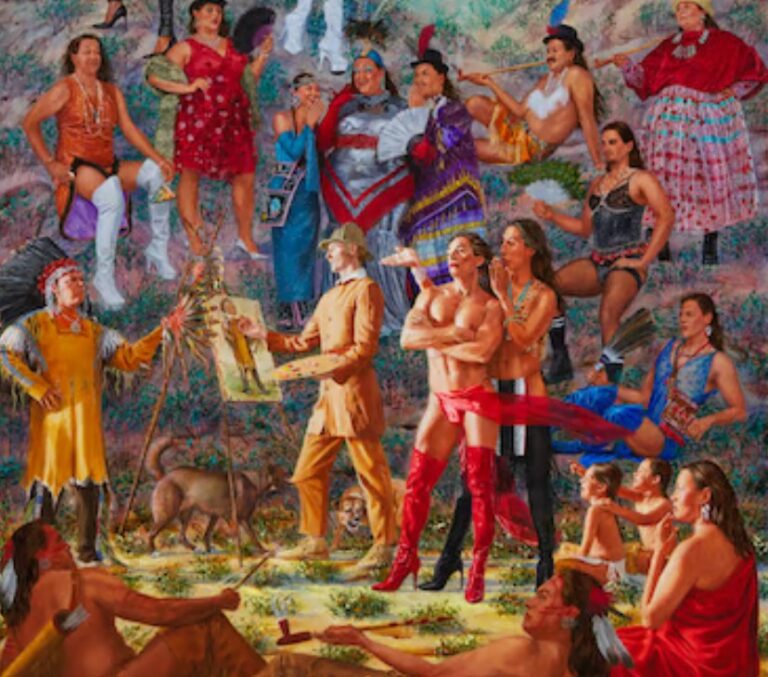
It would seem Monkman is a bona fide renaissance man because, for context, The Miss Chief Cycle is based on a series of paintings that Monkman created over the span of twenty years which he then developed into a book that fuses fiction, memoir and real-life history as it recounts the exploits of Monkman’s original character/alter ego, Miss Chief Eagle Testikal. This book, in turn, provided the source material for what was now being adapted into The Miss Chief Cycle.
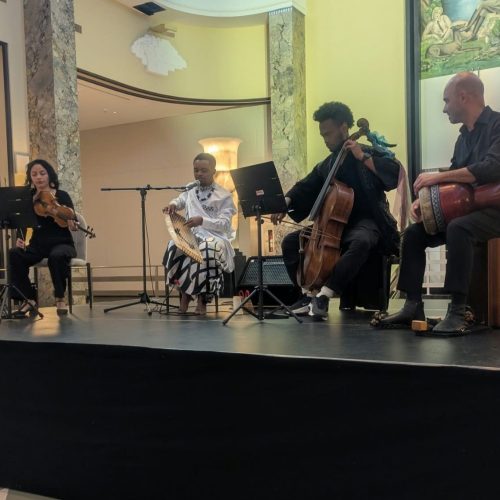
On the night in question, a stripped down orchestral accompaniment provided the musical base for mezzo-soprano Marion Newman; soprano Caitlin Wood; and Laurent Bergeron who was credited in the program simply as “singer,” but was to my ears a tenor; (I am making this claim from memory, however). All three singers performed with control, nuance, and a dash of that theatrical sprechgesang, (speak-singing), where appropriate. The stripped down accompaniment came in the way of a flute, a viola, and a trombone courtesy of three OSM members with the music itself composed by Dustin Peters. Peters, across the three scenes, employed affective use of motifs, chromaticism, key changes, and a gauntlet of other techniques to match the intensity of explored themes including diseased blankets, residential schools, forced conversion, and the over consumption of the earth’s resources, among others.
Of course, beyond any musical or compositional feats, what I found most intriguing, and perhaps exciting for that matter, was the inherent politicalness of such an exercise. The subversiveness of using the “high art” classical European discipline of opera to tell a story steeped in indigenous themes, (and told and written by an indigenous artist), was not lost on me. I tend to believe that setting a genre’s specific performance practice on fire is one of the more political statements you can make in music. In addition, the scenes themselves made for bold commentary in places. The second scene, for example, involved a naive painter who believes in a “noble” mission to immortalize natives on his canvas “before they are no more.” He considers them “a dying race!” and is verily self-impressed with his talents. Miss Chief Eagle, as if speaking directly to the white-washing present and violent past, mocks him by saying “you tell our story as it suits you, but you tell a lie.” She adds “We will always be here!” before laughing and leaving him.
The national memory of Canada is now, undoubtedly, being called into question more and more every passing year. The holiday that is September 30th and the nation’s efforts to showcase more indigenous art is in itself a reflection of this. That said, it’s quite possible that the country paternalistically “giving” indigenous artists a louder voice or “allowing” a day for the contemplation of its least palpable history, remains rooted in old attitudes. An attitude of agreeing to minute concessions and with no interest in real self reflection. Monkman may be telling us something important when Miss Chief tells the audience “We will always be here!” In my estimation, this line, and perhaps the opera as a whole, serves as a reminder: platformed or not, mainstream or obscure, and palpable or otherwise, indigenous art, stories, and peoples will doubtless continue irrespective of outside approval.