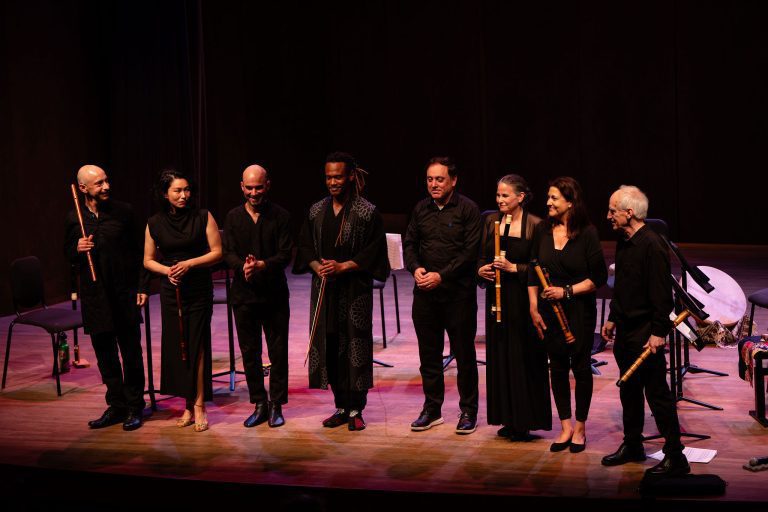
The Accès Asie Festival knows how to take risks. And we can congratulate it. On Tuesday, May 19, a concert was held at the Bourgie Hall featuring very disparate flutes (with a cello and percussion to add some texture): a Renaissance flute, a Baroque flute (Western classical icons, therefore), a ney (Persian flute), shakuhachi and ryuteki (traditional Japanese instruments), and a dizi (Chinese flute). The repertoire, although “tagged” world music, had everything to please the most curious and demanding ears, flirting with the harmonic complexity associated with modern classical music (there were indeed several works from the 20th and 21st centuries on the program).
Vivaldi’s Spring, in an arrangement for solo flute, unfolded throughout the concert, each movement being interpreted as a sort of bridge between various parts. Mika Putterman demonstrated the full extent of her mastery of the baroque flute. The percussionist Ziya Tabassian offered one of his compositions, an exploration based on the rhythmic structure of a Persian poem by Hâfez, while Ziad Chbat played a series of arabesques titled Nostalgia on his ney, a flute of West Asian tradition (up to Turkey) with an enchanting sound, akin to the Armenian duduk (which is not a flute, FYI, but a double-reed instrument, like an oboe).
Two harmonically “contemporary” pieces, that is to say, flirting with and even diving into atonality, were presented: an original composition by Jean Lérigé-Laplante, Évanescence. The piece is a sound wave that intertwines the different timbres of the flutes present, while still offering a welcome place to the cello of the Trinidadian-born Montrealer Kyran Assing, too discreet until then, I find (it’s not his fault, he had almost nothing to play).
The other chromatically dissonant piece was a composition by Bruno Deschênes, a “harmonic complexification” of an ancient Japanese melody, Shin Etenraku. The melody, taken as is but passed from one section to another with modifications and densified combinations, offers no reference point for our Western ears, which are not very familiar with the authentic Japanese repertoire. In the end, we had a modernist work, quite austere but frankly interesting.
A Chinese piece for solo dizi had a lively effect on the audience, with its naturalistic effects, like excited birds, and its spectacular virtuosic flights. Excellent performance by Shuni Tsou.
Moreover, it should be noted the excellence of all the instrumentalists present, all solid performers of their instrument.
The French Baroque composer Joseph Bodin de Boismortier saw his Concerto for Five Flutes, Op. 15 No. 1, transcribed for the present flutes, something he probably never dreamed of. The arranger, Bruno Deschênes, admitted to having taken a risk with this idea. We won’t say it was a great success, even though the artists clearly put all their conviction into it. It is difficult to combine Western and non-Western flutes accustomed to microtonality in a tempered language (with equal intervals) like that of European Baroque. One sometimes wonders if what one hears is off tune, or if it is the natural inflections of the Shakuhachi or the dizi that clash more violently than harmoniously with their baroque sisters. The idea, interesting at first glance, deserves to be refined.
That said, we recognise the interest of this unusual meeting, and we hope, despite a few hiccups, that this type of chamber ensemble will return to us with new ideas because the principle is promising and stimulating.
And hey, why not add a few other instruments (even non flutes) like the clarinet, the duduk, the bassoon, the mandingue flute, the Inca quena, the Indian bansuri, some recorders (the bass one!) and other cellos?
Ensemble :
Bruno Deschênes, shakuhachi and direction
Boaz Berney, Renaissance flute
Élisabeth Caty, shakuhachi and ryuteki
Kyran Assing, cello
Mika Putterman, baroque flute
Shuni Tsou, dizi
Ziad Chbat, ney
Ziya Tabassian, percussions