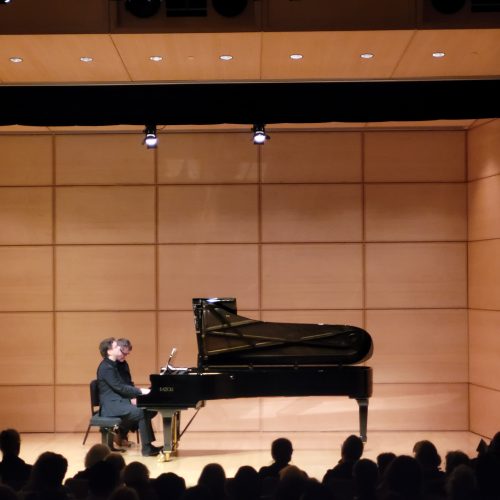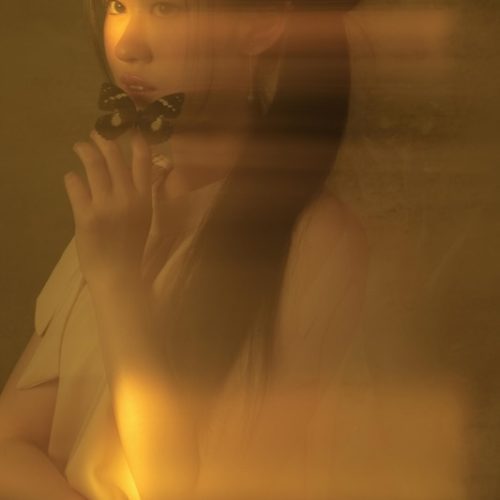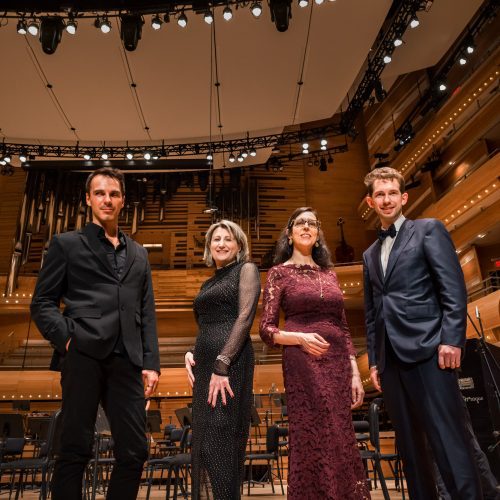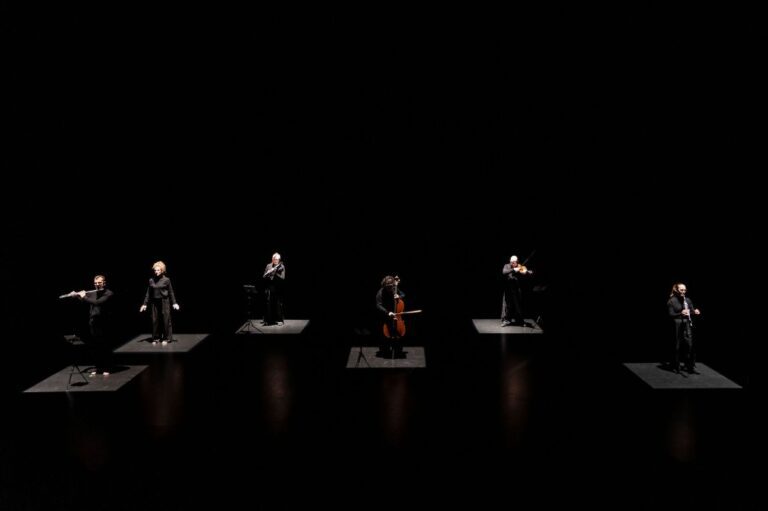
The concert begins with the usual acknowledgment of the unceded territories of Tiohtià:ke (Montréal), which Krystina Marcoux performs this time in sign language, while her voice-over resonates from speakers positioned behind her. Perhaps without realizing it, the audience has already entered the work. Speak no words – Le silence des mots is intended as an exploration of gesture turned into language, and its evocation is communicated from the very beginning.
A ticking clock echoes through the speakers, which I identify as being placed backstage and at the rear of the stage. This seemingly incidental sound is one of the main leitmotifs of the work, a protean element appearing sometimes under various sound treatments, sometimes fully exposed, sometimes dry. This sense of time moves inexorably forward, reminding us that nothing is fixed. The bodies stretch and contract on stage; their movements progress both in time and space.
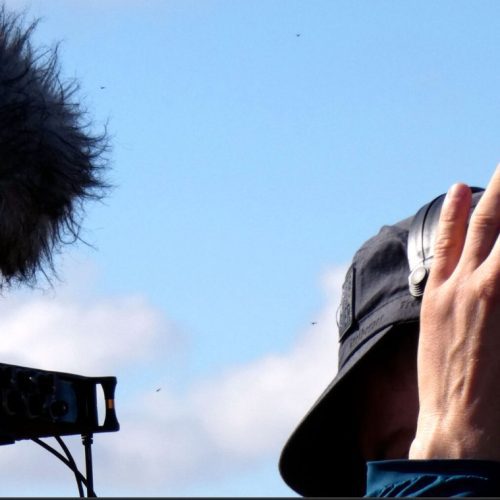
On one hand, the tool developed by Christophe Lebreton, called IMSS (Interactive Motion Sound System), allows musicians to interact with a real-time sound processing system using only the movement of their bodies in space. As a composer and avid enthusiast of sound technologies, I was very eager to observe this tool in action.
On the other hand, Krystina Marcoux is responsible for the artistic direction and conception of this performance. In her interview with Frédéric Cardin from PAN M 360, the multidisciplinary artist mentions, among other things, a key focus of her current artistic path: how is it possible, as a performer, to create from human material?
The first integration of IMSS is detectable in the very first scene: the musicians, arranged in a row facing the audience, reveal their hands one by one in a shaft of light. Initially, this simple gesture of appearance triggers a synthesizer note that animates as long as the hand remains in the light. Some notes slightly deviate from the tempered tonal system, but the effect of atonality remains rather marginal, and consonance predominates.
The one-to-one relationship between gesture and sound (one hand equals one note) quickly becomes blurred: eventually, the hands start to move more actively, and the note appearances seem to gain independence from them. The performance then moves into filter openings and closings, and shimmer reverbs when the hands are raised in the air. From this first scene, the dynamism of the system stands out, where parameter assignments evolve fluidly over time under the rhythm of the omnipotent clock.
A square of light defines a confined space in the middle of the stage. This light isolates and frames, emanating a sense of solitude. After struggling with a folding chair, music stand, and sheet music in this confined area, Juan Sebastian Delgado reappears with his cello. He is standing, his cello supported by a strap. He bows to the front, then to his right, then to his left, toward what I estimate are the locations of the backstage speakers.
He plays a low pitch, a single note to begin with, and a pattern emerges, performing Bach’s first cello suite in G major. It quickly becomes apparent that this rendition differs from the original: the tempo is drastically stretched, contracting at times when the cellist’s body moves with greater amplitude. His cello playing oscillates between resonant fundamentals and light ornaments and harmonics, giving this interpretation of Bach’s suite remarkable flexibility and dynamism.
Later, it is Gwenaëlle Ratouit’s clarinet playing that undergoes sound treatments, which here seem rather fixed or more subtle in their variations. Her playing initially consists of accumulations of very short staccati multiplied in a granular delay, filling the hall with a cloud of percussive, noisy, and tonal elements. Her expressive playing following this segment demonstrates great virtuosity.
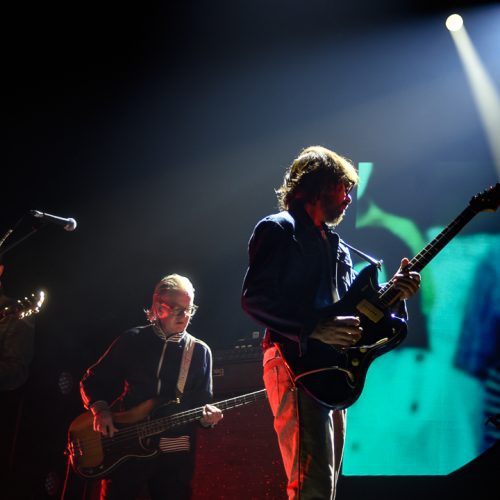
At this point in the performance, the musicians are all placed sparsely on stage, isolated within their squares of light. Gwenaëlle sets the tone for this section, and the instrumentalists respond to one another in turn. Some interactions seem to formulate a coherent musical response to the clarinet, while others, like Pamela Reimer’s first melodica interventions, take us into an entirely different musical universe for a moment.
These discontinuous interventions are at times reinforced by the underlying pattern, which provides a framework for melodic play before returning to the virtuosic clarinet and granular treatments. These interventions eventually unify, and the music achieves strong cohesion by the end of the segment.
Throughout the work, however, one notices the distance separating each musician and their vain attempts to connect. Confronted with this reality, the protagonist Krystina Marcoux appears increasingly frantic in her search for an escape from her alienation. Speak no words – Le silence des mots seems, in a way, to reveal these walls erected between communicative beings, to name the masks we hold up between each other and even within ourselves.
At one point in the performance, there is a flute solo by Jeffrey Stonehouse, conversing alone with his stereophonic echoes in a kind of desperate call. Here, the musician gives the impression that it is with himself that he is trying to break down walls and regain his unity.
A single moment of communion occurs at the very end of the work, where the musicians come together to play in an interwoven melodic structure reminiscent of minimalist writing techniques. Initially in dialogue, the vibraphone in its atonal melodic flights recalls Varèse more than the minimalists. Still, they eventually align and conclude the work in a true moment of musical culmination.
crédit photo : Kevin Calixte