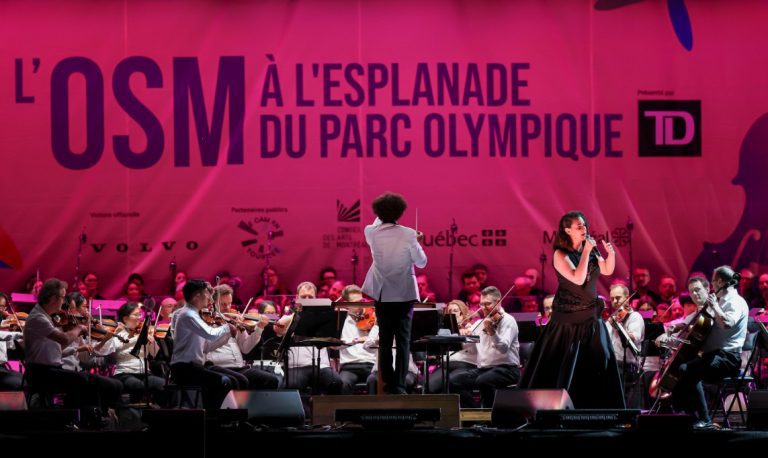
On August 12, under a clear sky, the fiftieth anniversary of Montreal’s Olympic Stadium, our unloved Big O, coincided with the Perseids, the partial solar eclipse and this annual concert given by the Montreal Symphony Orchestra, on the Esplanade of Olympic Park, at the foot of the imposing structure which is being renovated and for which we hope acceptable acoustics – which was by no means the case during 5 decades of sporting and cultural activities.
The discussion touched on the stadium’s construction, the Expos’ long stay until their relocation, Diane Dufresne and her 1984 “Magie rose” show, and the occasional concerts by U2, the Rolling Stones, and Pink Floyd. They also reminisced about the mega-shows by Madonna, George Michael, Verdi’s Aida with its grandiose (or bombastic, depending on your perspective) sets, David Bowie, George Michael, Michael Jackson, Genesis, and even the Montreal Symphony Orchestra under Vic Vogel’s direction at the 1976 Olympic Games opening ceremony. Notably omitted were the appearances of Bruce Springsteen, Sting, Peter Gabriel, and the riot at the Metallica/Guns N’ Roses concert in 1992.
I myself covered most of these concerts for La Presse, and I thoroughly enjoyed them while trying to downplay the major acoustic frustrations, as the Big O was considered a vast and deplorable echo chamber—a conceptual flaw on the part of its architect, Roger Taillibert. Let me emphasize: the announced renovation of the stadium’s interior furnishings will be unforgivable if this major irritant isn’t addressed.
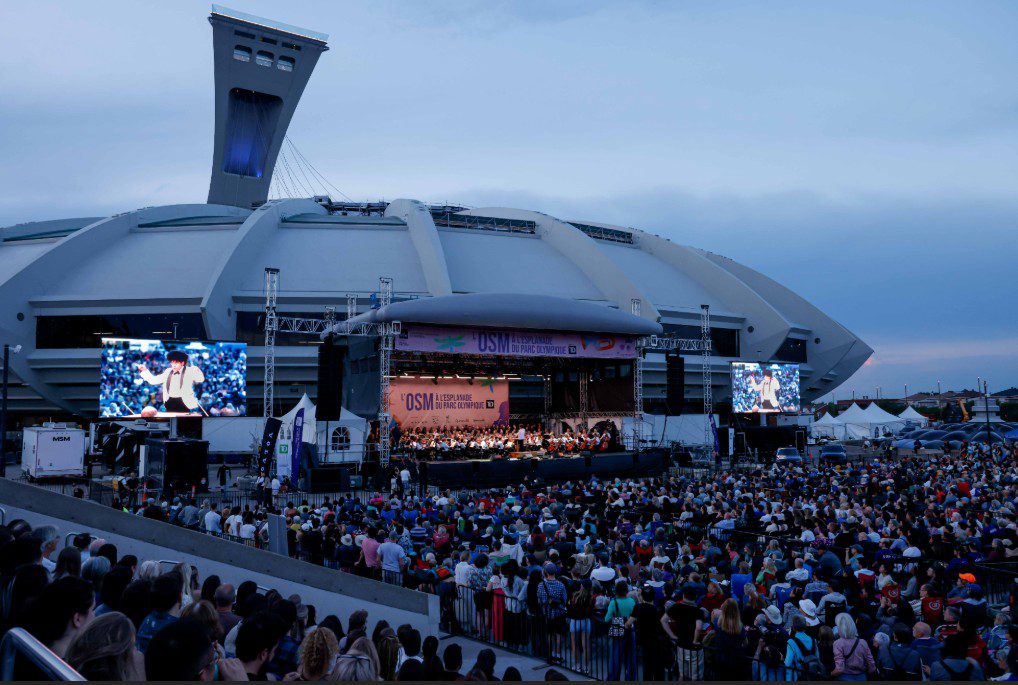
After receiving Montreal’s highest honour from our mayor Soraya Martinez Ferrada, Rafael Payare took his seat.
The first work on the program, Dmitri Shostakovich’s Festive Overture, was created in 1954 for the Bolshoi, in the context of the 37th anniversary of the October Revolution, a year after the death of Stalin with whom he had a complex relationship, to say the least. In this piece, the great Russian composer continued to thwart the dictates of Soviet authority by mixing symphonic evidence with daring and virtuoso writing for the strings and a brass section placed in the foreground – 4 horns, 3 trumpets, 3 trombones.
This was followed by a text evoking the construction and history of our fifty-year-old stadium, read by actress Sophie Cadieux, set to John Adams’s “A Final Shaking,” the fourth movement of Shaker Loops, a work originally composed in 1978 for a septet and later adapted for a symphonic setting. It’s clear that the narration largely overshadowed the music, as one might expect.
I was 17 when I watched the opening ceremony of the 1976 Olympics on TV; it was the first time in my life that I listened to the music of André Mathieu (1929-1968), a piano prodigy and composer little appreciated in his time, whose excerpts had been put together under the impetus of Vic Vogel (1935-1919), an essential Montreal jazzman and also André Mathieu’s neighbor in the 60s. I don’t remember exactly the style of the arrangements of the time then performed by the OSM under the direction of our late Vic, the arrangements of Alexandre David probably strengthened the rhythm, all followed by Daphnis et Chloé, Orchestral Suite No. 2 by Maurice Ravel, a composer very popular with jazzmen.
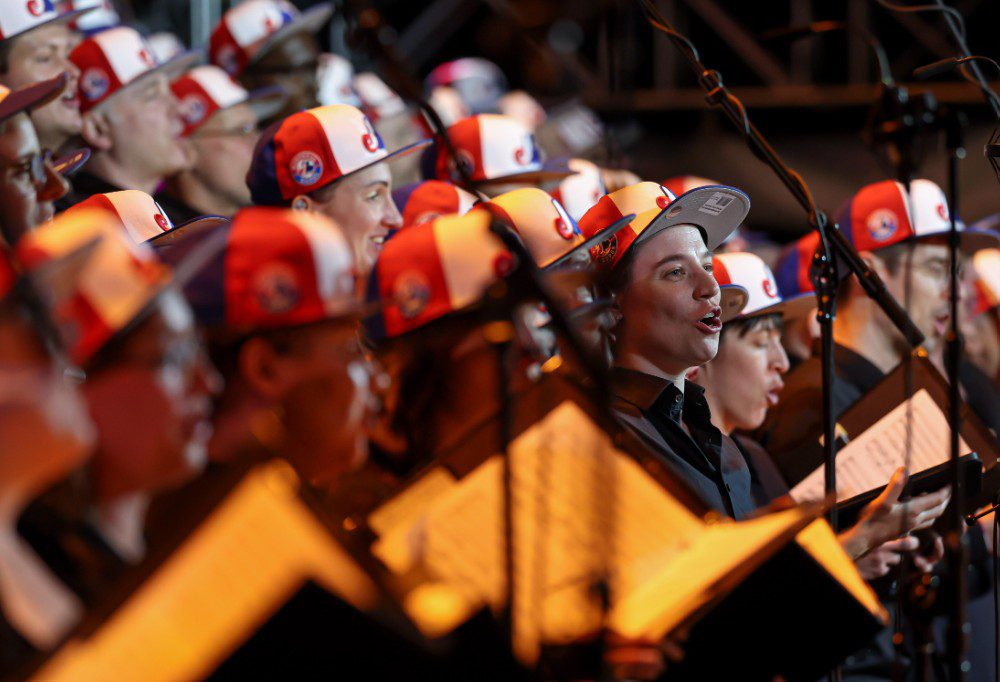
It’s hard to imagine the highly talented Alexandre David, a former metal musician turned contemporary composer, arranging a Johann Strauss waltz, Frühlingsstimmen, usually reserved for New Year’s balls and skaters. Once again, we observed a more pronounced rhythm, an almost pop-rock attitude… and why not!? This famous Strauss waltz was “mashupped” with Take Me Out to the Ballgame (Jack Norworth/Albert Von Tilzer), the absolute anthem of baseball fans since 1908, all sung by choir members wearing Expos caps to the delight of the large crowd gathered on the Esplanade.
Arranged by Hugo Bégin, the Stade’s greatest pop-rock hits were a medley of the mega-hits played at the time: U2’s “Sunday Bloody Sunday” (which wasn’t the focus of the Irish band’s sets; we remember the tracks from the albums Achtung Baby and The Joshua Tree), George Michael’s “Faith,” Madonna’s “Vogue,” Michael Jackson’s “Billie Jean” (he came to the Stade in 1984 with the Jackson Five, not for his first solo tour), David Bowie’s “Let’s Dance,” and Pink Floyd’s “Money” (whose album Dark Side of the Moon had been performed in its entirety at the Autostade in June 1975 and wasn’t a central work in the concerts given at the Olympic Stadium, unlike Another Brick in the Wall, which was indeed the signature song of a show at the Stade). We also recognized the Rolling Stones’ “Paint It Black,” released in 1966, not during the Stade’s run and the Steel Wheels album era.
Finally… we can deduce that the arranger sometimes preferred well-known hits to pieces emblematic of these concerts given at the Big O. Enough of this consideration, on Wednesday we observed the increased ability of classical musicians to get into the groove of pop or rock, which was not obvious not so long ago.
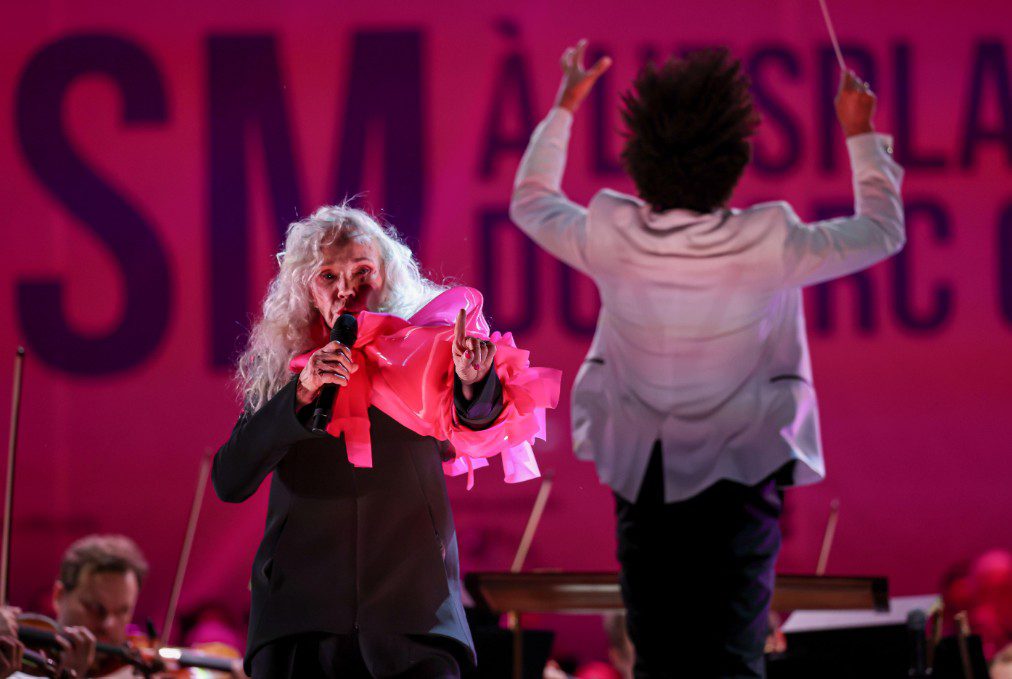
And it continued! The triumphant march from Verdi’s Aida preceded the fabulous alto/contralto Rose Naggar-Tremblay in a solid lyrical interpretation of “Je voulais te dire que je t’attends,” a classic by Michel Jonasz, originally performed by our very own Diane Dufresne. Acclaimed for her environmentalist mashup of “Oxygène” and “L’hymne à la beauté du monde,” complete with choir, the unparalleled Quebec performer brought the house down, with the audience seemingly unconcerned by her obvious vocal limitations, inherent to her 81 years.
Thus, the OSM, its conductor, and their guests were in top form before a European tour that could prove triumphant. The ever-popular Ode to Joy, the celebrated finale of Beethoven’s Ninth Symphony, was impeccably performed with the precision, grandeur, and passion necessary for a successful interpretation. Soprano Lauren Margison, alto Rose Naggar-Tremblay, tenor Frédéric Antoun, and bass Alex Halliday were the soloists; the choir was masterful; the brass section positioned to the left of the giant screen performed brilliantly; the OSM and its maestro rose to the occasion, making this a highly successful and universally acclaimed event, all capped off by the dazzling fireworks display.
Photo credit: Antoine Saito/Montreal Symphony Orchestra