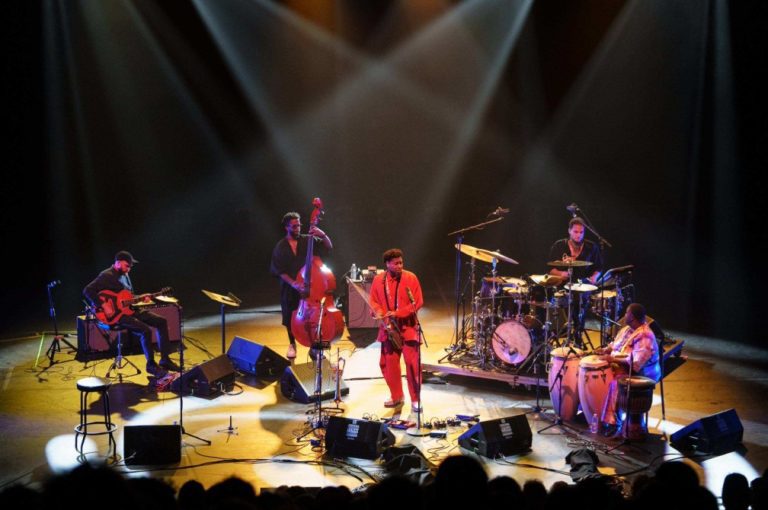
Chief Xian aTunde Adjuah’s, formerly known as Christian Scott, show at the Théâtre Jean-Duceppe last night was less a concert than a statement of intent. The Louisiana-born composer used the evening to unveil much of the music from his forthcoming 2027 album, Anti-Jazz Hero, a project that seeks to question what jazz means nearly a century after the music first emerged. Reinvention has long been central to Adjuah’s work, but this latest chapter feels like his boldest yet.
Looking beyond the conventions of modern jazz and back toward its African roots, Adjuah has developed his own instrument, Adjuah’s Bow, an intricate hybrid inspired by three different African harps. Combined with an array of effect pedals, it became the driving force behind the first half of the performance. The music often felt closer to electronic sound design than to anything recognizably jazz, built on hypnotic grooves, dense textures and explosive rhythmic interplay. The dialogue between the drummer and djembe player was especially electrifying to watch and had us fully locked in.
The second half took a slightly different but welcome turn. Long-time collaborator Elena Pinderhughes joined the ensemble, bringing a welcome lyricism that contrasted beautifully with the raw physicality of the opening set. Setting the Adjuah Bow aside, he returned to the trumpet, reminding everyone that beneath all the experimentation remains one of the most distinctive horn voices in contemporary music. His phrasing carried the same emotional urgency that has defined his career, now framed by an ensemble equally committed to exploration.
Whether Anti-Jazz Hero can ultimately reshape the conversation around jazz remains to be seen, but this premiere made one thing clear: Chief Adjuah has little interest in preserving tradition for its own sake.
Photo by Benoît Rousseau