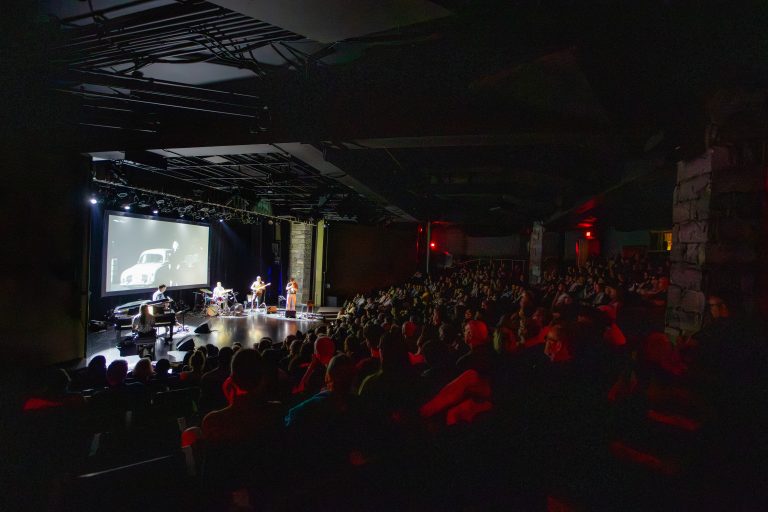
Thursday evening at Gesù, a cine-concert like no other was held. Ascenseur pour l’échafaud, a film by Louis Malle released in 1958, and whose almost entirely improvised soundtrack by Miles Davis contributed as much to the film’s success and fame as the quality of Malle’s direction itself. One had to ask the following question: should one replay note for note a score originally created spontaneously, thus betraying its original spirit, or should one rather pay homage to that spirit by improvising anew, even if it means breaking the solidly rooted references in the minds of movie buffs?
In this dilemma, trumpeter Rémi Cormier has clearly chosen his side by favouring the second solution. The Montrealer, already comfortable with the nocturnal and urban groove style of the original music (listen to his music on Bandcamp), went for atmospheres that were sometimes subdued, sometimes more dynamic and propulsive (for car scenes, for example). Musically speaking, Cormier weaves a rather velvety tapestry, with occasional dissonant or grating outbursts. A picture of warm, muted colours. His colleagues Théo Abellard on piano, Levi Dover on bass, Louis-Vincent Hamel on drums, and Nick Di Giovanni on guitar play along and insert their own contributions within the rather straightforward framework of the suggested emotions and atmospheres. In terms of paying tribute to Miles’ music, it’s effective and very appealing. We will note some passages where the volume of the music is unbalanced compared to that of the film and the dialogues. The kind of thing that gets refined over time.
Here is the purely musical and technical aspect of the relationship between the music and the film. It is at the level of its dramatic and emotional connection with the images that one sometimes wonders what should have been done differently. Several originally silent (meaning without music) scenes (there are quite a few, given that there were only about 20 minutes of music in the final cut of the 1h30 film, I remind you!) seem here overloaded, as if they were a bit too abundantly covered with “mood” and atmosphere. Notwithstanding the quality of the score improvised by Rémi Cormier’s quintet, one cannot overlook the symbiotic relationship with the images.
In the 1958 film, Malle had deliberately chosen to limit musical interventions to a few selected moments. There was a reason for that. The dramatic effect, the communicative and emotional expression of the characters’ psyche, all of this was distilled sparingly, and above all balanced between the “natural” vitality of the actors’ performances and the “commented” delivery by the soundtrack. In the film, as it will be seen on any streaming site, the arrival of the music marks an important moment each time, a departure from the raw space of the story, a step back to better embrace a broader perspective of the emotions and inner lives of the protagonists.
In the version presented at Gesù, this balance is shattered by the presence, almost wall to wall, of music that covers everything. We are somewhat overwhelmed, in a closed elevator, and the references crumble. Even though Rémi Cormier’s composition is very good, it is heavily overused. I have remarked to myself, several times, that I would prefer it to be a simple concert rather than a film concert.
A striking example: the scene where Florence (Jeanne Moreau) leaves the café after asking the bartender if he had seen Julien (stuck in the elevator). The feeling of solitude of the character, immersed in the nocturnal urbanity, is magnified by the appearance of the trumpet and its haunting melody, gently cushioned by the rest of the quintet. After almost thirty minutes without music, the quiet strength of this moment is striking. Last night, it was completely overshadowed by the incessant presence, from the very first moments of the film, of the soundtrack. An originally significant appearance now stripped of any particular interest.
I’m not saying that the music should have been played note for note either. Cormier’s argument seems very valid to me: Miles would never have done that. But it seems to me that the spirit of this music does not reside solely in its style and sonorities, but also in its place in the narrative and dramatic progression. In other words, fewer notes and more silences should also have been part of the analysis of the character of this music.
Even if the dosage will have to be adjusted, the concept, bold, and the beautiful score, were carried out with authentic and fully successful involvement.
What will be your primary intention in going to this concert: to listen to good music inspired by Miles Davis, or to experience a very special relationship between images and sounds? The answer will certainly influence the degree of your satisfaction.