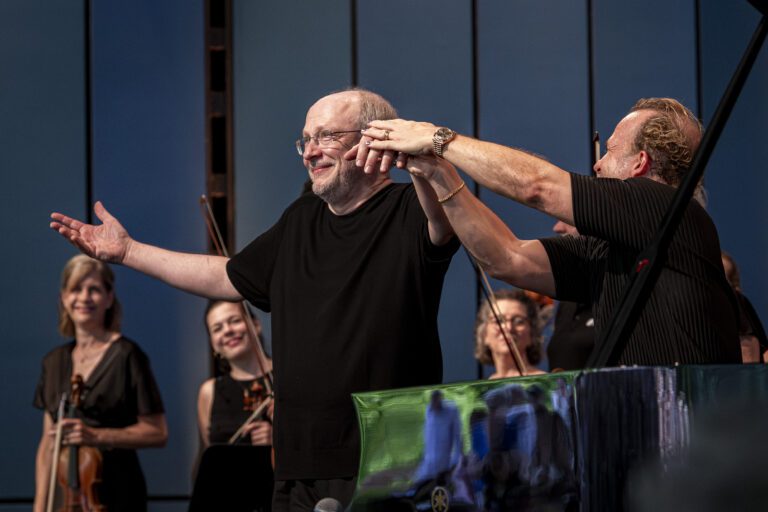
Nature, and human nature in general, had the last word this Sunday at the Lanaudière Amphitheatre for the concert by the Orchestre Métropolitain (OM) conducted by Yannick Nézet-Séguin, with the imperial Marc-André Hamelin on piano. Let’s remember that it was the young sensation Yuja Wang who was supposed to be there, but sick for a few days, she had to withdraw. In Lanaudière, miracles do exist, according to the artistic director Renaud Loranger. He may not be wrong, because replacing an artist as intense as Wang at the last minute with an absolute master of his art such as Hamelin is indeed a blessing.
With the OM and Yannick, the two Ravel piano concertos were on the menu, the one for the left hand and the one in G, of course. From the outset, we knew that we had not lost anything in the exchange, because the Quebec pianist seized the Concerto for the Left Hand in D Major, without ever letting up the pressure for a moment, so explosive in its contrasts, so nervous and urgent in its motifs and melodies, so fragmented in its references, moving from jazz to military music, modernism and lyricism. Hamelin controlled the entire discourse and pacing of the work, with unwavering confidence, to which Yannick and the OM submitted with grace, infusing their musical part with very beautiful colors, feverishly drawn by the conductor. This kind of music is second nature to the Quebec pianist, as if he never needs to think about it, just let his instinct and essential Self take over.
The Concerto in G major, more substantial in content though not much longer in duration, is an absolute marvel, which is part of our collective music-loving psyches. Here, if we could feel a slowness to “get into” the game from Hamelin, but quickly resolved. The two external movements demonstrated a beautiful mastery of the textural play in the orchestra, by Yannick, and of the pointillist discourse by Hamelin. A few rare flights seemed less clear in their execution than those of the concerto for the left hand, no more. It was in the central movement, which is one of the most beautiful musical passages in history, that the pianist showed inspiring poetry and benevolent gentleness. Not better than the best, but not worse either. In short, a high-quality reading, of the kind we expect from the best artists in the world. If the OM did well in this movement, it missed the step towards an absolute standard, particularly in the woodwind solos that precede the great and wonderful English horn soliloquy. Some aesthetic clumsiness was noticeable in a wrongly placed flute breath and a slightly vulgar clarinet attack. The English horn solo itself, although very beautifully sung by the excellent Mélanie Harel, could have been projected with more force and stately presence in front of the orchestra. In short, it is in these infinitesimal details that the difference between the OM and the OSM is noticeable. A notch, a very small notch, but one that makes the difference for those who listen carefully.
Hamelin was almost heroically greeted by the audience, to whom he offered magnificent Jeux d’eau by the same Ravel. Another Lanaudois miracle: it was exactly at the climax of the piece that thunder and rain began to fall, in a spontaneous symbiosis as wonderful as it was funny. We would have wanted to program it, but we could probably never make it happen.
As an opening piece, Yannick had chosen a very pretty impressionistic score by Lili Boulanger, D’un matin de printemps, which set the table nicely for what was to come, namely a festival of orchestral colors.
As if the musical density had not yet been maximized enough, the concert ended with the substantial Symphony No. 2 in D major, Op. 43 by Sibelius. This time, nature did not collaborate kindly with the musicians. After a few minutes of settling into the first movement, the audience and artists had to take a break from the musical communion because the downpour, not only noisy, even made its way onto the stage due to the strong winds, risking damage to the performers’ instruments, especially the strings.
We were destabilized by the resumption, which did not take place at the beginning of the work, as announced, but roughly where we had left off. With stability restored in our minds, we paid attention to the unfolding of these sublime pages from the symphonic repertoire. Yannick succeeded where, I find, he did not entirely satisfy in his Atma label recording. In the latter, he draw an almost mineral, chthonic vision, whereas I believe that this symphony requires an airy approach, without neglecting the grounding in the soil. It’s a bit of what we got as the sky finally lit up. The Finale was adequately held and sustained in its celestial and luminous ascent so emblematic, so mystically powerful. Satisfaction, despite the initial disagreements of Mother Nature.