Additional Information
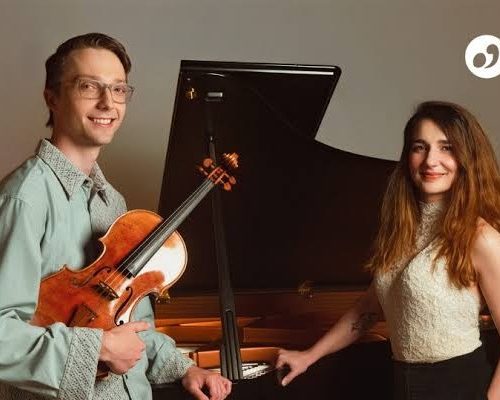
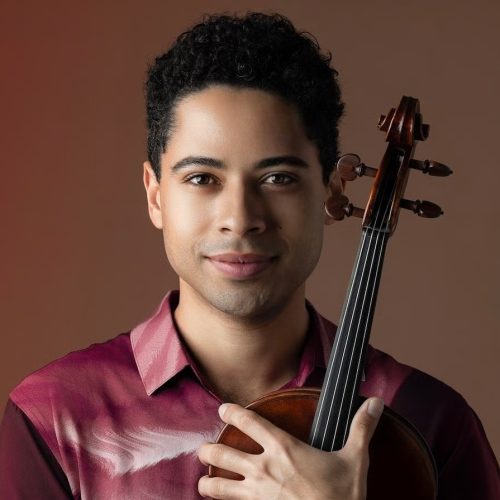
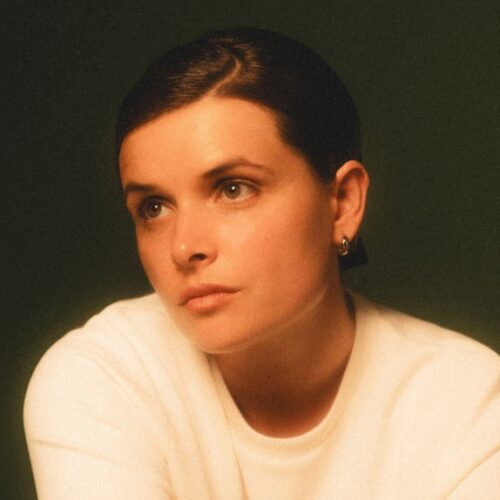
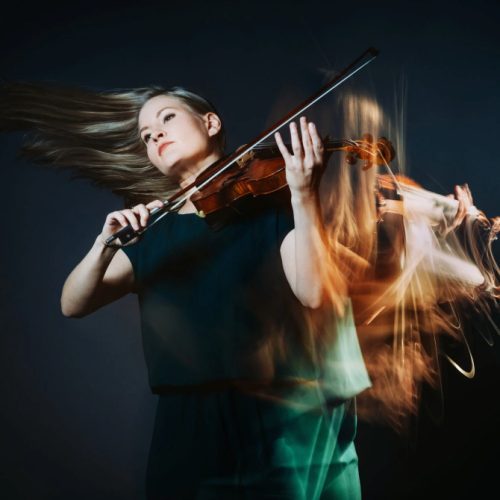
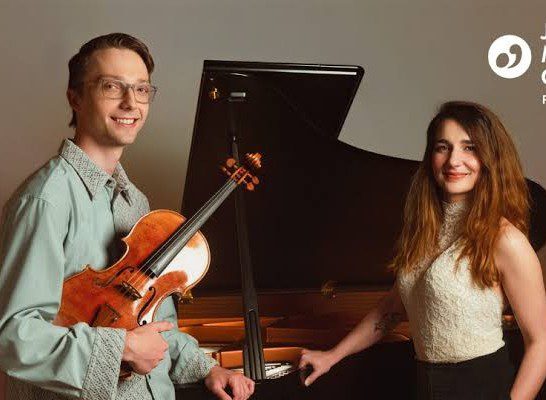
A viola and a piano, in all their fantasy. Jeunesses Musicales Canada is presenting two young artists on the rise, pianist Elisabeth Pion and violist Wilhelm Magner, in a tour that is currently in full swing (and called Viola Fantasy), and which will see them take to the stage in Carleton-sur-Mer (this evening), Gaspé (November 30), Port-Cartier (December 2), Montreal (at the Joseph-Rouleau hall, on the Plateau, December 3), Rouyn-Noranda (December 15) and Jonquière (December 20). I took the time to talk to them, on the side of the road (they literally stopped their car for the interview), in order to discuss the program (Schumann and César Franck, among others).
INFO, CONCERT DATES AND TICKETS
PanM360: Hello to both of you. I’ll start with you, Wilhelm. You won the Prix d’Europe in 2022, the first violist in 111 years to achieve this feat! How do you feel about this achievement?
Wilhelm Magner: It was a pleasant surprise because when you sign up for these competitions, it’s for self-improvement, you don’t necessarily expect it to work out. It is a great privilege for me and it has opened many doors, offering me several opportunities. I was able to study at Yale University for two years, and it helped me a lot in getting concerts, and eventually, in obtaining my position as a professor at the University of Texas (Austin), and it is partly thanks to this prize that I was able to launch my career on an international scale.
I am very grateful.
PanM360: Let’s talk about the concerts. How did you determine the program?
Elisabeth Pion: It was completely dictatorial, I made all the decisions! Haha. No, of course, these are really discussions and I think it happened quite organically. We are quite happy with the program we offered because it is really varied.
Wilhelm Magner: What we’re going to play are Schumann’s Fairy Tales, Elfentanz by Florence Price. After that, we will play Franck’s sonata. I don’t know if we’ll do it in full in Montreal, we need to check the concert’s timing because I think it’s a bit shorter concert, this one. We might only do two movements. And what we also do is a Q&A session during the break, which allows the audience to interact with us.
In the second part, we mainly play our own compositions. I wrote one piece, Elisabeth wrote several. We even continue to develop them during the tour. Yesterday, we were still making small adjustments. We are reconnecting with a somewhat forgotten practice. At the end of the 19th and the beginning of the 20th centuries, all performers were also composers.
People wrote a bit like bands, they wrote their own “hits.” It was lost in the 20th century when people became hyper-specialized. But we wanted to reconnect with that.
Then we finish with the Carmen Fantasy by Franz Waxman, which is one of the great virtuosic works for the violin. But of course, I don’t play the violin. I made a version for viola without transposing. So, we have some action.
PanM360: What is the main difficulty for you in interpreting this piece by Waxman? It is already very virtuosic for the violin…
Wilhelm Magner: We are missing a string! That’s the main challenge, I would say. It is probably already one of the most technically demanding works in the violin repertoire. The viola, on the other hand, is bigger. So, everything is more difficult. But I always ask myself the question “what’s the point?” when I do these transcriptions. And what I find is that it gets closer to the tessitura of the voice that usually sings these arias (a mezzo-soprano). So we can more easily capture the original colours.
It’s true that it’s very virtuosic, but there are also magnificent melodies, very operatic moments that work very well on the viola. It’s always a challenge to take a piece for another instrument and find solutions to express things without sacrificing, let’s say, the original material.
(Franck’s Sonata) lasts 28 minutes, but every time we play it, it feels like three minutes and it’s over.
PanM360: What is your personal relationship with the magnificent Sonata by César Franck?
Elisabeth Pion: Me, I am particularly a fan of César Franck’s music. I find that it’s music that isn’t played as much on stage as that of other great French composers (Franck was of Belgian origin, but still…). We always hear Debussy, Ravel, etc.
I find that Franck is their equal in terms of what he has managed to produce as a work. It’s important to play it more. Then, it’s a composer that I have explored quite a lot. I have often played the quintet, among others, which is an incredible work. His music in general is very captivating. You can’t get out of a loop. It’s very haunting music. You are caught in a harmonic vortex. But we’re happy to be caught up in it. It’s great music. Also, since he was an organist of the highest level, there are very deep basses.
There is something very earthly, but that rises. It lifts you from the ground up. It’s music that can be incredibly intimate, but also grandiose or visceral. The Sonata, in itself, is absolutely brilliant. I had never played it before playing it with Wilhelm, but every time we play it, I discover new things. It’s really fun.
Wilhelm Magner: I also think that one of the things that is very pleasant about a tour like this is that we can develop our vision of the music. Usually, for a concert, we have two rehearsals at most, then it’s the concert. After that, we take the plane and start again with something else.
But spending two or three weeks immersed in works allows us to discover new things and delve deeply into the interpretation of the music. For me, it’s very, very enriching. Between the concerts, we talk, we rehearse a bit, and we discover, as Élisabeth said, all sorts of wonders in the score.
Franck’s Sonata is a piece that resonates deeply with people. By the way, that’s why it has been transcribed for practically every instrument. There are versions for saxophone, or for cello, of this piece. The beauty of the viola version is that we can borrow the best ideas from the violin version and the best ideas from the cello version and create our own ideal version. It’s magical. Elisabeth and I have a lot of fun doing it again. It lasts 28 minutes, but every time we play it, it feels like three minutes and it’s over.
PanM360: What is your relationship with the Jeunesses Musicales?
Elisabeth Pion: It’s a relationship that has developed over the years. The JMC supported me a lot with AIDA scholarships. I think the first scholarship I received was in 2015-2016, something like that, when I started doing internships.
They also helped me when I went to the Brevard Music Center in the United States. I was very young, I was 18-19 years old. Then after that, when I went to London for my studies, they supported me again.
I also received the Choquette-Symcox Prize in 2022, which is a very nice recognition. It’s an organization that is committed to supporting artists in the long term. It’s really not a “one-time deal” where they give you money and that’s it. They really want to see how you evolve. I really feel like it’s like a fairy godmother who has been following me for several years. Now that my career is going well, it’s a pleasure to participate in a tour because I feel like I can give back. Not just concerts, but also giving workshops with young people, and being generous with different audiences across various provinces. It’s really a chance. In any case, I am really happy to be able to be a standard-bearer for the JMC because I think it is an institution that deserves to be supported and discovered. There are many people who don’t even know it exists! Yet, it has been central to the artistic and career development of many Quebec and Canadian artists.
We can be proud of this institution.
Wilhelm Magner: Yes, I would say pretty much the same thing. I had met the JMC at a recital a few years ago and at that time, we had talked. They had supported me one day with a scholarship when I was studying and preparing for various international competitions.
I think I was going to the Prague competition or something like that, and they had supported me financially. For a few years, we had been discussing the idea of doing a viola tour because it is very rare for the viola to be highlighted. They believed in the project. It took us a bit of time to bring it to life because our schedules were busy, especially Élizabeth. We were in Montreal for two days last June, we rehearsed for one day, and after that, we arrived from two different countries on the day the tour started. But the JMC supported all of that and helped us organise the tour. It was a great pleasure to work with them.
They also assisted us with something we had never done before. We worked with two actors, actresses who helped us prepare the spoken part of the concert. We wrote texts, we worked on them with, among others, Julie Daoust from Radio-Canada, and we spent quite a bit of time doing that.
And even little staged scenes to tell a bit of our story. And that was really something different that we had never had the chance to do. It opened our eyes, I think, to the similarities between musical phrasing, poetic phrasing, and spoken phrasing. It’s pretty much the same thing, we were making the same mistakes.
We learned a lot, and that was very special. It’s an institution that has done a lot, I think, for musicians in Canada. And I know several musicians whose careers have been transformed thanks to the JMC.
We are very grateful for everything the youth continue to do. They are very dedicated people.
PanM360: Have a great end of the tour!