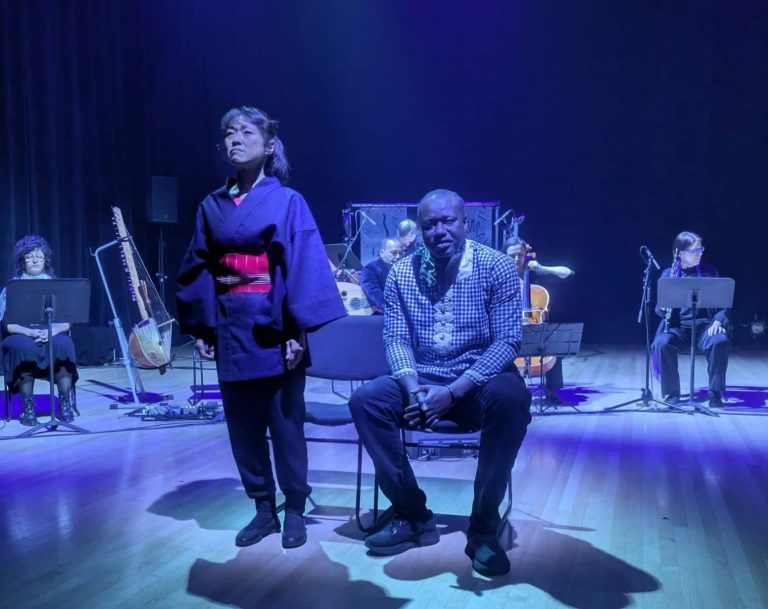
We don’t understand what is being said or sung in Areuh! by André Pappathomas. Unless you speak Arabic (Syrian and Tunisian), Armenian, Hindi, Japanese, Portuguese, or Wolof. But, according to the creator himself, it is enough to understand the musicality of these languages and the emotions expressed by the speakers to grasp everything. We’ll come back to it.
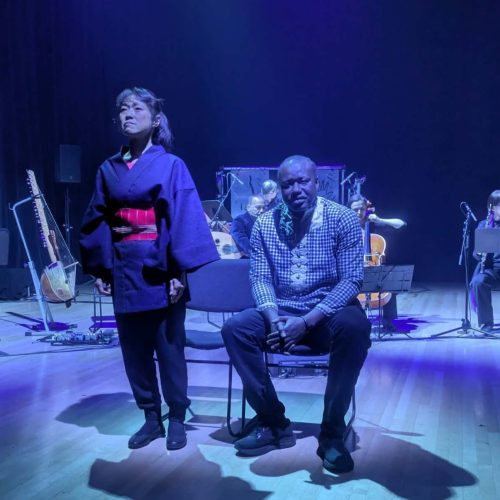
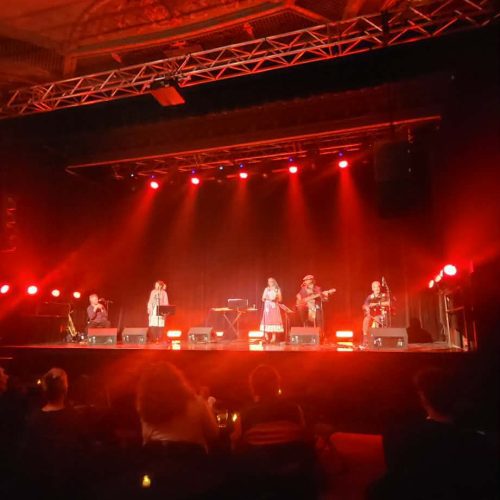
Musically, we are in a modern approach that is often consonant, interspersed with very expressive noise episodes. Pappathomas writes well, and he knows how to give space to his solo instruments, characterised by their unique and subtle colours. We are talking here about a kora, an oud, an oboe, percussion instruments, a cello, a violin, and a shamisen (a Japanese lute), and even a shruti box (a wind instrument mechanically blown, played in Indian classical music). Except for the shruti box (barely heard) and the shamisen, illustrated by a single true solo (what a pity, we would have liked this instrument with its piercingly sharp tone to be used much more), all the soloists offered beautiful exchanges, often refined and delicate. Moments of grace, too, between the oud, the cello, and the percussion (excellent Olivier Maranda, as always with him).
But it is the vocal aspect that occupies the center of attention in this work in seven very impressionistic and poetic tableaux, like a journey of life, from the pre-natal limbo to the final “wearing out of bodies.” Voices that belong to the instrumentalists but also to a solid vocal quartet (Gabriel Dharmoo, Éric Gauvin, Liz Lima, and Virginie Mongeau) which more often than not deploys undulating and consonant melodies, through which, however, expressionist passages of scraping, screaming, guttural sounds, and other extended techniques come to account for some dramatic twists of the score. Sometimes, spoken texts also intertwine with the songs. Singers imbued with an experience in avant-garde music, who know how to convey every detail of a contemporary score.
READ THE INTERVIEW WITH ANDRÉ PAPPATHOMAS ABOUT AREUH!
From the beginning to the end of this creation (Opera? Cantata? Musical theatre?), one is captivated by the beauty (even in its rougher corners) of the verbal expression, which is very poetic (as confirmed in the discussion after the concert). We are touched by the composition, the carefully crafted instrumental and vocal colours, the continuous flow of the music, the fluidity of the transitions.
A few rare phrases in French are offered, as a “guide,” to better discern the meaning of the different tableaux. During the post-show discussion, the composer and some soloists offered keys to understanding that seem very interesting, even enriching, to me. I would have liked to have them at my disposal before experiencing the work. Some spectators said they didn’t need them. One person even suggested that “understanding” narrows perception and appreciation.
I completely disagree. I have already heard this kind of absurdity about astronomical science (‘understanding the science of the secrets of the Universe prevents us from fully enjoying its mystery’). What nonsense), and I always respond that understanding takes nothing away, it adds. It offers a deeper meaning. Free to us afterwards to return to a simple spiritual appreciation. But the presence of knowledge never calls pleasure into question. On the contrary, it magnifies it with new wonders.
In short, the same thing here, it seems to me. As far as I’m concerned, having a document with the texts (poetic, therefore probably very beautiful in their meanings) and a sharing of the intrinsic reflections associated with the unfolding of the seven tableaux in question would be beneficial. At several moments, although I appreciated the “music of the languages” that are foreign to me, I would have strongly liked to know more precisely what was being said. It seems to me that I would have had the impression of entering more deeply into the proposed aesthetic and spiritual habitus. No need for live subtitles. A simple program would do the trick.
Notwithstanding this detail, Areuh! proves to be a creation that is both beautiful and meaningful, fostering dialogue and enriching encounters.
ARTISTS
Farah Azrak, Syria (Arabic) – Shruti box
Sadio Djali, Senegal (Wolof) – Kora
Hasmik Gasparyan, Armenia (Armenian) – Soprano
Mohamed Masmoudi, Tunisia (Arabic) – Oud
Saulo Tenorio, Brazil (Portuguese) – Violin
Kayo Yasuhara, Japan (Japanese) – Shamisen
Gabriel Dharmoo, tenor
Éric Gauvin, tenor
Elizabeth Lima, mezzo-soprano
Virginie Mongeau, soprano
Jacqueline Leclair, oboe
Catherine Le Saunier, cello
Olivier Maranda, percussion
Saulo Tenorio, violin
André Pappathomas, conception, direction, and invented instruments