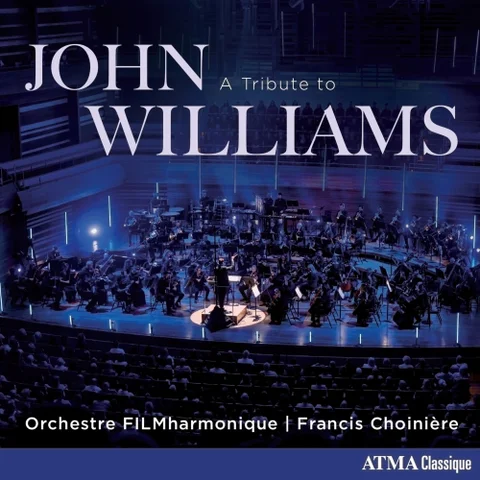
I will never say no to new recordings of John Williams’ excellent music. Whether it is concert music (the composer has written magnificent concertos for practically every instrument in an orchestra), or, of course, from his vast catalogue of film music.
I won’t turn my nose up at the meticulous quality of Francis Choinière’s interpretations as the conductor of the FILMharmonique either. Take, for example, in the theme of Jurassic Park, the heartfelt crescendos, not forced, and the subtle nuances of strings, full of tenderness, the shorter pauses than usual in the brass motifs in the first part of the piece that intelligently lighten the message, in short, very beautiful ideas put forward by a conductor who understands his subject very well. Then those fine violin lines in the Harry Potter theme (and the bass trombone adding an amazing pedal!), or Schindler’s List played with sensitivity by the solo violin, and so on for the rest of the program.
There is therefore nothing really to lament in this recording, except the program itself. All these themes, all these melodies, we have heard them time and time again. Especially if we are even slightly in love with film music. Yet, in each of these elaborate soundtracks, there are exceptional orchestral gems that remain far too confidential compared to the main themes, and which deserve much greater visibility.
Let’s take Indiana Jones. The famous march is always fun, but if we dug a little deeper, we could suggest the Scherzo for Motorcycle and Orchestra from the 3rd installment, The Last Crusade, a small masterpiece of less than three minutes of exciting orchestration, like a miniature concerto for orchestra that Williams enhances with an irrepressible pulse. Williams is probably the composer who knows best how to make a symphonic orchestra bounce, film composer or classical composer alike, without resorting to the methods of American Minimalism. In the same film, Escape From Venice is another example of swirling writing in which no desk has the right to rest for a moment.
On the Jaws side, do you know the piece Out to Sea/The Shark Cage Fugue? Trust me, you should. What other composer would dare to propose an authentic and spectacular fugue, in the rules of the art, to accompany a terrifying scene where we never see the monster in question? It is simply fabulous, and a thrilling piece. And then, in Star Wars, well, it would take another three full pages to list the gems. A few, off the top of my head: in Episode IV, the iconic Binary Sunset, the wild The Land of the Sand People, and the epic The Last Battle; in Episode V, The Battle in the Snow with its soaring tubas, crowned with elegant roughness, the exciting Asteroid Field, the Ravelian City in the Clouds, or even Yoda and the Force; then in Episode VI, Into the Trap, The Forest Battle, or the darkly hymnic The Emperor. I don’t even mention the other six episodes, written later, as we know.
I could also continue with less spectacular films, like Munich, Angela’s Ashes, Dracula, The Fury, The Witches of Eastwick, Born on the Fourth of July, Hook, JFK, Sleepers, Catch Me if You Can, and so on, for which he wrote wonders.
In short, A Tribute to John Williams is well played, well recorded (indeed, hats off to the sound engineer) without a doubt. But since film music is no longer as snubbed as it was 20 or 30 years ago, please offer us new perspectives. There are plenty of them.
A few Williams gems (enjoy):