Additional Information
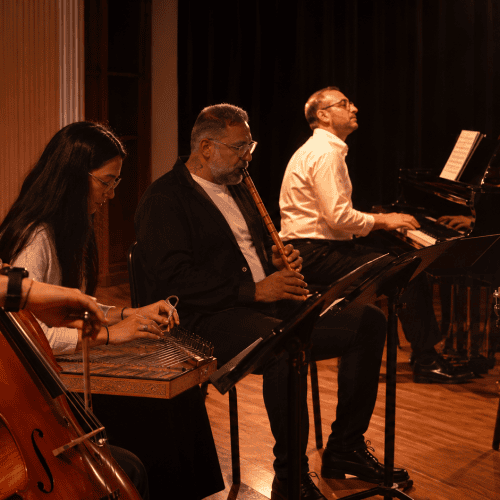
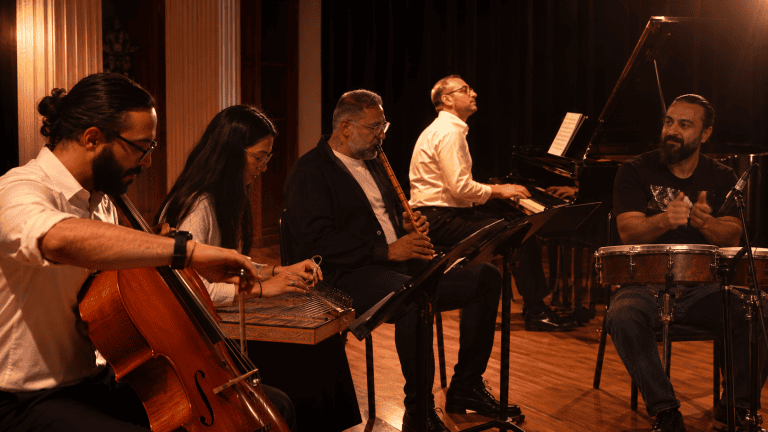
On Sunday, November 1st, the Montreal’s Festival du Monde Arabe presents a crossover between Arab and Western music. The show MaqaMorphose (a combination of maqam, the name given to Arabic musical modes, and metamorphosis) will offer a reinterpretation of the songs of Mohammed Abdelwahab (1902-1991), who shaped and defined the style of classical song in the Arab world. That said, the concert will be entirely instrumental and supported by arrangements in a mixed chamber format (Arab and European classical). An original quintet will bring to life the various pieces of Abdelwahab: a piano, a cello, a qanun (plucked string instrument), a ney (traditional reed flute), and percussion. I met the duo behind this project, Chaima Gaddour (qanun) and Samih Souissi (cello).
PanM360: Hello. Tell me about the two of you, quickly…
Chaima Gaddour: I am a qanun player. I have been living here in Montreal for three years now and I am a music teacher. I am also pursuing a PhD in music at UQAM. At the same time, I conduct the Arab Orchestra of Montreal.
Samih Souissi: I am a cellist with a classical training, and I also hold a diploma in Arabic music. I met Chaima while doing concerts in Montreal and touring all over the world. I mainly live in Paris, but I often come to Montreal.
PanM360: First and foremost, you form a duo together called Convergence. A qanun/cello duo. How did this partnership come about?
Chaima Gaddour: When I met Samih and when we toured together, it turned out that personally and artistically, we have a lot in common. That’s why our duo is called Convergence. It’s because we found that our two instrumental universes complement each other well. The qanun is a rather high-pitched instrument with plucked strings, while the cello is deeper, played with bowed strings that create connected and long sounds. We thought we needed to create something unique to us, very open. Convergence was born like that.
Samih Souissi: Yes. We put all our influences into it, from classical music to Latin music, Irish music, Japanese music, who knows, and we converged all that towards Eastern, Arabic music. That’s the Convergence duo.
PanM360 : And now, MaqaMorphose is something else…
Samih Souissi : Yes, with MaqaMorphose, we are changing the paradigm. First of all, it is a quintet. Then, the source is reversed, meaning we start from Arabic music, rather than travelling towards it from other music. We wish to highlight the entire melodic and harmonic richness of this repertoire. We therefore make arrangements of great classics of Arabic song, written for voice and often quite large orchestra, and we bring them down to a European chamber format, but with the qanun and the ney.
Chaima Gaddour: We are also keen to shed light on instrumental music. It is not, let’s say, as popular in Arab culture, which greatly appreciates singing and lyrics. With this project, it’s a way to make strictly instrumental music appreciated by having melodic markers that will capture the audience’s attention.
Samih Souissi: And then we take the opportunity to have fun with the combinations and timbral possibilities. There are qanun/piano duos, cello/ney, qanun/ney, piano/cello/percussions, etc.
PanM360: Tell me about the repertoire. These are not your compositions, but rather arrangements of famous songs by one of the greatest artists of the Arab world in the 20th century, Mohammed Abdelwahab.
Chaima Gaddour: Absolutely. He is a composer who revolutionised Arabic music because he is someone who travelled and blended various styles.
Samih Souissi: He is someone who has managed to evolve Arabic music from within. He did not distort it. He didn’t impose a European classical approach on Eastern music, even though he was sometimes inspired by Beethoven, Bizet, etc. He brought his own sensitivity to this musical tradition. He did not abandon the fundamentals of maqam, melody, etc. He was also a genius of melody.
Chaima Gaddour: There are some of his songs, we listen to them once and we repeat the melody. These are the things that interest us. With all the humility in the world, we try to draw some inspiration from what he has done and offer it in our own way in a small group.
PanM360: So, are all these songs of his arranged for your ensemble?
Chaima Gaddour: A lot, but all. He also composed film music and instrumental pieces, which he called instrumental symphonies. He also wrote songs not for himself, but for great Arab divas, like Oum Kalthoum.
Samih Souissi: We built the concert around a number of medleys. For example, at the end of the concert, (“spoiler alert”), there will be a long medley of songs written for Oum Kalthoum. It showcases the richness of the melodic and rhythmic aspects.
We somewhat strip these songs of their lyrics. We want to highlight the beauty of the melody that carries them. Around that, there will be improvisations. All the instruments on stage, they will improvise. The improvisations will help create connections between the songs or introduce songs with improvisations.
Chaima Gaddour: Especially since improvisations, generally in Arabic music, they go around the maqam. Then it becomes a fundamental cornerstone of Arabic music.
Samih Souissi: And we especially don’t want to redo what has already been done. There are pieces that have been performed by orchestras. But we will take, let’s say, the essence of these pieces and highlight their melody, enriching them with counter-melodies. Because here, we are more interested in the composer than in the singer or the instrumentalist (Abdelwahab).
PanM360: We can certainly anticipate that many spectators will sing along to the melodies, because these songs, we repeat, are very, very famous in the Arab world.
Samih Souissi: Exactly, what’s great about this concept is that it targets both people who know the repertoire and those who don’t. People who come to discover will also be able to grasp the subtlety a bit hidden behind the song or the words.
PanM360: And then, you do all this by mixing instruments from very different traditions.
Chaima Gaddour: Yes. The piano, for example, brings a rhythmic dimension and a harmonic dimension.
Samih Souissi: But for the harmonic dimension, when there are microtonalities, let’s say, we will change the chords so that we don’t touch those notes. It creates tensions, which then lead to resolutions, etc. At the same time, the piano will find itself in certain melodies where it will be the singer. It’s the MaqaMorphosis!
PanM360: Are all the musicians based in Montreal?
Chaima Gaddour: Everyone except him… (lol)
Samih Souissi: Sorry… 🙂
PanM360: What impact do you hope this show will have on the audience?
Samih Souissi: I would say two things. First, discovering this music, and this composer who is emblematic of Arabic music. There is a before Mohamed Abdelwahab and an after Mohamed Abdelwahab. He brought about an artistic revolution. The second thing is to give more value to Arabic instrumental chamber music. In classical music (European), we have the reflex to go listen to a chamber orchestra, to go listen to a soloist. But for Arabic music, it’s not as much the case.
PanM360: Are these songs well-known among the new generation?
Chaima Gaddour: For my generation, it’s not obvious, no… But generally, when you are at the conservatory and your parents listen to this music, and you play an Arabic instrument, you will inevitably go through Mohamed Abdelwahab. Otherwise, you recognise songs, like the one that is usually sung on Mother’s Day. At that moment, we all listen to Abdelwahab!
Samih Souissi: Spoiler: it will be at the concert!
MaqaMorphose:
Chaima Gaddour, qanun
Samih Souissi, cello
Arden Arapyan, piano
Mohsen Achour, percussion
Aymen Trabelsi, ney