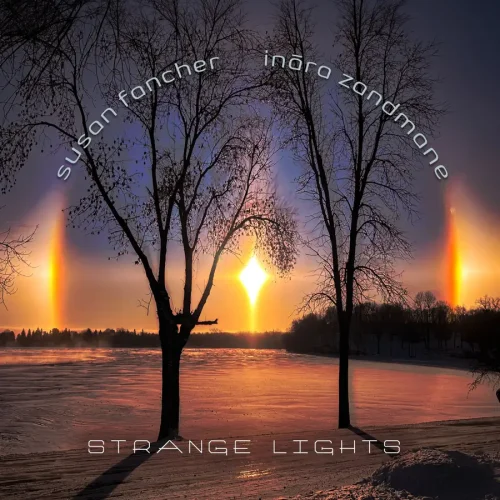
Neuma brings us a very beautiful and accessible contemporary music proposal for saxophone and piano. The tone and color are set from the very first measures of the 1st movement of Strange Lights, by Harriet Steinke (born in 1994). A soft, slightly veiled light emanates from the post-minimalist music of Steinke, an American composer based in Detroit. As announced in the brief program notes, Strange Lights aims to explore the sonic qualities of the saxophone, in symbolic relation to those of light: warmth and brilliance, intertwined. It is largely successful, and one quickly understands that the choice of saxophone was ideal for this marriage of contrasting but complementary timbres and colors. Moreover, the piece is beautifully lyrical and rhythmically pulsating, without nervousness, especially in the second movement. Susan Fancher, a leading performer I was not yet familiar with, rises to the challenge and deploys a magnificent velvety sound, pleasantly metallic in the high notes, in order to illuminate the entire discourse with an advantageous light.
The Sonata by Mark Engebretson (born in 1964) opens a door to a different sound world. The first movement, In the Pocket, launches into a feverish and urgent activity that somewhat resembles the music of Michael Gordon or the Piano Circus ensemble. A kind of repetitive Minimalism with a touch of sarcasm compared to that of colleagues like Philip Glass or Steve Reich. The second movement, I look out on the day, slows the pace, with a reflective melody over punctuated piano chords. The atmosphere is introspective and calm. The Directions concludes this Sonata with a renewed, fluttering energy and harmonies more chromatic than before, although the general feeling of optimism remains intact. All of this leads to a dense, lush, but exciting conclusion.
The last composition on the program, New Stories by Dorothy Chang (born in 1970), stimulates our musicophile senses with four characterful movements, which eclectically (but with solid coherence) draw from a multitude of memories that have influenced the young artist and consolidated her identity as a second-generation American of Chinese descent. Through a tight harmonic pen, which favors a somewhat demanding modernist chromaticism, entirely tonal, Chang distills elements of 80s pop and Chinese folk songs as well as Bach, Brahms or Stravinsky. Michael Gordon’s brand of minimalism reappears at times (the second movement, A Tall Tale Told), but in a more grating posture. I also hear a bit of Messiaen, the one from the Abyss of the Birds, in the slow alto saxophone soliloquy in the third movement, Reflection, which is very inspired. Chang ends her quadrilogy with Folksong, whose Chinese roots are difficult to perceive for ears not well versed in the matter. We are nevertheless guided toward a somewhat austere but passionate finale.