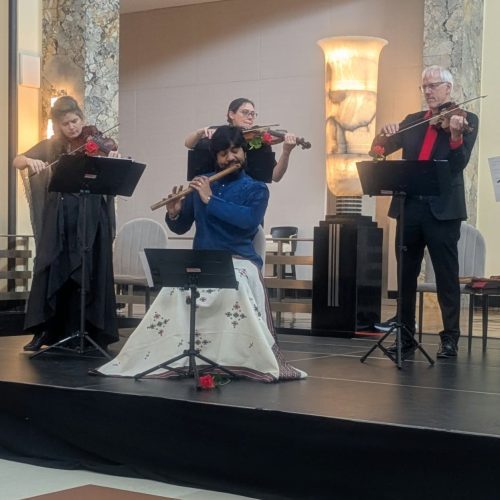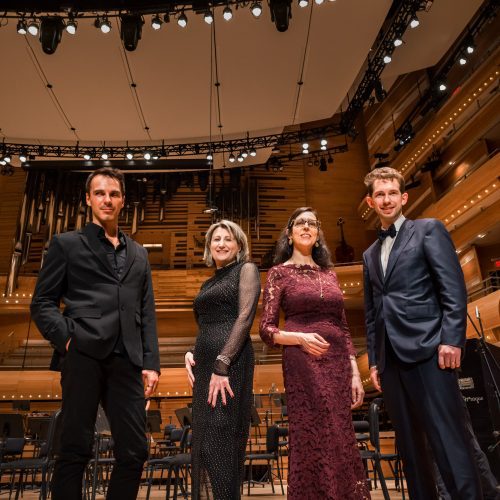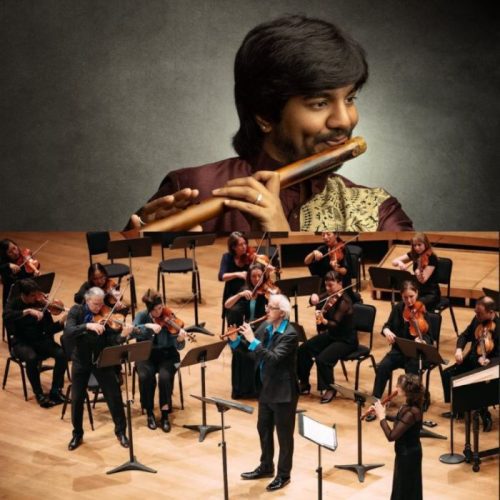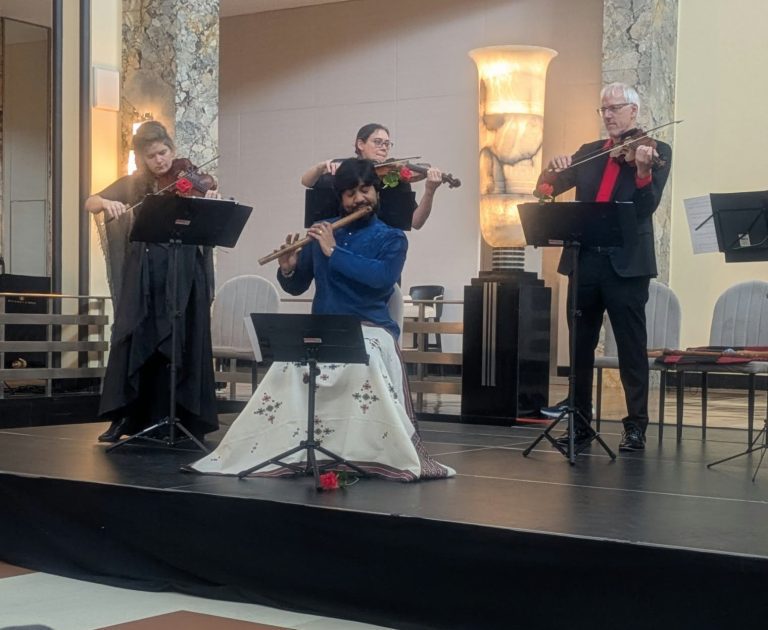
The Caprice ensemble offered an unusual meeting between Carnatic music (from South India, represented by the excellent flautist J.A. Jayant) and Baroque (European) during a rather pleasant concert on the 9th floor of the Eaton Centre in Montreal. If the concerts are usually scheduled at 5 p.m., it was at noon that it was held, exceptionally. I don’t know if it was the time itself, but the attendance result was positive, for a proposal that was quite niche after all. Successful initiative, therefore, in terms of attendance, and, I am happy to say, also in purely artistic terms. It was not a total fusion between the two aesthetics, far from it. Let’s rather call it a meeting and a dialogue, in which each protagonist often expressed themselves in their own musical language.
It is the transitions between the pieces, Indian and Baroque, as well as the judicious choice of the program, that managed to create a beautiful impression of symbiosis for the entirety of the hour and a few of the concert.
The concert was launched with an improvisation on the bansuri flute, carried by the subtle arabesques of Jayant, a flautist renowned for his timbral quality and technical ease. An exoticism (from a Western point of view), which led to a striking contrast, when the Caprice ensemble began a kind of variation in prelude to the launch of the hit of baroque hits: the famous Pachelbel’s Canon. Fortunately, there was no routine in Caprice’s performance. A colourful reading of ornamental details and a lively rhythmic dynamic made it quite refreshing. Jayant returned with a classical Indian piece (Jagadodharana by Purandara Dasa, a composer who worked during the European Renaissance), supported by the traditional drone associated with this music, but here provided by the Montreal orchestra. Caprice continued with Bach’s Air on the G String, and the rest of the hour unfolded somewhat like that, but with transitions between the two traditions making quite a bit of sense all the time, whether on a rhythmic, harmonic, or simply atmospheric level.
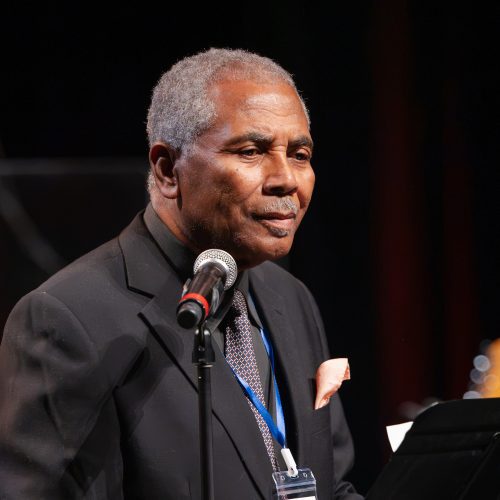
I also highlight the very beautiful contribution of the bass William Kraushaar, who gave us some very beautiful moments of vocal grace in Purcell (Wondrous Machine and The Cold Song), Handel (O ruddier than the cherry), and especially Monteverdi (Si dolce è’l tormento), one of the most beautiful song melodies, across all styles and eras. His deep timbre, with a dark and captivating purple hue, gave me some chills. Only in The Cold Song did I perceive moments where the artist omitted certain repetitions (symbolising the shivering cold) or phrase endings. It is indeed a piece that is difficult to sustain mechanically. But it’s really not much to complain about, in the end. In any case, he recovered very well in the next piece, and finale, signed by Handel. A whirlwind piece of intense love, executed with precise and captivating technique for the listening ears.
The director of Caprice, Matthias Maute, said that this concert served as a territory to explore and build a music of the future, where the world’s traditions would speak to each other on equal terms, while inspiring stimulating innovations.
READ THE INTERVIEW I CONDUCTED WITH HIM ABOUT THIS CONCERT
In this sense, the essay proposed by Caprice and his guest is quite successful, and makes one want to have more in the future.