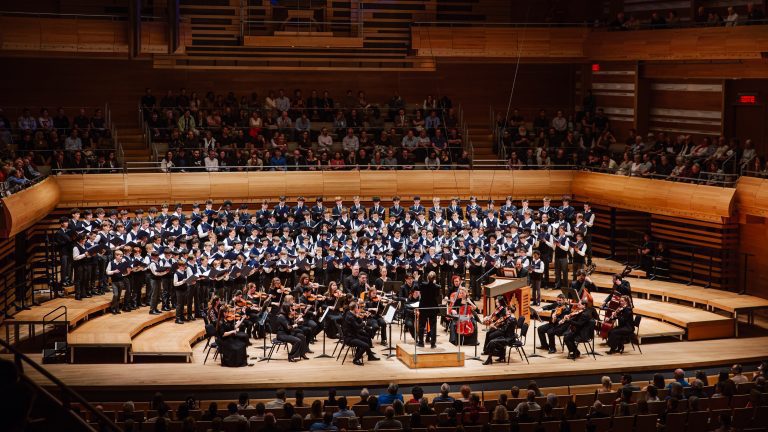
The Viva Vivaldi concert last Saturday, May 30, not only marked the end of the season for the Orchestre classique de Montréal (OCM) under the direction of Andrei Feher, but also the 70th anniversary of the Petits chanteurs du Mont-Royal. For the occasion, two great classics by Vivaldi were presented, a composer whose popularity is not in doubt: The Four Seasons, to highlight the qualities of the orchestra and especially its first violin, Mark Djokic. Then the Gloria RV 589, in a fully choral version, conducted rather briskly by the approximately 150 choristers present.
As an introduction to the concert, the Orchestra played a composition by Tom Lachance, as part of a partnership with the Schulich School of Music at McGill University, we are told. The work, which lasts about ten minutes, is called Concerto for Two Violins in G Major, and is a copy of the architecture of a baroque concerto of the type written by Vivaldi. Three movements marked fast-slow-fast, an exchange of dialogue between the soloists (Mark Djokic and Marianne di Tomaso) and the ensemble, and effects of marked contrasts. Here, the interplay is between tonal harmonies and modernist dissonances, in a back-and-forth that is not surprising, given that we have already heard this kind of process several times elsewhere. That said, Tom Lachance was able to exploit the principle skilfully enough, despite its predictability, to maintain interest.
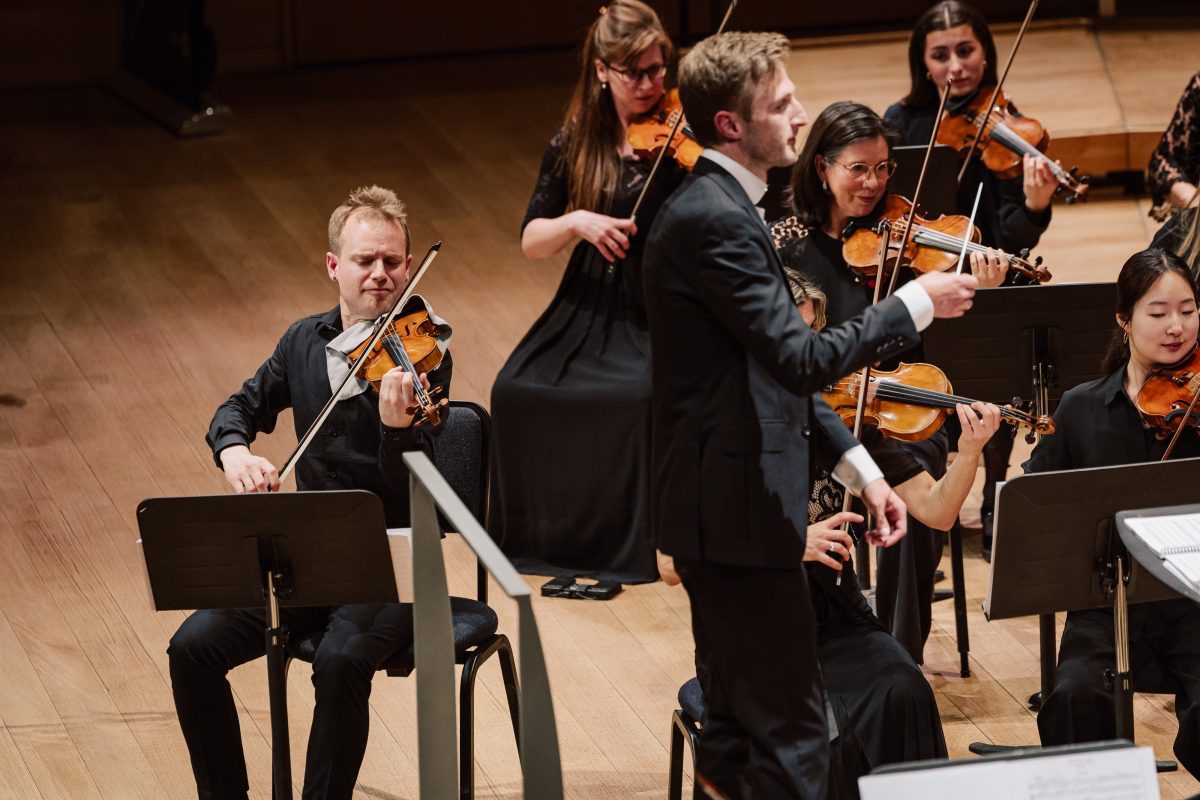
The Four Seasons followed, with Mark Djokic, first chair of the OCM, in very good form. The one who had injured his leg the day before moved slowly to his position, but once settled, he delivered a lively and articulate reading of the numerous virtuosic lines of the score. Without being devoid of a few hiccups, Mr. Djokic’s mastery is solid and confident. We will highlight the beautiful performance of the OCM under the baton of Andrei Feher, convincingly intense. He led his ensemble with incisive attacks and fairly short final note holds, informed by the aesthetics of historical performance, while allowing the modern instruments of the Orchestra to fully resonate. A roundness of sound, therefore, which beautifully married with the surgical practice of rhythms. The OCM offered a fusion of authenticist practice and a certain modern opulence that I found to work very well. Moreover, Mark Djokic also played this game by practicing the urgent style of historical baroque in the fast movements, but sometimes adding a more modern lyricism in certain melodic lines of the slow movements. A beautiful balance that satisfied the music lover’s pleasure of your devoted chronicler.
The second part welcomed with great pomp the approximately 150 young choristers of the Petits chanteurs. The Maison symphonique was filled with a majority of the boys’ parents and friends, and it was noticeable. Maybe a little too much, especially because of the applause between each movement at the beginning of the Gloria! A bit annoying, even though at one point, conductor Andrew Grey (director of the Petits chanteurs), and not Andrei Feher, who had lent him his baton for the occasion, radically sped up the transitions between the movements, not giving the applause sprinters time to execute.
First, let’s remember that the Gloria RV 589 is interspersed with a few soprano solos, which had to be replaced here by the section of young boys in the choir. As for the tutti choruses, you will quickly understand that with 150 voices, the clarity and precision of the polyphonic lines, and especially the virtuosic counterpoints of several movements, were not easy to manage well. All in all, Andrew Grey managed to create some moments that left a strong impression. Apart from a few muddy passages (the Gratias agimus tibi, 4th movement among others), which were difficult to distinguish in such a mass, the different voices were clearly perceptible, and the required agility was quite satisfactory. So let’s tip our hats to the young singers and especially to their conductor.
I also wish to strongly highlight the excellence of the solos offered by the principal chairs of the OCM. The famous trumpet solo in the introductory movement was nothing short of exquisite. Also, superb melodic lines were offered by the oboe and cello throughout the piece.
As an encore, Andrei Feher delighted himself by taking up the baton again and conducting the mass of musicians in Vivaldi’s Laudate Dominum RV 606.
A successful evening for the OCM, which we hope will fill its subscription book, as well as for the sustainability of the Petits Chanteurs du Mont-Royal.