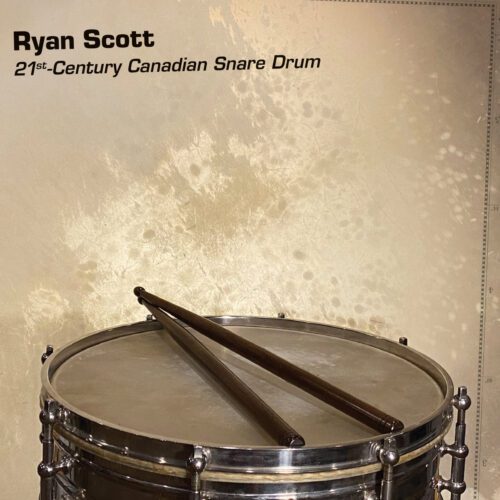
In avant-garde contemporary music, anything is possible. But a (double!) album of compositions for solo snare drum? Even that, I hadn’t seen coming. I tell myself that if some people grind their teeth at the idea of a solo harpsichord recital, what will they do in front of this instrument limited in timbral possibilities? And what about its melodic and harmonic potential? Non-existent, of course.
Well, to that I would reply that, if you have a minimum of curiosity, you will go lend an ear or two to this 21st-Century Canadian Snare Drum by Toronto’s Ryan Scott. You might very well come back surprised, amazed, and certainly more respectful of the musicality of this instrument.
Snare drum and friends
Let’s first say that the aforementioned snare drum is not alone 100% of the time. Ryan Scott sometimes adds a bass drum, cymbals, or other percussive objects to it. Some electronic tweaks are also occasionally added by the various composers. Several pieces are therefore more abundant in terms of textures, although the vast majority of the sounds heard do indeed come from the modest instrument.
It is therefore quite an impressive feat to have managed to commission so many works (fourteen!) for the snare drum from so many contemporary composers. And not just any composers: Andrew Staniland, Michael Oesterle, Vincent Ho, Nicole Lizée, Bryan Current, Monica Pearce, Emilie Cecilia LeBel, and many more.
Surprising diversity
Against all odds (prejudices, to be honest), Ryan Scott, through these prestigious commissions, performs a sort of miracle by showcasing a very diverse panorama of music featuring his instrument. Rhythms are, of course, at the center of the various expressions, but so is the exploration of textures thanks to advanced techniques (rubs, strikes on the edges, the sides, the use of different types of sticks, etc.).
Several pieces focus on purely musical play and the creation of interesting, even intriguing, soundscapes. The best success in this regard is ANTIGRAVITYDRUM by Andrew Staniland, my favourite in the program. The composer creates an engaging rhythmic framework, without banality, to which he adds bouncy and beautifully coloured electronic grains. The result is an extremely delightful piece, which I wanted to listen to many times. I think it will be the same for you as well.
Also noteworthy are titles like Skinscape IV by Bekah Simms, which explores the various ways to emphasise that the surface of a snare drum is a skin. It can be rubbed, scratched, struck, etc. Or, the rhythmic maze of Michael Oesterle in Hush, the fascinating nocturnal-urban, electroacoustic deliriums of Nicole Lizée in The Far Night, or the fragile construction, all in gradually densified pointillism, of Emilie Cecilia LeBel in Heirloom.
Here, undoubtedly, is an astonishing album that will transform your perception of an instrument that seems as thankless as the snare drum, with proposals that are as original as they are varied.
Hats off.