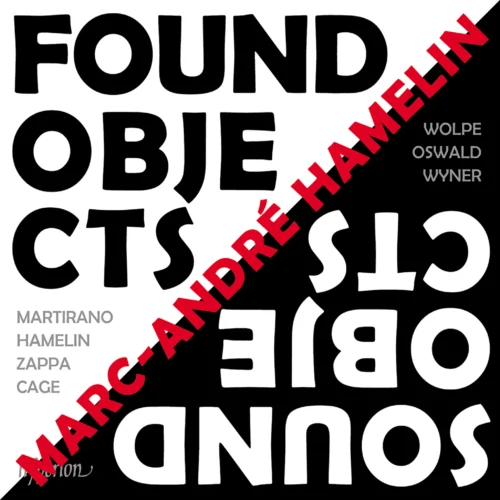
Trust pianist Marc-André Hamelin to transform a program of demanding atonal pieces into an exciting, energetic, and beautiful journey. These “found objects” are so many hidden treasures that the artist magnifies with his perfect and spectacular technique and his exceptional musicality.
“Ruth is Sleeping” is the first piece Frank Zappa composed for the synclavier. A version for two pianos has already been recorded on the remarkable album, Zappa’s last, The Yellow Shark with the Ensemble Modern. But a solo version also exists, and Marc-André Hamelin could not resist the urge to tackle it, brushing aside (between a few swirling notes) the formidable difficulty of the exercise. Mission accomplished, because “Ruth is Sleeping” seems to float in the air and radiate in space.
“Stuck on Stella” is one of the few piano pieces by the intriguing Salvatore Martinaro, a very surprising composer for his unconventional scores. Although conventionally crafted, “Stuck on Stella” is an atonal score that seems to dance, sing, and want to seduce. With beautiful passages that are sometimes impressionistic, or elsewhere more expressionistic but very communicative, it succeeds in offering a kind of listening experience that atonal music cannot quite easily achieve. Hamelin is of course largely responsible for giving it all the desired breath and coloristic abundance.
John Oswald’s “Tip” is an exercise that composers and listeners like to confront from time to time: that of the potpourri (what a horrible word). Here, it is a bit the result of a challenge that the Canadian would have taken up, namely that of inserting as many quotes from well-known classical pieces (and some from the popular repertoire) into a coherent nine-minute work. Challenge met with flying colours, especially as Oswald manages to construct a comprehensible narrative arc by linking together airs thanks to their natural resonances or thematic proximity. The snippets of melodies are rarely more than about two seconds long, and their juxtaposition creates an overall impression approaching atonal music. It is very well constructed and it rises above a simple exercise in style. Will you be able to identify them all?
The Perilous Night is a suite in six short movements for prepared piano, by John Cage. It is one of the first scores for this type of instrument by the composer and it was written for the choreographer Syvilla Fort. Cage has a lot of fun creating unprecedented sounds with his setup, an astonishing fusion between the colours of a percussion ensemble and the timbral resonance of the piano. Despite the fact that Cage was going through difficult personal times at the time of writing, the playful side of the sounds expressed here easily takes over, making the experience unfailingly enjoyable.
Stefan Wolpe’s Passacaglia is of another order. It’s a substantial piece of over 13 minutes based on a simple succession of increasingly large intervals, plus eleven other series derived from it. Although it all sounds dryly theoretical, Wolpe injects a dose of energy and a sense of construction (with a very exciting hammered finale) that makes it all digestible. Hamelin is in resplendent form and electrifies the score with his impeccable virtuosity and breathtaking power.
The American of Canadian origin Yehudi Wyner is a nonagenarian still kicking with creative verve. At 95 (last year), his Duo Concertante for viola and piano was premiered by Kim Kashkashian and Robert Levin! If Refrain dates from 2012, it is nevertheless a composition by an 83-year-old. No sign of wear, even less of a decrease in expressive energy. That said, the energy in question generally remains in subtle hues and in a peaceful and very elegant blossoming. It is built with a lot of refinement and Marc-André Hamelin describes this piece as an “oasis of pure eloquence.” That’s true.
Hamelin finishes unpacking his bag of surprises with his own composition, Hexensabbat. Not atonal but rather bathed in tight chromatic harmonies, this “witches’ sabbath” reveals a frenetic savagery interspersed with calmer moments to end in a hysterical and ecstatic finale, perfectly appropriate. The pianist puts all the muscle he is capable of, but also his immense finesse. It will be difficult to do better, but we ardently wish that the best pianists would try their hand at it as often as possible.
A pianistic tour de force that only Marc-André Hamelin knows how to achieve.