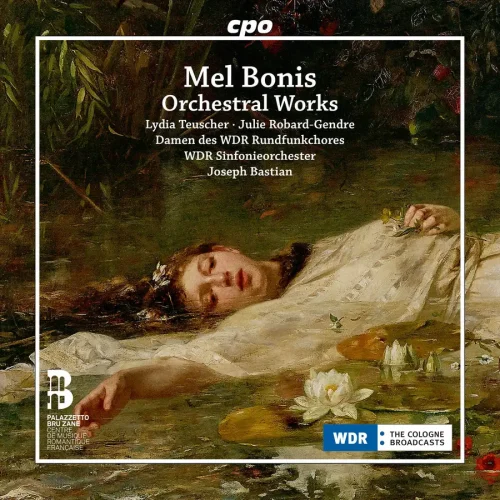
Mel Bonis (1858-1937) is one of those composers whose talent and genius are being rediscovered in the 21st century, alongside Florence Price (1887-1953), Charlotte Sohy (1887-1955), Ethel Smyth (1858-1944), Dora Pejačević (1885-1923), Amy Beach (1867-1944), and many others. The Frenchwoman Bonis received a solid education with César Franck and Charles Koechlin. Her musical style can be described as post-Romantic with touches of Impressionism, but with an expressive perspective that sometimes recalls Fauré.
What stands out immediately is a great mastery of orchestration. Bonis is a gifted colourist. She draws lines and phrases that are often memorable for the woodwinds (in particular), which she knows how to magnify the evocative power of.
Legendary Women
The Dream of Cleopatra, Ophelia, and Salome form an orchestral triptych dedicated to three famous women, real or fictional. While the famous queen of Egypt receives an opulent treatment, radiating a romantic Orientalism deeply rooted in 19th-century fantasies, Shakespeare’s ill-fated heroine (Ophelia) is bathed in a Debussy-esque setting of the most beautiful effect. The dark strings (violas and cellos) undulate over the tremors of harps and a few delicate arabesques of flutes. It’s exquisite. The sultry Salome (a biblical character who incited King Herod to have John the Baptist beheaded) is portrayed by a richly endowed ensemble, in which thematic aggregates are assembled to create more defined themes, and which are in turn carried and embodied in changing atmospheres, with oriental colours, once again. In the background, a sensual energy, carried by dancing pulses, ultimately resurrects a character as enchanting as she is fascinating.
Under other opus numbers, there are six other compositions by Bonis in honour of legendary women, which are not included in this recording (they exist in piano score as they have not all been orchestrated): Mélisande, Viviane, Phœbé, Omphale, Écho, and Desdémone). We really, really want to hear all of them.
Exoticism
The Oriental Suite, Op. 48, also bathes in warm and Mediterranean colours in two attractive movements: a swaying and beautifully melodic Prelude under the heat of a midday sun, and a more lively Almée Dance that recalls the expressive pages of the same genre by certain Russian composers (Rimsky-Korsakov, Taneyev). Irresistible.
We remain in the realm of exoticism, this time inspired by Spain with the grand waltz Los Gitanos. One is immediately struck by a certain initial resemblance to the famous Espana by Chabrier or Rimsky’s Capriccio Espagnol. There is also something very French in this idealisation of a Spanish waltz that one would rather hear in a Parisian hall. That said, it’s very well done.
The logic of the construction of this program is impeccable with the following work: a Suite in the form of waltzes that includes three well-defined movements. The first, medium tempo (Ballabile), is followed by a slow episode, but not too slow (Interlude and slow waltz) gently expressive. Finally, an elegant and light final movement named Scherzo-waltz completes the short triptych in a Tchaikovskian ballet spirit.
Pearls
Several short genre pieces follow: a bouncy Bourrée, a delicate and charming Pavane that could be the little sister of Fauré’s, a melancholic Sarabande, and a slow and modest Sacred Dance, without any outpourings.
The last three pieces are gems that showcase Mel Bonis’s talent for blending voice and orchestra. The Cat on the Roof op.93 hops and sways smoothly like the adorable feline suggested, while Christmas of the Virgin Mary is of admirable tenderness and allows us to imagine the scene with emotion. Soprano Lydia Teuscher is perfectly alluring in the role of the cat, but mezzo-soprano Julie Robard-Gendre appears a bit heavy in the garb of Mary, in front of a subtle and intimate orchestra.
Le Ruisseau op.21 (The Stream) calls for a female choir to evoke the natural and relatively tranquil flow of a dreamy watercourse, traversing an almost enchanted forest.
The WDR Symphony Orchestra Cologne, under the direction of Joseph Bastian, plays with great finesse and coloristic refinement, an essential prerequisite in this delightful music.