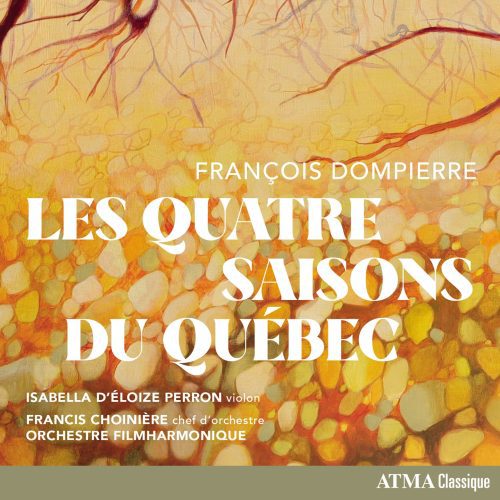
François Dompierre is on the verge of giving Quebec its version of almost every formal canon of great classical music. Recently, a set of Preludes, a Concerto grosso (on the theme of tango), a Cello Concerto, a Requiem (commissioned by Francis Choinière and his FILMharmonique). Further back in the past, a violin concerto, another for piano, etc.
A set of Four seasons was apparently missing from the lineup. We are well acquainted with those of Vivaldi of course, to which many other composers have responded over time: Boismortier in France, Haydn in Austria, Raff in Germany/Switzerland, Glazunov and Tchaikovsky in Russia, Noskowski in Poland, Piazzolla in Argentina, Glass in the United States, and many more.
But Quebec deserved its own, and, as it was almost to be expected given the composer’s expressive and lyrical nature lends itself so easily to it, François Dompierre is the one who got to do it.
Voici donc un ensemble de Quatre saisons inspirées de la nature québécoise, commandées et créées par Francis Choinière et la section de cordes de son orchestre. S’ajoute l’excellente violoniste Isabella d’Éloize Perron, qui confirme le choix de Dompierre de rester attaché au format vivaldien, celui d’un ensemble pour soliste et orchestre à cordes.
Si Vivaldi avait opté pour un concerto en trois mouvements pour chacune des saisons (donc quatre concertos pour 12 mouvements au total), Dompierre demeure plus modeste avec le choix d’un format en quatre mouvements, illustrant chacun une saison. Un seul grand concerto donc, où chaque partie est bien sûr associée soit au printemps, à l’été, à l’automne ou à l’hiver, mais en plus exprimée à travers une danse traditionnelle. Les titres sont en ce sens révélateurs (et fort attrayants) : Rigaudon de printemps; Complainte d’été; Valse et contredanse d’automne; et Quadrille d’hiver.
Le Rigaudon de Printemps a bonne allure, comme un cheval au trot, passant en milieu de mouvement dans un décor pacifié et chaleureux telle une première belle et chaude journée de Mai. L’Été et sa Complainte sont portés par une mélodie touchante et fortement mélancolique, alors que l’Automne redonne un peu de pep dans les souliers avec une valse légèrement swingante, qui semble parfois hésiter sur ses assises. Des pizzicatos et des poussées de l’orchestre semblent imiter le temps incertain de cette saison, ou les feuilles qui tergiversent entre s’accrocher encore un peu ou se laisser tomber doucement au sol. À mi parcours, une contredanse plus animée, de style irlandais, excite un peu le déroulement avant que la dernière partie du morceau soit le théâtre d’échanges dynamiques entre les deux thèmes contrastés, qui finissent par se terminer sur une posture incertaine et une évocation finale du deuxième thème se dissipant graduellement.
Le dernier mouvement est un Quadrille joyeux, qui laisse entendre que l’hiver québécois, loin des clichés catastrophiques, est également une saison empreinte de plaisirs, de célébrations et de bonne humeur.
De courtes citations des Saisons de Vivaldi, des clins d’oeil plutôt, parsèment l’oeuvre, ainsi que d’autres brindilles tirées de celles de Piazzolla, disséminées parcimonieusement afin d’allumer quelques étincelles dans l’esprit des musicophiles plus férus.
La soliste, Isabella d’Éloize Perron, rend très bien justice à la musique de son compatriote et aîné, avec la bonne dose de swing dans le rythme et l’articulation, ainsi que le lyrisme souhaité dans les épisodes chantants, toujours importants chez Dompierre. Les cordes du FILMharmonique ne manquent pas de velours, ce qui est très approprié, mais sans alourdir la nécessaire clarté d’une musique qui se veut plus chambriste que réellement symphonique.
Du grand Dompierre, comme on l’aime, c’est-à-dire un classiciste éduqué qui maîtrise comme peu d’autres l’art élégant de la belle et bonne fusion entre la rigueur d’un art sérieux et l’attrait assumé de la séduction populaire.Here is a set of Four Seasons inspired by Quebec’s nature, commissioned and created by Francis Choinière and the string section of his orchestra. The excellent violinist Isabella d’Éloize Perron joins, confirming Dompierre’s choice to stick to the Vivaldian format, that of an ensemble for soloist and string orchestra.
If Vivaldi had opted for a three-movement concerto for each season (thus four concertos for a total of 12 movements), Dompierre remains more modest with the choice of a four-movement format, each illustrating a season. So, just one grand concerto (well, not that long at about 20 minutes), where each part is of course associated with either spring, summer, autumn, or winter, but also expressed through a traditional dance. The titles are in this sense revealing (and quite appealing): Spring Rigaudon; Summer Lament; Autumn Waltz and Contredanse; and Winter Quadrille.
The Rigaudon of Spring has a good pace, like a trotting horse, passing in the middle of the movement in a peaceful and warm setting like the first beautiful and hot day of May. Summer and its Lament are carried by a touching and deeply melancholic melody, while Autumn brings a bit of pep back into the shoes with a slightly swinging waltz, which sometimes seems to hesitate on its footing. Pizzicatos and orchestral pushes seem to imitate the uncertain weather of this season, or the leaves that hesitate between clinging on a little longer or gently falling to the ground. Halfway through, a more lively Irish-style contredance enlivens the progression before the final part of the piece becomes the stage for dynamic exchanges between the two contrasting themes, which ultimately end in an uncertain posture and a final evocation of the second theme gradually dissipating.
The final movement is a joyful Quadrille, which suggests that the Quebec winter, far from catastrophic clichés, is also a season filled with pleasures, celebrations, and good cheer.
Short quotes from Vivaldi’s Seasons, rather winks, are sprinkled throughout the work, as well as other snippets taken from Piazzolla, sparingly scattered to ignite a few sparks in the minds of more ardent music lovers.
The soloist, Isabella d’Éloize Perron, does great justice to the music of her compatriot and elder, with the right dose of swing in the rhythm and articulation, as well as the desired lyricism in the singing episodes, always important in Dompierre’s work. The strings of the FILMharmonique have a good velvety wear, which is very appropriate, but without weighing down the necessary clarity of music that aims to be more chamber-like than truly symphonic.
Some great Dompierre stuff here, like that of other gems he gave us overt time. The composer (now 83) is an educated classicist who, like few others, masters the elegant art of the beautiful and good fusion between the rigor of serious art and the assumed appeal of popular seduction.
The album will be available everywhere August 28
The Four Seasons of Quebec will be touring Quebec and Europe starting in September.