Additional Information
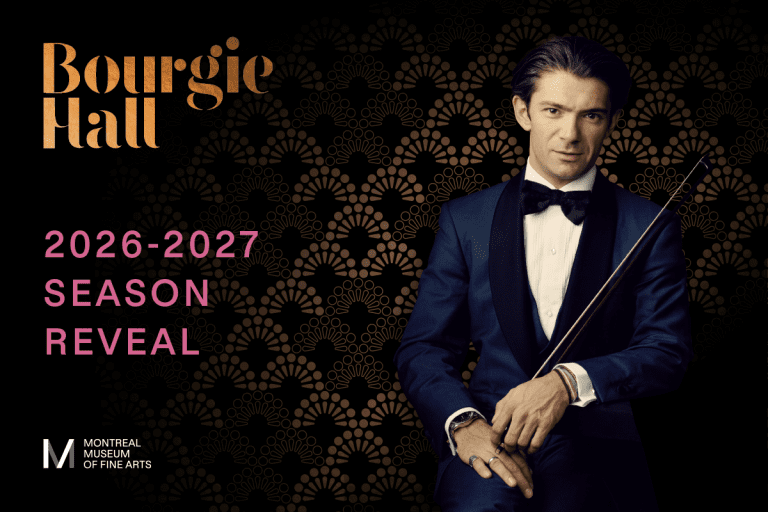
Bourgie Hall has just unveiled the schedule for its 2026-2027 season. As always, a lot of choices for music lovers. “Home” festivals dedicated to Beethoven, Philip Glass, and Pierre Mercure, string quartets galore (Takacs, Goldmund, Juilliard, Kronos), the presence of a star-studded trio (Jean-Yves Thibaudet, Lisa Batiashvili, and Gautier Capuçon) not only once but twice, composer George Benjamin on stage to play his music, partnerships with the FIL (International Literature Festival) and the FTA (Trans Americas Festival), unpublished poems by Gilles Vigneault set to music by Simon Leclerc, Afghan art music, jazz, musical mornings, big names from Quebec and Canada as always, the continuation of the complete Schubert lieder series, and we’ve only just scratched the surface. I spoke with the two masterminds behind the hall’s programming, Caroline Louis (General Director) and Olivier Godin (Artistic Director).
PanM360: Hello to both of you. The 26-27 programming appears to be a good vintage. How to start this discussion? Which concerts would you say represent the greatest ‘’catch’’ as programmers?
Olivier Godin: Each concert is a challenge in its own way. Because there is always a lot at stake. Are people going to come? Is it a project that costs a lot? I would say that the concert of the Thibaudet/Gautier Capuçon/Batiashvili trio is a great success for us. Managing to catch them on tour is not an easy task, because it’s a very, very, very, very important trio. Convincing them to play in a small venue is also a challenge, because elsewhere on tour, they play in 2000-seat venues! I think it’s a great victory.
It must be said that our venue has a great advantage: once artists perform here, they want to come back! This is the case with Víkingur Ólafsson, for example. And the message is circulating in the artistic community.
We are also quite happy to present amazing concerts, such as an Afghan music concert, in our series of music from here and elsewhere. It’s something that isn’t often done, and we’ve never done it. These are calculated risks, but we are proud of them.
I think that every concert has its challenges, its realities, its wonders too.
PanM360: I notice three “home” festivals. Beethoven, Pierre Mercure, and Philip Glass. The latter is, by the way, generally very well appreciated…
Caroline Louis: Glass is one of the big names today. He has indeed been very much in the media this year, perhaps for less fortunate reasons (the cancellation of the premiere of his Symphony No. 15 at the “Trump-Kennedy Center” in opposition to the Trump administration, editor’s note), but we had long wanted to delve into his work. Yes, it’s true that every time we present Philip Glass, there is a lot of interest. We found it interesting to celebrate his birthday, which will take place next year (he will be 90 in 2027, editor’s note), and also to showcase a panorama of his music, the variety of his compositions, particularly for voice, string quartet, and piano.
I want to say that Philip Glass is aware that we are doing this event. It has touched him a lot and we are happy about it. We are particularly welcoming a great voice of today, Anthony Roth Costanzo, a singer who performs all over the world, who recently sang in Paris in Glass’s opera Satyagraha, and who is also very happy to come for the first time to the Bourgie Hall.
Olivier Godin: We have surrounded ourselves beautifully for this festival, like Anthony Roth Costanzo, but also the Kronos Quartet. These are people who have worked very closely with Glass. We wanted to open the festival with an ensemble significant to Glass, the Kronos Quartet, which has played almost all of his music for strings. People who are very, very close to him, and I think it was important for us to highlight this anniversary with experts in the field.
PanM360: A week of Glass, the fans (of which I am one) will be very happy! For Pierre Mercure, it’s three days, in honour of his centenary, which is already excellent news because we don’t hear his music that often…
Olivier Godin: Yes, a great opportunity to discover it, or rediscover it. There will be an opening conference with Claudine Caron, who is a specialist on Pierre Mercure, and Mario Gauthier, who is a researcher.
Then there will be a concert of his instrumental music, followed by a screening at the Museum Cinema. Radio-Canada lent us some archives, because Pierre-Mercure was also a producer there, so archives of the shows he produced in the 50s and 60s.
The NFB also lent us a documentary. And on the third day, we will explore the electro-acoustic side of his production, with the group Theresa Transistor presenting his electro-acoustic works.
PanM360: And then in March 2027, it will be Beethoven month, so to speak…
Olivier Godin: There won’t be only Beethoven in March, but yes, there are several concerts in his honour because he died on March 26, 1827. So it will be exactly 200 years.
Among others, we will have the Goldman and Julliard quartets, and the Wanderer Trio, which is also returning. A lieder recital by Beethoven will be combined with lieder by Schubert, for whom it is the continuation of our complete works.
There will also be the Ninth Symphony for two pianos. We can’t do the Ninth with an orchestra at the Bourgie Hall, of course. So we decided to invite Philippe Cassard and Cédric Pescia, two magnificent pianists, one French and one Swiss, who have the version of Franz Liszt for two pianos of this symphony.
PanM360: Tell me about this new collaboration with the FTA (Festival TransAmériques).
Olivier Godin: Caroline and I have wanted to collaborate with the FTA for a long time.
It’s probably one of the most important dance and theatre festivals in America. What they do is quite exceptional. And we decided to propose a project by an Italian artist, Alessandro Sciarroni, called Un canto, or A song.
These are actor-singers who are on stage. It’s a work staged with music that was written in the 60s, 70s, 80s, and 90s. It’s movement to music. It’s something very meditative, very introspective, and very, very, very beautiful from what I’ve seen of the large excerpts.
Caroline Louis: The goal is to bring together different audiences, to attract lovers of literature, dance, and theatre to the Bourgie Hall.
We are increasingly approaching this kind of crossover. Festivals are also an interesting way to be present at the unifying events of the cultural season in Montreal.
You will see more of it over the next few years with us.
PanM360: There is also a beautiful, recurring collaboration with FIL (Festival international de Littérature). And this year, I notice a project with Gilles Vigneault?
Olivier Godin: Ah yes, that’s something very touching, I must say. It’s a collaboration between composer Simon Leclerc and Gilles Vigneault, who will be 98 in October. We had the idea to launch a parallel project with Schubert’s lieder, that is, to commission a cycle of lieder from composers and poets from here!
Simon Leclerc will set Gilles Vigneault’s poems to music, some of which are unpublished. The commission for the poems is from the International Festival of Literature. It’s Michel Corbeil, our dear colleague, who takes care of that.
And we are ordering the music from Simon Leclerc. It will be performed in October. An extraordinary thing that I personally experienced is that we went to Gilles Vigneault’s place in Saint-Placide last year.
We spent an afternoon in his workshop listening to him recite new poems to us. I never thought I would experience something like that in my life. It’s a moment I will remember for the rest of my existence.
PanM360: And, George Benjamin’s visit? What are the details?
Olivier Godin: That was a stroke of luck we had. It’s another good break. You were talking earlier about the concerts that we are very happy with, this is another one.
We intended to invite Pierre-Laurent Aimard again, who had come, if you remember, in 23-24 for Ligeti’s centenary. While discussing with his agent, we were trying to see which program would be the most interesting to present in 26-27. At one point, she said to me, “Did you know there’s a project to create a work by George Benjamin for four-hand piano with Pierre-Laurent and George at the piano?”
I said no, I didn’t know! And suddenly, the discussion became quite serious. We already had a date for the recital. We simply added George Benjamin. Basically, it’s going to be a recital entirely by Pierre-Laurent Aimard, in which there will be some works by Georges Benjamin, including the premiere of a piece for four-hand piano, and Georges Benjamin will come and play it. He will be there.
After the concert, we will have a talk because since we have both of them, we will sit down and take the time to talk with them about creation. What is it like to write for a composer, to write for a performer in particular like Pierre-Laurent who has known so many major composers, whether it be Boulez, Ligeti, Kurtag, and now George Benjamin.
PanM360: The complete Schubert lieder continues for the third year. An initial assessment?
Caroline Louis: We are quite happy. We can say that attendance is growing. We had many nice attendances this year, exceptional moments with Anne-Sophie Von Otter and Wolfgang Holzmaier in particular. We can feel that there is an interest. We also do education, mediation, conferences, and parallel activities related to Schubert.
Olivier Godin: It’s a great adventure, this series. We try to present lieder, not all the most well-known ones at first, not all the most famous singers either.
We’re trying to balance all of this. This year, we have a year that leads us towards a certain light. There will be Konstantin Krimmel and Christian Immler, two great names in lieder. The latter will be paired with the excellent Francis Perron on piano.
We have had several generations of Schubert interpreters. There was Andrè Schuen, Samuel Hasselhorn last week, and next year, Konstantin Krimmel. These are, I would say, the three proud representatives of lieder in Germany. There is also Mireille Lebel who will come to do a Schubert and Max Reger project, with Jean Marchand and me. Schubert’s lieder, but also his legacy, all the composers who were inspired by him.
There will also be Les Rugissants who will come to perform a kind of Schubertiade. I think it’s important to have that side of Schubert: friendship, community, a whole society around his music because he himself presented his lieder in similar settings. There will be lieder for the heart, but not just Schubert. There will be Schumann, Brahms, and other very beautiful things with Jacqueline Woodley and Patricia White.
PanM360: I noticed that you said “attendance is growing.” Does that mean that the beginnings were sometimes mixed in terms of ticket sales? Can you compare it with the series of Bach’s cantatas?
Caroline Louis: In fact, if we look at the opening of Bach’s cantatas, there were strong moments, particularly with the presence of Kent Nagano and the OSM at the very beginning of the complete works. I’m not surprised, indeed, in the first season, we had slightly more modest venues. And quickly, we also built interest among the clientele, we had to communicate, we had to make the project understood as well. Currently, we are really here, we have a beautiful pool of loyal customers who come back to the different concerts.
Then the project has great visibility internationally as well. There are many artists who want to participate in the complete lieder at the Bourgie Hall.
Olivier Godin: I would perhaps quickly add to that that, in general, we have deliberately decided to go a little against the grain. The vocal recital is something that has been somewhat losing popularity over the past 15, 20, 25 years.
PanM360: Why?
Olivier Godin: I think it’s because it’s something that is static. There is no staging, there is no set design, there are no costumes, there is no lighting. It’s really just a person with a piano, and that’s all there is to it.
These are 25 songs, 25 different stories. You have to take the time to invest in it. I think there are many singers who do less than before because, as a singer, participating in an opera production for a month, a month and a half, two months, is much more rewarding than going to do a recital that requires almost as much preparation.
I would say that here in Montreal, we’re doing well. Some colleagues in Europe tell me, “You do vocal recitals, that much, and it works?” “, they are very surprised. I think we’ve found a direction, a way to do it that works, and the audience is increasingly on board.
PanM360: You have found all sorts of methods to overcome certain initial “difficulties” for the public…
Olivier Godin: First, we said we were going to do something at a very high level. With high-quality performers. Then we offer surtitles, just like at the opera. Because the lieder are in German. This allows everyone to understand the beauty of these texts. People are not caught up in a paper program reading and finding the voices that are rendered. They have it live in front of them above the singer. It’s important to say that. Sometimes we even give German lessons at concerts with the Goethe-Institut. We explain the lessons of the words, the origin of the words that will be heard in the program.
And there are the very beautiful lectures by Jean Portugais, which illuminate the listening experience.
PanM360: We could go on for a long time. There’s jazz making a comeback (Baptiste Trottignon!), Charles Richard-Hamelin and Andrew Wan, the Orchestre de l’Agora, etc., etc…
Caroline Louis: Indeed, it is necessary to carefully review the program that is now available. And moreover, the future is promising because we have surpassed the pre-pandemic attendance levels on average. It’s a very good sign and we are very happy about it.
Olivier Godin: We have the best job in the world!