Additional Information
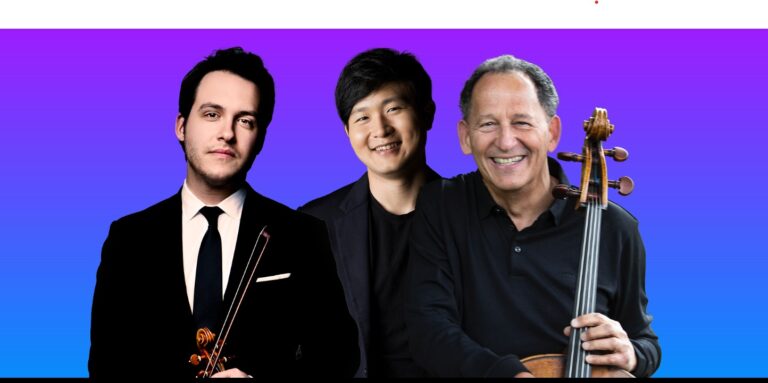
Since 1995, the Festival de musique de chambre de Montréal has presented a series of programmes in June featuring a fine blend of classical and jazz repertoire. Cellist Denis Brott was the driving force behind the Festival, and continues to be its artistic director. The FMCM concludes on Sunday with a concert highlighting the relationship between Russian composer Pyotr Ilyich Tchaikovsky and his patron Nadezhda von Meck.
The concert will be accompanied by a novel experience at the Maison symphonique: the musicians and audience will be brought together on stage, and the programme will be accompanied by a theatrical performance, with the composer and his muse played by actors Jean Marchand and Anne-Julie Proulx. Contacted by PAN M 360, Denis Brott explains the ins and outs of this closing concert.
PAN M 360 : And so we enter the private life of the famous Russian composer.
DENIS BROTT : Tchaikovsky had a troubled life, at least unusual for his time. Yes, he was homosexual, he was obviously discriminated against, and he got married even though it wasn’t what he wanted.
PAN M 360 : You wanted to reflect this through this programme?
DENIS BROTT : With the help of Michèle Marchand, we selected 2,000 letters exchanged between Tchaikovsky and Nadezhda von Meck. She was a very wealthy woman, the widow of a railway magnate. Money was not a problem for her. She loved music. She heard Tchaikovsky’s music and fell in love. For 12 years, she supported him 100% financially. She allowed him to leave his position at the Moscow Conservatoire and she financed his entire career. They exchanged more than 2,000 letters, many of them intimate and I would even say love letters. Since Tchaikovsky was gay, they never met.
PAN M 360 : It was a platonic relationship, you might say.
DENIS BROTT : Platonic, yes. They communicated intensely and there was a kind of codependent relationship. And it’s very unusual that the relationship lasted so long in the context of that time. And there are tragic elements in this: a few months after Tchaikovsky’s death (some think he committed suicide), Madame Von Meck died.
PAN M 360: As for the choice of works?
DENIS BROTT : I have programmed two great works. The first part is the Trio for violin, cello and piano, which is a masterpiece despite the fact that Tchaikovsky once considered that these three instruments were a bad combination.
In the second half, we play Le Souvenir de Florence, which is a sextet that I have arranged for 17 strings including the double bass. So this will be a first in this version.
Between the movements, we have Jean Marchand, who will play the role of Piotr Ilić Tchaikovsky, and Anne-Julie Proulx, who will play the role of Nadezhda von Meck. The script is really moving: listening to the content of these letters and then listening to the music produces a totally astonishing symbiosis.
PAN M 360 : And so it was you who wrote this adaptation of the sextet for 17 strings.
DENIS BROTT : Exactly. It’s the first time in my life, in fact. We’ll see whether it succeeds or not, but you have to take risks in life. You have to be adventurous!
PAN M 360 : Did you have the support of other professionals to achieve this?
DENIS BROTT : No, but I showed my work to fellow musicians whom I respect, to get their opinion. I have to say that every single person who looked at the score was very enthusiastic.
PAN M 360 : For the closing of the FMCM, we’re moving from Bourgie Hall to the Maison symphonique.
DENIS BROTT : You might think that this is not a space for chamber music, which requires a more intimate space. But what I’ve decided to do, and I think this is the first time at Maison symphonique, is to place the musicians on stage with their backs to the seats in the hall, and we’ll put the audience on stage, facing the musicians and also in the choir seats. So we have a capacity of 360 people. In a way, it’s a living room in a hall.
PAN M 360 : We’ve seen a concept like this at Théâtre Maisonneuve during the OSM’s Virée classique, but not at the Maison symphonique.
DENIS BROTT : It’s never been done, and I’m doing it because the acoustics in this hall are among the best. It’s just for the intimacy of chamber music, this space is too big. And there isn’t really a chamber music hall with good acoustics at Place des Arts.
PAN M 360 : So why not present this programme in a chamber music venue like Salle Bourgie?
DENIS BROTT : Because I wanted to experiment. After 28 years of programming the festival, I’m always looking for new experiences, both in the musical content for the performers and in the way it’s presented to the public. And Place des Arts is very well known to the general public!
PAN M 360 : So the Maison symphonique was the only venue at PdA with acoustics suitable for music without amplification.
DENIS BROTT : Yes, you need an echo that lasts longer than a second, 1.5 or 1.6 seconds, to get the resonance you need. We have that at the Maison symphonique and we don’t have it elsewhere at PdA. Anyway, we’re going to try it, and I think that for the audience it will be a truly immersive experience; the audience will be very close to the performers and they’ll also be able to hear a story that’s never been told before!
PAN M 360 : It’s true that little or nothing is known about the correspondence between Tchaikovsky and his patron.
DENIS BROTT : Exactly. This loving, non-physical relationship is an interesting fact to relate artistically.
PAN M 360 : So there will be 17 musicians on stage and two actors to take us through this experience.
DENIS BROTT : To be precise, 8 violins, 4 violas, 4 cellos and a double bass.
PAN M 360 : You always have to try new things.
DENIS BROTT : Even at my age! I’m lucky enough to still be awake and enriched by everything I discover in music. It’s fascinating. And the need to keep fit by playing an instrument is very physiological, I’d even say athletic.
PAN M 360 : Why stop doing what you love? There’s no reason to stop.
DENIS BROTT : It’s the same in any profession, I think. If you don’t love what you do, it’s work. If you love what you do, it’s not work.
AS PART OF THE MONTREAL CHAMBER MUSIC FESTIVAL, THE CHAIKOVSKY OBSESSION PROGRAMME IS PRESENTED THIS SUNDAY, 18 JUNE, 3.30PM, AT LA MAISON SYMPHONIQUE. TICKETS HERE