Jean-François Laporte, a Quebec artist who has been active on the contemporary art scene since the mid-1990s, creates works that integrate performance, sound art, musical composition, performance, interpretation, installation and digital art. As part of the Semaine du Neuf, on the premises of Groupe Le Vivier, he presents Spirituel, a sound installation in which the public is invited to immerse and circulate in order to “explore the meanders of one’s being, to contemplate those unique moments when the visual and the sonic meet in an unprecedented harmony.” We had the opportunity to attend the performance, as well as to discuss it with the composer, at the end of this short journey into this ethereal sound environment.
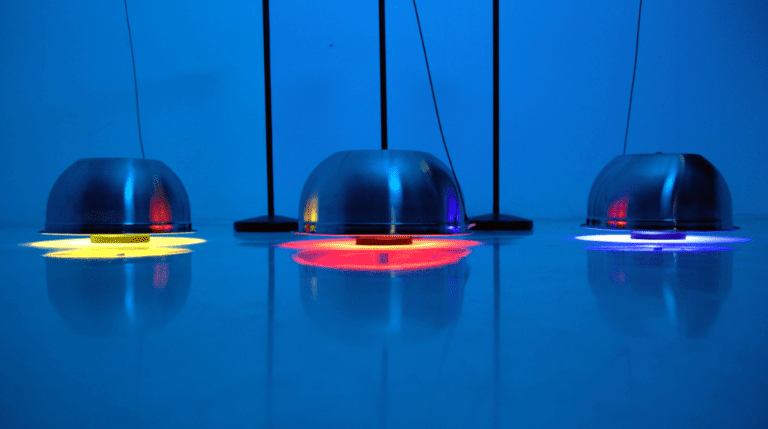
As we enter the hall of St Hildas church, where Le Vivier is now housed, we are greeted by a structure arranged in a circular fashion in the center of the room: 12 metal bowls of various sizes, turned upside down on themselves, and a 13th raised, the hollow part facing the sky. On these bowls, backlit by lights that change colour as the performance progresses, a wire hangs from a tripod. At the end of this wire is a small, rotating propeller that he will spin around the bowl, powered by a motor, to produce sound. This is the basis of what is revealed to our eyes and ears in this wooden room plunged into semi-darkness. Instinctively, we’re drawn to turn around this installation, intrigued by its shape, slightly dubious as to what we’re going to hear.
Gradually, some bowls begin to sing softly, illuminated by red lighting. Increasingly, the sounds generated by the regular and irregular rubbing of the propellers become more numerous and faster while the sonic and visual textures change. The rubbing that evokes the sound of Tibetan bowls gives way to the rapid striking of a few propellers, which, placed on the base of these bowls, imitate the percussive attacks of Indian tabla players with their unique sound; a few moments later, the sonic mass of a gamelan is evoked, ending with sounds reminiscent of our church bells.
Being alone in this sound environment, free to move around the space, to stop and contemplate the sound, we are immersed for the entire 15-minute installation in a space where time seems to stand still or become elastic. The organic way in which the different musical strata flow together keeps our attention and curiosity on the alert. We’re left wondering which element will activate, where, how, and how intense it will be, both sonically and visually. Reflections also arise in this space, as we try to decipher how the theme of spirituality, in addition to being presented within the confines of a church, is musically articulated.
Could the twelve bowls represent the twelve sounds of the chromatic scale or the 12 apostles of the New Testament? Or do the musical references evoke, in their own way, the great religions of Hinduism and Buddhism? The answers are many and personal, making each visit and iteration of the work unique for each individual.
As we emerge from this visual and aural cocoon, into which we could easily have been swept and lulled, we begin our discussion with Jean-François Laporte, asking about his background and musical training.
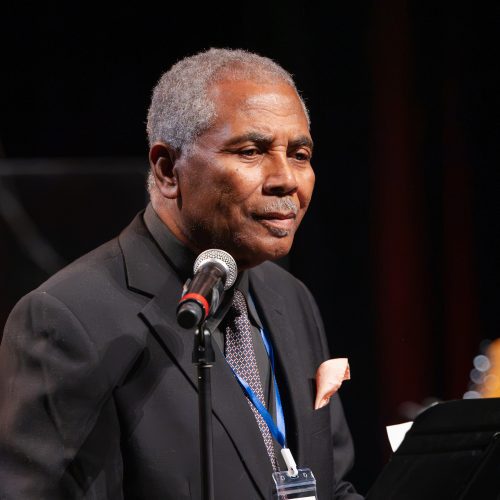
Jean-François Laporte: I didn’t know anything at first. I came into the music business at the age of 25 and knew nothing about art. Except that I’d loved music ever since I was a kid. I went to Central Africa when I was 18-19 in 1988 with Canada World Youth, to Zaire [now the Democratic Republic of Congo]. It was there that I discovered what music was all about. What I knew about music was being a songwriter. Initially, I studied civil engineering and worked in construction, which I didn’t like at all. Even though I was making money and everyone was telling me: “You’ve got a good job and a good salary”, that wasn’t what I was passionate about. At one point, I had the flash that it had already been four years since I’d returned from Africa, and I said to myself: do you like music? Maybe you should take some lessons. So I dropped everything. I gave myself five years and told myself that by the time I’m 30, if it works out, I’ll keep going. I went to Cégep Marie-Victorin, which was the only college at the time where you could get in without a background in music. I went there because I wanted to be a songwriter, and I discovered a lot of things right away. There were four of us students, and we had paid a composition teacher in four sessions.
I never finished my DEC because I was accepted to study music at the Université de Montréal. At the time, people like me were obliged to take a four-year course rather than a three-year one, with the first year devoted to electro and instrumental. It was there that I discovered many worlds and many things: Varèse’s Poème symphonique, composed for the 1958 World’s Fair, Parmegiani’s music, electroacoustics, and so on.
PAN M 360. What elements inspire you personally in your compositions?
Jean-François Laporte: Timbre is at the heart of everything I do. What interested me for a long time was to be in a mass, and to be able to sculpt with my ears, to hear things and really get to grips with elements that are present, but that we don’t normally listen to. What interests me in oriental music, the shakuhachi, for example, I like the wind, I like the impurity, the bits of saliva that you hear, whereas with the transverse flute, even if it’s very close, there’s no breath, you just get beautiful notes. Whereas with other instruments, breath is part of it.
PAN M 360: Where did you get the idea for the kinetic, sound and visual installation Spirituel? Why did you choose to make it an installation rather than a performance piece intended for the stage?
Jean-François Laporte: You can trace all that back to my composition professor at the Université de Montréal, Marcelle Deschênes, who was an extraordinary woman and opened doors for a lot of people and a lot of composers. We really listened to each individual. With her, we never really talked about music as such, except after concerts. For her, music wasn’t the score. As for the choice of format, I really like challenges. When you come to an installation, you’re not in the same listening mode as when you come to a concert. I think installations are great in that they give you a malleable notion of time. Sometimes you don’t go to a concert because something has happened and you can’t go. The installation, on the other hand, doesn’t matter. It’s from 12pm to 6pm, so you can come whenever you like. You’re a bit more relaxed, you’re free. Nobody takes you by the hand. So you can experience it in your own way.
Spirituel is presented until March 15, at Espace Ste-Hilda between 12pm and 6pm. MORE INFO HERE.