A wide array of venues and events lay before us on this night bridging February and March 2026. Usually quite sensitive to the effects of choice overload, I had decided to focus on just two specific destinations: Montreal Museum of Fine Arts, to see the Kent Monkman exhibition, and then the SAT.
My arrival at the SAT was marked by the sharp smell of dry ice; the crowd was still relatively sparse. I had stopped by to get my stamp before the line grew too long, then took the opportunity to gauge the atmosphere. It wasn’t yet midnight, and I was well aware that most people planning a Nuit blanche outing tend to schedule more than one stop.
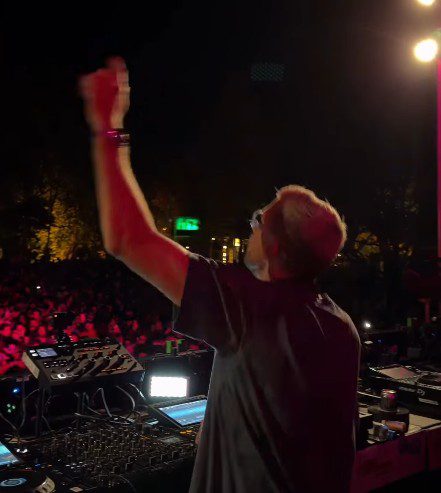
Two large screens allowed us to follow the DJ sets in real time and to take in the very distinctive look of the mixing console: a metal casing, large rotary knobs, two VU meters suggesting an analog circuit (one would expect a vinyl DJ set to go hand in hand with an analog mixer).
The pared-down design reminded me of the rudimentary equipment used in the first electronic music studios of the early 1950s in Cologne, where Stockhausen composed his Studie I and Studie II. I noticed a few individuals—perhaps simply fascinated by the gestures, or perhaps professionals with a keen interest in the gear—completely absorbed by these projections.
At that point in the evening, the music was not yet particularly danceable, and the transitions felt ambitious—sometimes overly so, and occasionally unsuccessful. A handful of people at the front swayed their hips, while most remained in observation mode. There was still a certain hesitation in surrendering to the rhythms; the mood simply wasn’t there yet. The cluster of DJs and collaborators behind the turntables, exchanging glances, comments, and movements with the records, drew more attention than the music stirred bodily response.
I stepped out after less than an hour to head toward Montreal Museum of Fine Arts, where I had read that the Kent Monkman exhibition was free for those 25 and under. The street and metro station were buzzing with an unusual liveliness for such a late hour. One sensed that the night was only just beginning for most of us.
Upon arriving at the museum, the line initially seemed endless. Almost reluctantly, we took our place at the very back, the biting night air urging us forward. To my surprise, in less than fifteen minutes we were climbing the steps toward the Monkman exhibition. We were told there were only thirty minutes left before closing.
This time constraint, coupled with the broader context of Nuit blanche, made for a museum visit unlike any other. The density of visitors recalled major European museums; everyone moved briskly from room to room, eager to see everything, with little time to linger intellectually over each work.
The late hour also lent the experience a distinctly unusual tone. All these factors led me to rely on immediate, visceral impressions in my encounter with the exhibition. My eyes scanned the walls until an image caught my attention; I stood before it and let a shiver run down my spine.
At first glance, the imposing scale of the canvases greatly enhanced their impact. I noted with satisfaction that very few phones were raised to capture images already immortalized; instead, a current of movement animated the crowd, which continued flowing steadily toward the next gallery.
Somewhere in an adjoining space, music played by a DJ drifted along the tall marble columns, further contributing to the unusual character of the visit. Though I appreciated this somewhat fanciful musical addition, I found myself wondering about the rationale for including such a performance in a museum setting. Was it to draw people in, to encourage ticket sales? To maintain the momentum of an evening just getting underway? After all, it was Nuit blanche. They could place DJs wherever they pleased. Before long, the closing of the galleries was announced, and we made our way out.
Back at the SAT, the energy inside had shifted dramatically. The room was packed; the air dense and humid. The music had moved decisively toward a more dance-oriented style, and it felt easier now to merge with the moving crowd. The atmosphere was loud, almost boisterous. One could sense the fleeting, carefree nature of the gathering. I couldn’t help comparing this experience to one I had had three weeks earlier, in the dome at the same venue, where Wata Igarashi and Marie Davidson had allowed me—probably for the first time—to feel completely spellbound by a DJ set. Here, many people seemed merely to be passing through; the contrast with an event sustained by focused attention was palpable.
I left as the energy peaked, boarding a crowded bus that carried with it the frenetic charge of this February Nuit blanche.