Something transcendental happened on the closing day of the Lanaudière Festival. Wagner’s Tristan und Isolde was performed, and this veritable musical epic left no one indifferent, and for very good reasons.
First, there was Tristan’s chord, which opens the work and guides most of the four hours of music that follow. A dissonant and highly unstable chord that heralds an opera dominated by torment, conflict, impulse, and fusion. A chord to rule them all, and in darkness, to bind them.
As soon as the famous prelude ends, the action takes place on the ship carrying the characters to Cornwall.
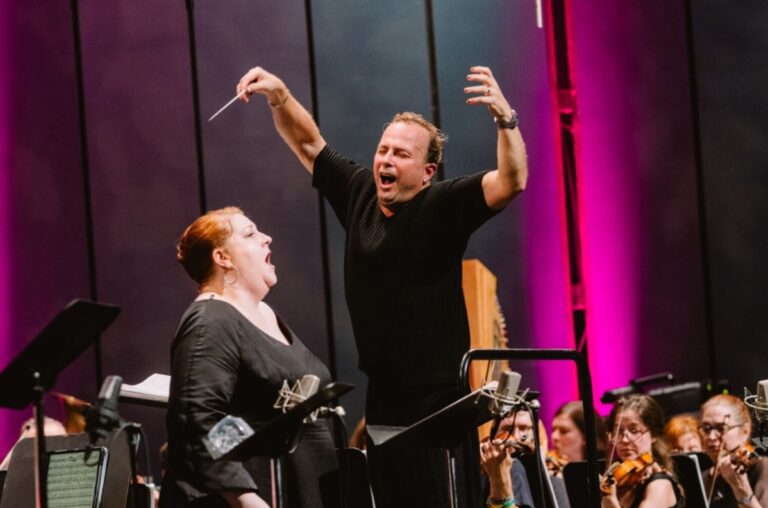
Soprano Tamara Wilson shows her true colors and stands out as Isolde. Her deep voice and theatricality fit well with the text and music. At her side, Karen Cargill seems a little subdued, despite her beautiful voice. In the first act, her role as Bragäne is sometimes mischievous, sometimes haughty, but her voice is steady and accurate, as we heard at the OSM’s season opening in Les Gurre-Lieder. In both cases, the words are sometimes delivered in a honeyed manner, but this is only a minor detail in this magnificent performance.
From the moment he enters the stage, tenor Stuart Skelton as Tristan is vocally superior, but stoic in his characterization. Accompanied by Christopher Maltman as Kurwenal, he appears very good.
Tristan and Isolde complement each other well at the end of the first act, especially when drinking the love potion instead of the death potion.
This inversion leads to a spectacularly triumphant finale, accompanied by brass fanfare, as the boat arrives at its destination. At this precise moment, despite the appearance of joy, the music is unusually tonal for Wagner. In fact, it is a complete reversal of the musical hierarchy; if instability prevails and becomes the norm, the stability of C major stands out and implies that it is not synonymous with happiness. Indeed, our two protagonists have just realized that they are bound together for life and death by love, while Isolde is Tristan’s prisoner, let us not forget.
The second act contains the longest love duet in the history of opera. For more than 30 minutes, Wilson and Skelton do not just sing about their passion, they live it.
Isolde draws Tristan into her game, and we don’t realize how quickly time is passing when King Menke appears on a terrifying dissonance that breaks the musical flight. Bass Franz-Joseph Selig has a very dark, cavernous voice, but with clear and flawless diction. The interludes with the bass clarinet were perfect in tone.
While Skelton was less engaged in the first act, it was a different story in the third. He was completely absorbed in his role as Tristan, dying and mad. Absorbed and absorbing, staggering from one end of the stage to the other, leaning on the music stands and podium as he passed, before dying as he saw Isolde for the last time.
Finally, when Isolde reappears at the very end, upon Tristan’s death, we find her passionate and in love once more, for a sublime Liebestod that will long remain in the memories of those present.
The whole thing culminated in that B major chord, which resolved not only the musical flight taken up again in the second act, but also the four hours of tension we had just experienced, confirming the only way to free ourselves from this saving impulse.
A word about the Orchestre Métropolitain, which was sublime. In Wagner, there are no arias as such, but the story is told by the orchestra, which guides the singers through a range of leitmotifs. Honorable mentions go to the first oboe and English horn players for their intriguing solos, but also to the OM’s male voice choir, which sings very little but is also very precise and punchy.
Before closing the Festival de Lanaudière, the chairman of the board of directors, Simon Brault, came to thank “an audience that travels, that detaches itself from screens and that does not subscribe to algorithms, for a few hours.” These were fitting words that went far beyond the usual thanks and were very well received.
However, these compliments were quickly forgotten during the first intermission. With a very short intermission, the audience barely had time to sit down before the fanfare announcing the return to the stage could be heard. The problem was that eating indoors was not allowed, so the only solution was to eat on the lawn, behind those who were already seated. The second problem was that it was impossible to return to one’s seat once Act 2 had begun. On top of that, there was no time to go to the restroom.
When he came on stage, YNS politely sat down on his podium to wait, then spoke to lighten the mood with a comical parallel with tennis, one of his passions: “I understand that the breaks are short, but there are still 2 hours and 25 minutes of music left, and we’d like to be finished before tomorrow morning. So, as they say at the National Bank Open these days, the players are ready!”
Photo: Noah Boucher for Festival de Lanaudière