Additional Information
Loig Morin is an atypical case of French chanson in North America. Born in Brittany, he left France with his wife and twins to settle in British Columbia… and make a songwriter career in French! Since his arrival on the West Coast, he has been a teacher and producer, as well as leading an artistic career whose latest offspring is this recording, released at the end of May, Adieu Hiver, the third part of a tetralogy based on the artist’s moods and experiences over the course of the four seasons.
These include Printemps (2021), Automne (2021) and Adieu hiver (2023), not to mention Lonsdale (2012), La rivière (2018) and Citadelle (2019). These recordings reveal Loig Morin’s undoubted ability to make fine songs, coupled with a musical eclecticism that has led him to rock, synthwave, electro-pop, electro-rock, certain Americana inclinations and more.
Since his prolificacy is inversely proportional to how well known he is in Eastern Canada, let’s reverse the process with this first PAN M 360 interview.
PAN M 360: Let’s get to know each other! So you’re Breton, French and Canadian.
LOIG MORIN: I come from the small island of Groix, just off Lorient in Brittany. My parents are Bretons. After that, I grew up in the Lyon region.
PAN M 360: You do have a Breton first name.
LOIG MORIN: It means glory and battle. With a first name like that…
PAN M 360: It puts a lot of pressure on you!
LOIG MORIN: Ha ha!
PAN M 360: And so you landed in British Columbia.
LOIG MORIN: That was in 2010. In fact, my wife is Moroccan, and we couldn’t see ourselves living in a context (often xenophobic) where she couldn’t emancipate herself professionally in France (she works in IT), so we decided to go and live elsewhere. So we applied to immigrate, and ended up with an opportunity in British Columbia. We’ve stayed there ever since, because we really fell in love. We lived in North Vancouver for a long time, and now we’re based on the Sunshine Coast, in Gibsons (north-west of Vancouver). Like Groix Island, you have to take a ferry to get there! Vancouver is a city that had so much success with the Olympic Games, it had become far too expensive and there’s now a Swiss feel to it – you’re not allowed to do this or that… But when you go to the Sunshine Coast, you find that adventurous spirit where things are allowed, and there are fewer people. We really like it there.
PAN M 360: So you’ve kept your family intact by making music, which is a feat in itself!
LOIG MORIN: When we arrived in British Columbia, I did a bit of odd jobs, and then I was offered a job as a music teacher at the French school. So I did that for two years, taking advantage of the space and facilities as well as giving music lessons. Then I stopped teaching and set up my own studio (Music Lab) where I regularly welcomed young and old to learn how to create songs. So I recorded several albums by local artists, and released albums myself.
PAN M 360: You had already done this in France before emigrating, hadn’t you?
LOIG MORIN: Yes, but the albums I made there were withdrawn from circulation. When I was 18, in fact, I left school and met the singer / songwriter William Sheller, who signed me for three albums on his own label. I then did a lot of rock and then had children after meeting my wife, who had come from Morocco to study in France. When we had the twins, I stopped music for a couple of years and then we decided to leave France.
PAN M 360: A few years and a few albums later, it’s time for “Adieu hiver”, the third in a series of four seasons.
LOIG MORIN: This time, I really came up with the idea of doing summer songs in winter, while retaining the sharp, metallic edge of winter… Why? Because I couldn’t quite decide if it was the right season… Really winter? It became clearer as I went along. So here we have these summer songs created in winter, which allowed me to explore electronic music a little further, without leaving the song format. The next album will be either “Été” avec chansons or another album where the song format will no longer predominate. En pente douce, I’m planning to move away from the song format.
PAN M 360: Let’s talk about the lyrics on Adieu hiver, which are all well written. William Sheller did take ou for the good reasons !
LOIG MORIN: Thanks. So, it starts with the first song,” Top Model”; there’s the sun, the coldness of our times, that of Hollywood stars who express nothing, there’s that North American coldness, there’s that “summer under the snow” where I make fun of the United States a little, particularly Texas.
Then, the song “Américaine” evokes those people who decide to stop answering their interlocutor when they lose interest in them.
Then there’s “Maria”, about a woman who leaves to commit suicide in a crazy town called Wallace (Idaho), where there are only antique dealers. I visited this surreal place where people seem never to have left home. This completely lost town, out of time, inspired me.
And then there’s “Avalanche”, about people who want to do things to get out of their imprisonment, who want to live an exciting existence, and who ultimately can’t because their habits are too strong. There’s a lot of talk about it, but it’s all in the words. You keep replaying the images that make you think of what you’d like to do, but you can’t because you’re buried under an avalanche of obligations and social constraints that prevent you from doing what you dream of. You want to get out of this winter of difficulties, and the avalanche brings you back under every time.
After that, I really went for the synths on “Adieu hiver”. We go for the warmth, but there’s also this slightly depressive side that drags you back down, while leaving you dreaming of getting out of there. It’s not a song after all, it’s instrumental music that I wanted to put there in the middle of this rather sad album.
And then it’s back to the most pop song on the album, “Baisers de Savoie”. In it, I remember this girl I kissed a very long time ago – before I met my wife, haha! The song recounts the warmth of such an episode in November, in a small town in Savoie.
And the last song, “La bouche”, is really about Montreal, where I’ve actually spent a lot of time over the past two years. I really enjoyed observing Montrealers women, who are much less uptight than Parisians – the latter are retreating a little into their more classical side in a rather negative French context at the moment.
PAN M 360: Adieu hiver isn’t a strictly electronic album: it also features guitar, pedal steel, bass, drums and more.
LOIG MORIN: Yes, my instrument of choice is the guitar. After that, I play the other instruments.
PAN M 360: So it’s not just electro, and even then, you’re looking for warm sounds.
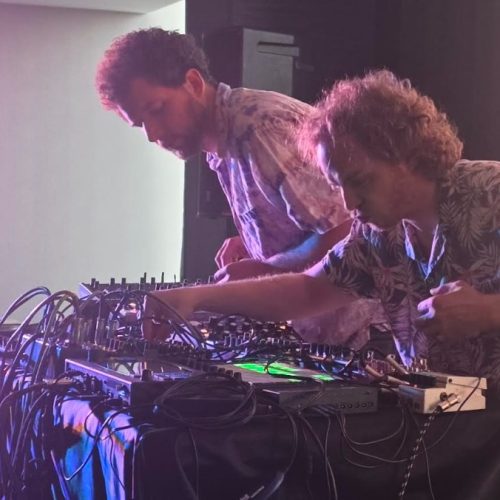
LOIG MORIN: In fact, it’s essentially analog; for me, digital remains cold and instruments quickly become obsolete. So I’ve acquired Moog synths (among others), I have several electronic modules grouped together on a Eurorack, and so on.
PAN M 360: How long did you plan to complete this cycle of seasons?
LOIG MORIN: Initially, I wanted to do it all in a year and a half, but then I got tired and said no, I don’t feel like it right now. I was more interested in exploring new sounds and avoiding the “commercial” pressure of making the last of the four albums. We’ll see, I’ll leave it to that… but right now I want to explore new sounds. To that end, I’m building a mobile studio in a truck, and I want to travel the country with it, meeting unknown artists, recording them and making my own music. So I’d like to make a nature album with electronic sounds and other sounds recorded in the field.
PAN M 360: Clearly, you still have a lot of ground to cover!