Additional Information
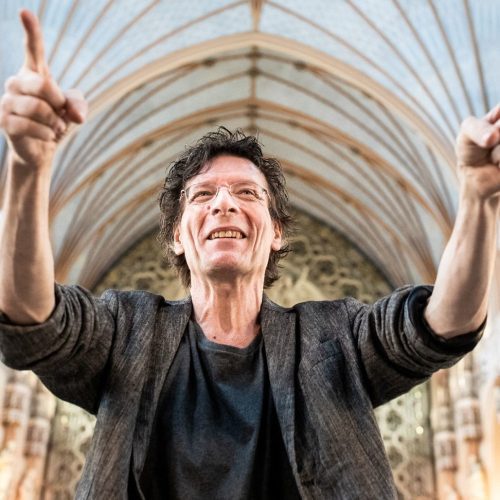
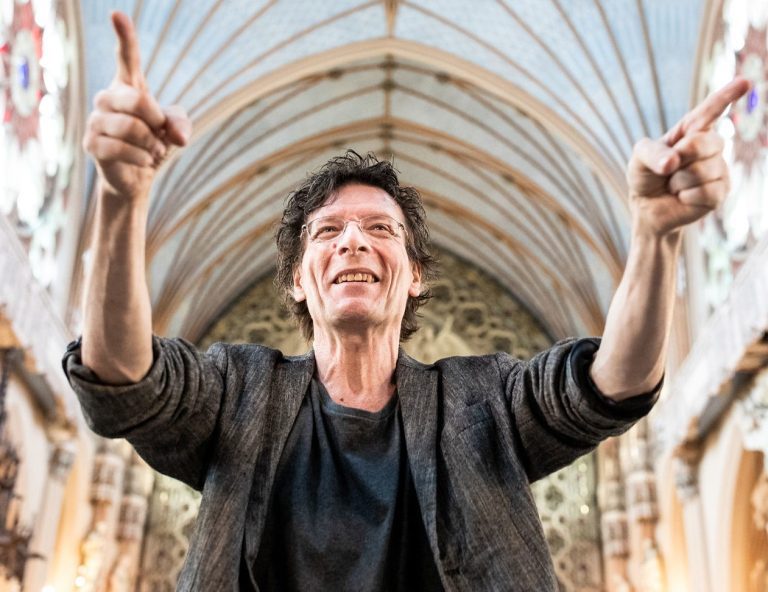
Everyone is familiar with the myth of the Tower of Babel, taken from the Bible. The rather negative moral associated with it condemns the diversity of languages spoken on Earth, as it causes humans to no longer understand each other. God punished them because they were too curious and audacious. And bang, they are each given a different language from the others. Fortunately, we have moved beyond this simplistic lesson and, ultimately, xenophobic (or rather linguophobic) perspective. We are now able to appreciate the intrinsic beauty of each language, its musicality, its expressiveness. This is also what André Pappathomas, composer and choral director, has believed for a long time, who will create a work in seven tableaux entitled Areuh! on November 17 and 18, 2026, at the Espace Orange in the Wilder Building, in Montreal. A syllable symbolising the universally recognised sound of a baby, making its first attempt at communication, before evolving itself and being able, one day, to deliver a complex and coherent discourse. In this work for nine instruments and ten voices, one will hear Arabic, Armenian, Wolof, Japanese, Portuguese, and French, spoken and sung, accompanied and harmonised. I spoke with André Pappathomas about this fascinating project.
Tuesday, November 17, 2026 | 7:30 PM
Wednesday, November 18, 2026 | 7:30 PM
Meet the artists after the concert
Orange Space | Wilder Building
PanM360: Hello. What led you to create this show, Areuh!
André Pappathomas: Areuh, in French, is the sound that all babies make when trying to reproduce their parents’ consonants. It’s a fundamental language sound. It’s the first sound of communication. This project came to me after a major project with 10 choirs that was presented in a concert at Wilfrid-Pelletier in 2016. When we were doing the final rehearsal that brought together these 10 choirs, I observed the people among themselves, from 10 different countries. What was remarkable was that people listened to each other speak. They listened to them as if they were listening to songs.
The songs of their languages. It had really touched me.
It’s been more than 10 years since then. And this project and this impression have stayed in my mind. This concert concept is focused on the melody of languages.
PanM360: Each language has its own particular music. And there, like a Tower or a Chorus of Babel, each person adds their layer of meaning. But, in the end, what do you wish to say with this?
André Pappathomas: In fact, it’s an ongoing reflection. It’s a study, nothing more, nothing less. But what I want to propose in this series on Tuesday and Wednesday is to encourage people to exchange ideas, like you and I are doing right now, that is, on this musicality, on the connection between the languages we hear around us and that of a primordial language which is that of post-childhood. Which is also that of the first linguistic education in humans. I just want to show the universality of communication and the beautiful music that comes from it.
It’s a way to raise people’s awareness through inspired listening. When you hear someone express themselves in another language that you don’t understand, but deep down, you can very, very well understand the fundamental musical meaning brought by the song in each of the languages. Which is better than being completely indifferent to it. There is something magnificent offered to us every time someone expresses themselves in a language close to us.
PanM360: Specifically, how does it manifest during the concert?
André Pappathomas: There are seven tableaux, it’s the story of a life, it even starts from the limbo, then birth, school, adolescence, life, love, war, and the wear and tear of bodies that ends the concert. The tableaux are a pretext to symbolise the journey of a life, but the structure is supported by the music of languages. For example, there is Kayo, the Japanese woman, who will say “there is so much to do” (in Japanese), she will say that at the beginning, and the soprano, Virginie Mongeau, will take up the melody of these words, and then it becomes a song, then it is harmonised, the cello joins in, the percussion gets involved, and we are off into a whole tableau that follows the opening tableau, where there will have been Kayo, this Japanese woman, and Sadio, who is Senegalese, who talk to each other, each in their own language (Japanese and Wolof), but seem to understand each other very well.
The concert begins with this exchange between the two, they are sitting, they are in limbo, in history, and they wonder if they should return to Earth. Kayo will say, “yes, we will return, there is so much to do still, there is so much to do.” Just before, Sadio, in Wolof, told him, “yes, we will listen to the winds dulling the madness of men.” The texts are very well-crafted and thoughtful, each scene will include a line in French so that people can situate themselves, but there will be no translation of all these words. The idea is to set the emotional tone, and I will briefly narrate the entire set of seven tableaux to the people, nothing more. For each tableaux, people will have a sentence translated into French to which they can cling, and let these words resonate. In the end, we will understand everything.
PanM360: No surtitles then…
André Pappathomas: No, because you have to be completely attentive, with a very sensitive and full attention. While you are reading what is written above, you are not present.
PanM360: Musically, where are we? What you usually do, that is, a mix of atonality and consonance?
André Pappathomas: Yes, all of that is true. For me today, what can be called atonal are aesthetic forms that can be very, very touching, very, very emotional, very intriguing, very beautiful. But we are not in a world beat context at all, it is composed, it is music created from this concern for the musicality of languages.
PanM360: There is Arabic, Wolof, Armenian, Portuguese, Japanese… Why these ones?
André Pappathomas: There’s Hindi too. If we go through all these languages and then compare them to the entire set of language families, in fact, all the families are represented. Except for indigenous and creole languages. I tried to get some, but time was passing and I had to settle on a choice. But I would have loved it very much. But it could be a second version.
PanM360: And there is a classical vocal quartet.
André Pappathomas: These are people I have been collaborating with for a long time. Lyric singers who have a rather classical training. For many, with a lot of experience in contemporary or modern music. They come to enrich harmonically, to be complicit in the unfolding of the music, in the development of the scenes. In fact, there is no harmonic instrument, except for the vibraphone played by percussionist Olivier Maranda. There is no guitar, there is no piano. For the chords, although the harmonisation is quite open, there is the quartet of voices. There are some textures that are really surprising. They can really go in all sorts of directions, those singers.
PanM360: Is there a language that touches you more than the others?
André Pappathomas: Not really. But I must say that Wolof, which I didn’t know at all, impressed me. But, languages are one thing. Beautiful, astonishing. But in truth, it is humans who fascinate me. Those who speak the languages. That’s where it touches me. It’s Sadio, it’s Kayo, it’s Saulo, it’s Hasmik, it’s Farah, it’s Mohamed. Their language takes on the greatness of who they are. Languages touch me because they are conveyed by those people whom I get to know at the same time.
PanM360: You really like these people…
André Pappathomas: Yes, yes. Yes, yes, yes.
PanM360: Thank you very much André Pappathomas
ARTISTS
Farah Azrak, Syria (Arabic) – Shruti box
Sadio Djali, Senegal (Wolof) – Kora
Hasmik Gasparyan, Armenia (Armenian) – Soprano
Mohamed Masmoudi, Tunisia (Arabic) – Oud
Saulo Tenorio, Brazil (Portuguese) – Violin
Kayo Yasuhara, Japan (Japanese) – Shamisen
Gabriel Dharmoo, tenor
Éric Gauvin, tenor
Elizabeth Lima, mezzo-soprano
Virginie Mongeau, soprano
Jacqueline Leclair, oboe
Catherine Le Saunier, cello
Olivier Maranda, percussion
Saulo Tenorio, violin
André Pappathomas, conception, direction, and invented instruments