Additional Information
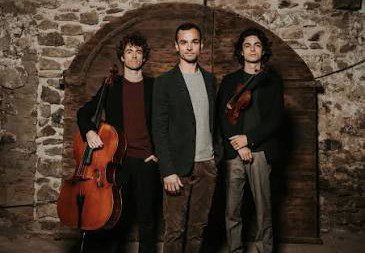
The HausMusique series on the 9th floor of the Eaton Centre in Montreal will host the Helios Trio on Tuesday, November 3, 2026, at 5 PM. The French ensemble, acclaimed with numerous awards and critical success, will perform two unwavering pillars of the repertoire for the occasion: Beethoven’s Piano Trio Op. 70, No. 1 “Ghost” and Shostakovich’s Piano Trio No. 2. Two works marked by death and tragedy. Theatrical, in the case of Beethoven (part of the material for his fabulous central movement marked Largo assai ed espressivo would come from sketches by the composer for music associated with ghosts in Hamlet and witches in Macbeth, two of Shakespeare’s plays), and real-life for Shostakovich (his trio was written in 1944, on a Jewish theme steeped in the atrocities of the Second World War). I met with two of the three members of the trio, cellist Raphaël Jouan and pianist Alexis Gournel, to talk with them about this concert.
PanM360: Hello. First, tell us about yourself. How did you form the trio?
Raphaël Jouan: Alexis and I, here, have been friends since the very beginning at the Conservatoire supérieur in Paris, and we quickly wanted to make music together. The idea of the piano trio came about because the repertoire is magnificent, and so it was created when we were still early in our studies, we were in our third year of undergraduate, and it was at that moment, in 2014, that the Trio was born.
PanM360: You have released two albums under the Mirare label, one dedicated to the French repertoire (Saint-Saëns, Ravel, Lili Boulanger) and the other to the Czechs (Smetana, Novak, Fibich). What drives your choices of repertoire?
Alexis Gournel: The idea is to defend the essentials of the repertoire, the Beethovens, the Brahms, the Schuberts, Ravel, the works that are expected of us as a trio, but it’s true that in our approach, we have always also sought to highlight somewhat more obscure repertoires. Very often, in our recitals, we add to these hits, if I may say so, pieces that are much less known, but which are often very, very beautiful.
Raphaël Jouan: And indeed, for the two albums you mentioned, we have given a very clear and distinct identity based on nationality (French first, then Czech). At the moment, we are working on the next album, which will focus on Armenian composers. It will be recorded in April, for a release in the fall of 2027. For the occasion, we commissioned the jazz musician Tigran Hamasyan. After the release, we will go on tour in France, and we will return to Canada with the program.
PanM360: Oh really? That’s a very nice piece of news. Regarding Tuesday’s program, let’s start with Beethoven, the famous Ghost Trio. What does it represent for you?
Alexis Gournel: The previous trios were still heavily influenced by Viennese classicism. But in this first of the two trios of Op. 70, Beethoven really breaks the mould in terms of form, especially in the second movement, in that famous “ghost” movement. There, he completely breaks the Viennese language and aesthetics he had practiced until then. This also coincides with the arrival of Broadwood pianos, which Beethoven greatly enjoyed playing.
These English pianos had a great resonance, particularly with a rather unique pedal system, but which gave the instrument a great sound amplitude. We also know that Beethoven had developed a great taste for exploring all the capabilities of this instrument, mixing sounds, and using extremely long pedals. In this trio, we realise that it works very, very well, especially in the second movement, particularly to create more textures on the piano, as well as with the strings where he experiments a lot with it.
Raphaël Jouan: At this moment, we begin to move away from the paradigm of pure beauty in music. For us, this brings this trio closer to that of Shostakovich, with its somewhat raw material. We like to seek out very cold sounds, for example, both in Beethoven’s slow movement and in Shostakovich.
Alexis Gournel: Ultimately, pitted against each other, it raises many questions about the aesthetics of ugliness. Beethoven, in his slow movement, has dissonances that are astonishing for the time, there are sound textures that are completely daring, that is to say, they go against all Viennese propriety of the era. Shostakovich too, in his language, explores ugliness.
After Montréal (and before that, Toronto and Halifax), the Helios Trio will be in Chelsea (Qc) november 6 and then in Regina (Sask) on november 8
PanM360: Have you ever tried playing this Beethoven trio on period instruments, like a Broadwood piano ?
Alexis Gournel: We didn’t do it on a Broadwood because we didn’t have one on hand at the Conservatoire de Paris, but we did it on a Graf, even though it is a slightly later instrument. There are sounds that are not at all like our modern Steinways, in terms of volume, resonance, and it’s true that in terms of blending timbres, it works much better with these pianos, with a longer vibrating length, a much more natural resonance, but much less volume, on the other hand.
PanM360: How do you depict the internal voices of the Beethovenian dialogue in this work?
Raphaël Jouan: In this trio, let’s say that the polyphony needs to be clear in our minds. But the goal is not to make something pedagogical out of it, because in the slow movement, which is deliberately quite blurry, the different elements will somewhat blend together. That’s what is magical and makes the texture interesting. We try to characterise them as much as possible on our own.
PanM360: Shostakovich’s Trio was written in 1944. There are many references to Jews, to the War, etc. What do you have to say about it?
Raphaël Jouan: Generally, we always give a presentation of several minutes before the piece, because there are so many symbols in this trio that you don’t listen to it at all in the same way when you are aware of all that. We don’t play it the same way either. It’s true that it’s uncompromising music, because it is marked by war, by the death of one of his very close friends, by the discovery of the horrors of the camps, and also by the people’s resistance to oppression. It’s a trio that conveys a lot of very strong messages.
Our interpretation has been shaped by that, meaning we want to create something that is uncompromising. We don’t try, precisely, to create something with melodies that are meant to be pretty, a bit cute, because according to us, in Shostakovich, there is always irony, there is always a biting edge. Also, we were fortunate, when we were students, to work on this music with the Wanderer Trio, who had worked on it themselves with Chostakovitch’s close associates.
They had the indications from Shostakovich himself. We have noted that in the second movement, for example, he had set a metronomic tempo that was fast to pass the censors, but in truth, he wanted a slower tempo.
PanM360: Thank you for these reflections, and welcome to Montreal!