There was enthusiasm during the unveiling of the 26-27 season of Les Grands Ballets Canadiens. We were presented with a certain excitement the upcoming collaboration with Guillaume Côté, former principal dancer of the National Ballet of Toronto, choreographer and creator of The Little Prince, which was beautifully received during its premiere, also in Toronto. Above all, this first commission given to the Quebecer was a reinterpretation of Shakespeare’s A Midsummer Night’s Dream, a story full of magic, ideal for a ballet.
Let me immediately show my colours: I loved the result. Côté enchanted the Montreal troupe, and consequently, the audience that filled the Wilfrid-Pelletier hall.
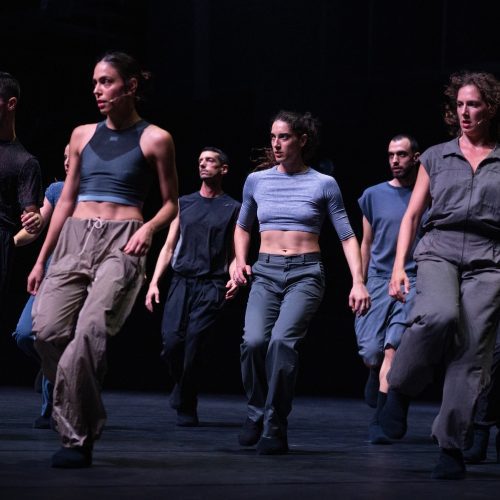
In A Midsummer Night’s Dreams (plural – for more understanding, see the interview I conducted with him HERE), Côté constructs a polyphonic choreography, filled with fluttering and swirling ensembles, almost non-stop (there are a few duets, including a rather extensive one between Titania and Oberon).
There is also a lot of humour, which the Shakespearean story allows amply, it must be said. But Côté handles irony and certain flamboyances with precision. The show is clearly divided into two parts, well delineated in terms of temperament. The first part is bathed in joy and love buzzing around. A truly juvenile, good-natured lightness is expressed through swirling and airy acrobatics, where no character knows how to stay in one place. Perfect embodiment of the fairy-tale and carefree universe imagined by Shakespeare. The second part is more dramatic, darker, but without losing its charm or its attractive character. I would even go further, if the first half is exciting (invigorating choreography, vital energy of the staging, etc.), the second half is emotionally powerful, especially in its symbiosis with the music (I will come back to this).
But before continuing, let’s summarise: the marriage of Hermia and Demetrius brings together the entire community of the magical world of Titania and Oberon, Hermia’s parents. But the loves of those around the couple are quite free (and not heteronormative – that’s Guillaume Côté’s personal touch), and they even end up affecting Hermia and Démétrius. This does not please Queen Titania, a rather solemn and conservative character, who orders Maya (a gently mischievous character, and the female counterpart of Shakespeare’s Puck) to use a magical flower on Hermia and Demetrius that makes them fall in love. But of course, it spirals out of control and the entire assembly ends up living in a whirlwind of ephemeral and multiple relationships, regardless of sex or gender. Unlike the original play where good manners are eventually restored to their precedence, here, it is Titania who ends up softening and allowing her “children” to live a little as they wish.
That is the narrative context. Let’s get back to the show itself. Côté says he has an intimate affinity with music. I confirm that it is true, and that the result on stage is all the more captivating. The choreographer uses music by Felix Mendelssohn (1809-1847), especially the symphonies no. 3 “Scottish” and no. 4 “Italian,” for melodic and dynamic reasons, as these irresistible masterpieces, even though they were never designed for movement, are intrinsically danceable. Also because Mendelssohn wrote famous music in the classical repertoire for A Midsummer Night’s Dream. From this score, which has its own magic, Côté only uses the Wedding March (which everyone knows!). Why not the rest? Côté explains all of this in the interview…
READ THE INTERVIEW WITH GUILLAUME CÔTÉ
It is enough to say that the use of Mendelssohn’s two most popular symphonies works perfectly, especially in the choices of organic transitions between the various parts of the works, played out of order, to meet the imperatives of narrative efficiency rather than musicological coherence. In the first part, tinged with mischief, flexibility and agility, it is the Italian Symphony that dominates. Rightly so, as the bouncy rhythms and the sunny character of the music perfectly match the theme and the staging. We are inundated with a bubbling agitation, but above all, a smiling one. The general pleasure is palpable, and it ends with Maya’s intervention and her magical flower. The mischievous spirit cannot help but enchant the entire assembly, rather than just the two newlyweds.
The second part establishes a paradigm shift. A nocturnal scene unfolds. The play of lights, the generous Moon in the background, and the protagonists immersed in a second state, enchantingly dreamlike, are beautifully accompanied by suggestive, impressionistic, and cinematic music. Satie (Gymnopédie orchestrated by Debussy) gently seduces, but it is especially Max Richter with November who embraces the entire room and the twilight characters with their endless claw-like fingers (but not at all threatening – kudos to costume designer Rémi van Bochove) in his sumptuous and powerfully emotional embrace. A moment of Hollywood creative communion, certainly, but devilishly effective. A few chills, be warned.
Also, I don’t want to forget the contribution of Montrealer Tommy Lunaire, with an electro-orchestral score tinged with Glassian Minimalism, which also at times recalls the expressive force, rhythmic vitality, and melodic beauty of Daft Punk’s techno-symphonic masterpiece, Tron Legacy. Lunaire is more impressionistic, certainly, and that suits the context perfectly. We may have discovered a future collaborator for the Montreal symphony, like Apache a few weeks ago? The young composer certainly has the potential for it.
The penultimate scene features a classically romantic pas de deux (to the Adagio from the Scottish Symphony) between Titania and Oberon, in which the king is enchanted by Titania. She reproaches him for his general apathy in the face of the situation. But his fate will have unexpected effects: Oberon enters a kind of psychedelic trance that reveals his more eccentric sides to his wife. The most striking episode, visually, is part of this scene: under strobe lights, an insectoid creature appears. Oberon falls in love with her and finally loosens Titania, who realises that her relational rigidity only suffocates everyone around her.
Hats off to the designer Patrick Martel. The creature is magnificent and will remain etched in our minds. Kudos also to the puppeteer who handles it, instilling it with a very natural gait and a credible stage presence.
The finale brings everyone together, in a community calmed by less social rigidity and more freedom.
Maude Sabourin embodies a suitably imperial Titania, while Thomas Leprohon manages to make us believe in this sometimes clumsy and awkward Oberon, a bit reserved, but ultimately unrestrained. Anaïs Roy, Antoine Benjamin Bertran, Aurora de Mori, Roddy Doble, Maeva Marcolini-Bowes, Célestin Boutin (who respectively portray Hermia, Demetrius, Helena, Lysander, Clara, and Ethan) bring the characters to life with the desired freshness and fervour. Sometimes, certain characters are confused due to slightly too similar costumes.
The Grands Ballets orchestra performs nicely, with adequately brisk tempos in the Mendelssohn pieces, under the baton of Dina Gilbert.
Midsummer Night’s Dreams by Guillaume Côté is a superb production, a moment of magic and enchantment that will stay in my memory for a long time. The bar is now set very high for the rest of the season.