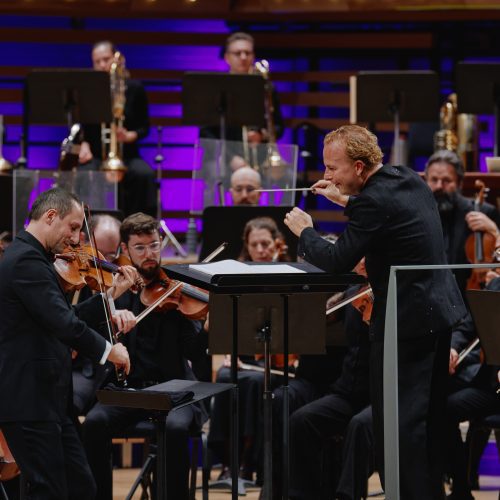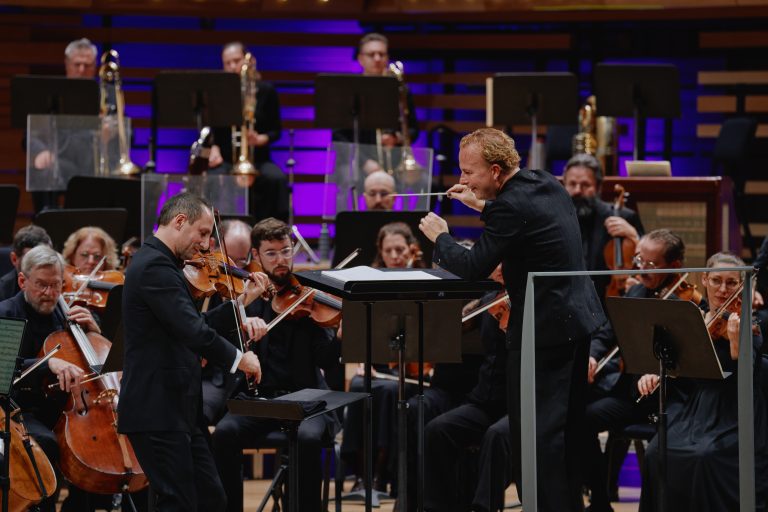
The launch of the 26-27 season of the Orchestre métropolitain (OM) under the baton of Yannick Nézet-Séguin took place yesterday at the Maison symphonique in front of a full house. The theme was centered, mostly, around interstellar space and illustrated by the famous Planets by Gustav Holst, as well as by a creation by the Anishinaabekwe composer Barbara Assiginaak, Shpiming Nangokaa (High in the sky, there are many stars).
It was the latter that opened the afternoon (the concert was at 3 PM). The audience was treated to a resplendent work, sparkling with a thousand luminous colours, like thousands of jewels on a dark velvet cushion. The score oscillates between Ravelian sumptuousness and contemporary shimmering, in a back-and-forth between warm atonality and cinematic consonances. The crowd applauded warmly, rightly so.
A bit off-topic, but masterful in its expression and especially its interpretation, the Concerto for Viola by the Englishman William Walton followed with immense panache. A work that is rarely heard on our stages, and yet has an imperial dramatic effect! It must be said that the violist Antoine Tamestit masters this music without a hitch. A full and nuanced sound, capable of the most delicate whispers without compromising an ample projection, as well as the most athletic fortes, that don’t lose any timbral quality. This artist plays, in the holistic sense of the term: he watches the orchestra musicians, listens to them, appreciates their playing, responds to them. A true concert artist, not a soloist “with accompaniment.” That is probably the connection with the rest of the program: Tamestit is a fiery star. The man took the microphone to thank the musicians (he was right, the OM was in exceptional form) and announce an encore: an arrangement of Flow My Teares by John Dowland. The poignant melody of the Renaissance gave a few chills, especially in its delicate interpretation in a duet with the OM harpist, Robin Best. We can pleasantly imagine a full recital with these two artists. Why not?
In the finale, Holst’s Planets practically lifted the roof off the Maison symphonique. Yannick did not hesitate for a second and launched the warlike Mars on a merciless rhythm. With an OM at its best (hats off to the soloists of all the sections), the conductor then drew a Venus and a Mercury full of nuances before launching the masterful Jupiter at an exciting tempo. Thank you for not slowing down its progress, which sometimes happens with some conductors. Here, no, Yannick chose to express without hesitation the feeling of joy that underlies the character granted to the giant by Holst. The central section, with its imposing theme, had all the required nobility.
Saturn and its emphatic cadence, marking the passage of time, had the desired power and, above all, effectively expressed the inevitable nature of the march towards old age. Uranus and its driving energy (as well as the theme introduced by the bassoon, which so much reminds one of Dukas’ The Sorcerer’s Apprentice) had a lot of character, while the whole ended with the impressionism, first shadowy then evolving towards the light, of Neptune.
The audience was delighted. One can only agree with it.