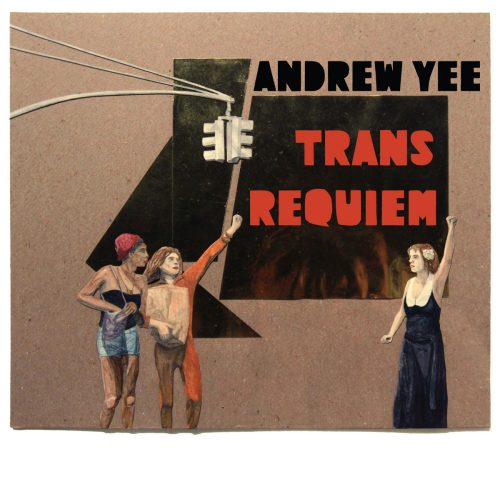
Trans cellist and composer, Andrew Yee (she/they) wished to write a significant work to testify both to the power of the tragedies that overwhelm the lives of trans people, but also to their resilience, their power, their joys, and their hopes.
The work for soloists, choir, and orchestra is bathed in generally elegiac atmospheres, imbued with solemnity and contemplation, sometimes also with vibrant intensity. The powerfully emotional music carries with dignity the message, proclaimed loud and clear, of recognition for the trans community and its integration into a complete and unified humanity.
In other words, through one of the most tried-and-true, holistic, and unifying musical forms (the Requiem), Yee wished:
“to give trans people the dignity of being grieved—the kind of communal space that we’re so often denied. This isn’t just a requiem for the dead; it’s a requiem for the living. A space to feel sadness, to reflect, to rage, to remember—and also to love and to find peace.”
The music is expressive and consonant (with the exception of a few rare dissonant rough edges), and unfolds with a breadth worthy of a good film score, yet without too much pomposity. Episodes of spoken word are particularly effective, such as the movement titled Light in tribute to the trans activist Cecilia Gentili, where Andrew Yee themselves recites a touching text about their own memories of Gentili, accompanied by the dark vocalisations of the bass voices in the choir. The effect is striking and memorable.
The two soloists, soprano Breanna Sinclairé and tenor Katherine Goforth, both trans artists, are called upon to perform occasionally, but each time with conviction. Sinclairé’s soprano is beautifully lyrical, and one can easily imagine her in Mahler or Strauss. Goforth’s tenor is very pleasant, with a beautiful roundness in the lower register and a projection that one can tell is effective.
ome texts immerse us in the unsettling intimacy that inhabits most trans people, in one way or another, and this daily. Here I am afraid:
I Am Afraid A man Has started talking to me I keep my back to him My long hair tucked behind my ear – is a shield I am afraid of this man I am afraid But not how he feels about me I’m afraid of how he will view his own sexuality If he sees my face Which has less makeup than I want
Or again, Death Before Detransition, the most powerfully activist moment of the whole requiem (based on a poem by Jennifer Espinoza):
You will have to pry/ my gender from my cold/ dead hands/ and even then/ all you will hold/ is an idea I carved/ into the side of the world/ with fire
The Trinity Church Choir in New York and the NOVUS ensemble adorn a score that aims to be highly dramatic with sumptuous sounds, fully benefiting from the rich colours given to it. All of this under the attentive direction of Melissa Attebury.
Trans Requiem is a work as much as a manifesto, but above all, it is music that knows how to touch and move with intelligence and conviction. I think Montreal would be an excellent place to hear it. Attention, programmers.