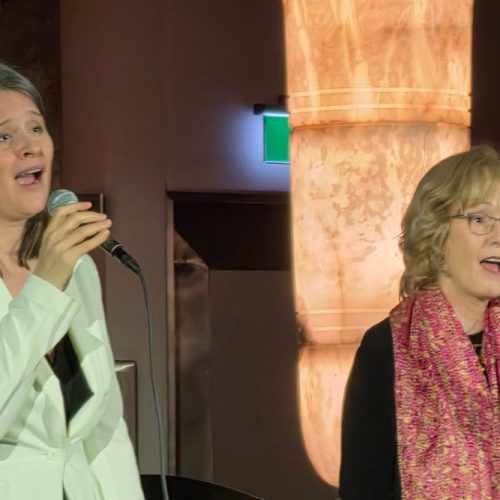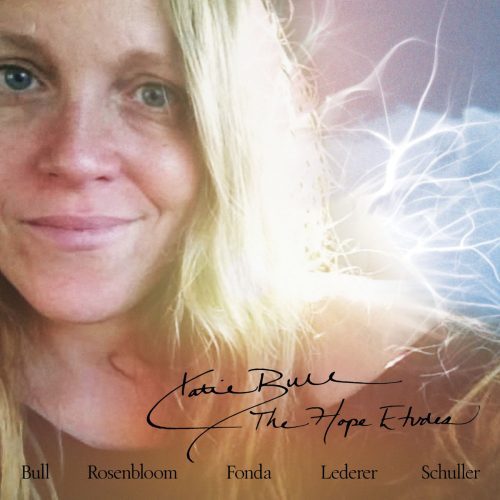
There is something of Mark Murphy in the melodic audacity of Katie Bull. Joni Mitchell too, in the singer-songwriter tradition applied to jazz. Here is an artist nurtured in the great tradition of improvisation by her father, as well as in athletic vocal deployment by her mother (an opera singer). Bull has integrated into her entire being, both physically and psychologically, the rare duality of being completely at ease in the often wild improv freedom while remaining perfectly in control of her creative universe.
The Hope Etudes offers six original compositions and three covers that soar far above the ordinariness of a certain vocal jazz moulded from the same all-purpose plastic. Katie Bull stands tall in the tradition, but she unabashedly undresses it to adorn herself in an extravagant and impressive manner. Her powerful voice, perfectly centred, sometimes airy, but more often almost earthy in its bass grain, flits through, around, above, and below the elegant lines of the songs chosen with a keen intuition, evoking both astonishment and aesthetic satisfaction.
The Mitchellian attitude is immediately evident with the first track, Home.Coming, while the next one, Assurance, which initially seems to maintain it, rather veers towards confident flights that Sheila Jordan would not have disavowed (who, if I’m not mistaken, also coached Katie Bull). Oh, What A Beautiful Morning (from Oklahoma! by Rodgers/Hammerstein), then, is completely transformed into a strong blues, turning upside down the very very white imagery of this tribute product to the colonial cowboy terroir.
Scatter pushes the Hard bop note in settings inhabited by Wayne Shorter or, closer to us, Cecile McLorin Salvant (vocal side). There is no Greater Love, a 1936 standard (written by Isham Jones and Marty Symes), is here slightly sped up beyond the medium tempo to which some great versions have accustomed us (Dinah Washington), while Bull, alongside her unrestrained quartet, ends up convincing us that such immense love can only be appreciated in a state of ecstasy without too many attachments.
And It Continues On pursues the journey by breaking the dominant mould until then with an initial melody that is childlike, of beautiful and touching simplicity, full of optimism, then skilfully developed, leading to a vertigo that threatens to tip everything over, fortunately caught back (or almost) and coloured, for a rare time in the album, with operatic vocalisations by Katie Bull. One of my favourite tracks. Jalopy Promises starts with spoken word, followed by a few more lyrical bursts from the lady before taking on a comfortable, slightly post-bop pace.
Another blues, this time for Light My Fire by the Doors. It fits, of course, but Bull goes a little further. The harmonies slide into surprising, almost uncomfortable zones, before refocusing. A fire that undulates, constantly threatening to overflow and slip out of control. Bull does not let herself be overwhelmed and concludes the piece with a return to the calm spoken word heard in Jalopy. Gamma Rays, a short two-minute piece, concludes the program in a pacified, impressionistic atmosphere, counterintuitive to the title, but ultimately very logical after the range of emotions experienced up to that point.
An album full of audacity and beauty, as astonishing as they are magnificently rendered by an impressive ensemble, mostly formed by long-time collaborators of the New York artist.
The Katie Bull Group Project
Katie Bull Voice
Mara Rosenbloom, Piano
Joe Fonda, Bass
Jeff Lederer, Saxophones
George Schuller, Drums