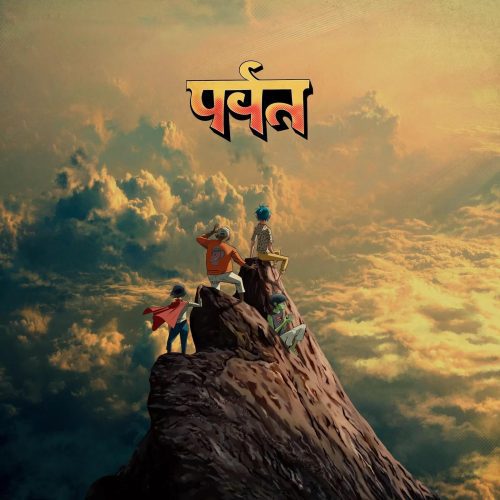
Gorillaz’s The Mountain is nothing exciting at first—just another musician at the end of their career who’s gotten their hands on a copy of Herman Hesse’s Siddhartha and decided to make some world music in India. Picture the sound engineer turning down the treble as the Billy goats enter the recording booth. It’s hard not to scoff when we’re still backlogging centuries of musical homogeneity from cultural misappropriation. I was about to write off Gorillaz’s The Mountain as an intriguing departure from their old stuff when it occurred to me that many of these features have been on Gorillaz tracks before: Dave Jolicoeur (De La Soul), Bobby Womack (Sam Cooke’s backing guitarist), Tony Allen (one of the founders of Afrobeat), Dennis Hopper (actor, see Blue Velvet), and Mark E. Smith (The Fall). Each of these artists has recently passed away, as did both of the fathers of Gorillaz’ creators Damon Albarn and Jamie Hewlett during the making of the album.
The album was released not even two months into the new year, but it’s got so much depth that I don’t mind the hubris that comes with saying that The Mountain will be one of the best albums of the year, for me. Forget album of the year—isn’t this one of those albums that defines a decade? “Feel Good Inc.” was among the list of songs that defined the genre-blending music of the 2000s; they’ve done it before. It goes without saying that Gorillaz are veterans when it comes to making music that reflects not only the world but also the way it’s changed.
The Mountain isn’t just another Sgt. Pepper’s Lonely Hearts Club Band. It really feels like this is an attempt at making sustainable music. There are themes of environmental and social sustainability in the Gorillaz discography (Plastic Beach speaks for itself), but sustainable music isn’t made to appeal to rhinestone eyes. It grows with you over time.
In a 2026 interview with Rolling Stone, Albarn said that The Mountain is about reincarnation and how saying goodbye doesn’t have to be a painful experience. Reading that, it becomes hard to ignore the fact that music itself has an element of reincarnation to it. Even the instruments themselves have past lives. In the title track, you’ll hear the low bloop of the tabla, while in other songs like “The Shadowy Light,” the bass part is passed off to the Moog Voyager (one of the synths recycled from Plastic Beach). Listeners of The Mountain might even begin to suspect that the tabla (nicknamed ‘the talking drum’) must have been the OG key bass way back when. Johnny Marr (The Smiths) also plays very subtle guitar parts throughout The Mountain. In “Casablanca,” “The Sweet Prince,” and “The Plastic Guru,” he plays alongside the daughter of the famous sitar player Ravi Shankar, Anoushka Shankar. I’ll be damned if Marr’s jangly guitar playing doesn’t share a passing sonic resemblance to Anoushka Shankar’s sitar and the Ghungroo bells.
So, isn’t this another essential to sustainable music? To bring back the artists of the past with their instruments and to make music with them? To make an album that can recontextualize these musicians in a way that feels like we’re hearing them for the first time? Songs like “The Mountain,” “The Sad God,” and “The Plastic Guru” made me feel like I had never really heard the sitar or the bansuri flute before, even though they are so ubiquitous in the music, movie, and TV soundscapes.
The last thing to note here is how Damon Albarn has kept himself in the background of his own band since Gorillaz’s debut. Even when Albarn does enter the songs, his vocals are, most of the time, sung through a ham radio mic, making him sound like he’s the one being sampled. He avoids the centre of the song, but in truth, the song has no centre. No one person can take all or even most of the credit for making this album. Albarn’s influences and his influences’ influences are all right there, playing together atop The Mountain where Earth meets the afterlife.