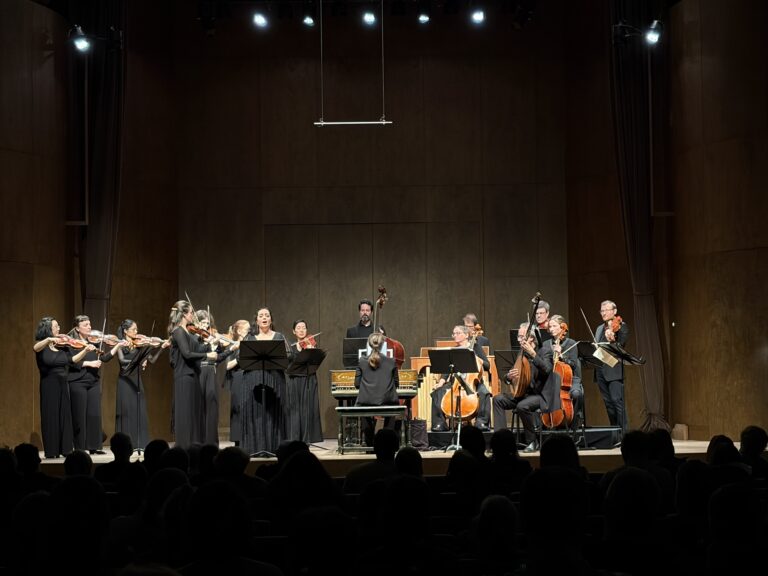
For the penultimate concert of its season, Arion Baroque Orchestra invited Montreal’s music-loving audience to immerse themselves in Baroque Italy—an Italy in all its “caricatured” glory, to borrow the artistic director’s words to the audience, where emotions are expressed in their raw, unfiltered form.
For it is indeed emotions—sorrow and pain, certainly, but also love, friendship, joy, and elation—that run through this program curated by harpsichordist and guest conductor Marie van Rhijn. A program that also celebrated women composers during this International Women’s Day weekend.
To convey the various emotions of these works, the spotlight was on the voice, featuring French contralto Anthea Pichanik. In the first part, which opened with Antonio Vivaldi’s cantata *Cessate, omai cessate*, the power of her voice captivated us, as did her embodied portrayal of this rejected lover lamenting his rejection by his Dorilla. Pichanik possesses a rich, brassy timbre in her mid-range, with full-bodied high and low notes, which were, however, sometimes lost in the orchestral mass and at certain phrase endings, yet she displayed a commanding stage presence and a grounded, committed performance. In the excerpt from Maria Margherita Grimani’s cantata *Pallade et Marte*, the aria of the god Mars—a triumphant march with a distinctly martial style, yet retaining a very light touch—was performed with verve. It is above all the dialogue between the cello and the bassoon that captures the listener’s attention in this work. Originally composed for cello and obbligato theorbo, Marie van Rhijn adapted it by replacing the theorbo with the bassoon, writing a specific part for it, much to the delight of Mathieu Lussier. The dialogue between the two instruments effectively illustrated the relationship between the two protagonists, Athena and Mars, with an almost humorous exchange that one would not have imagined possible in this way within the 18th-century repertoire. A short concerto for harpsichord, subtitled “Madrigalesco” by Vivaldi, served as a bridge between these two pieces in the first part, showcasing the harmonic richness of the composer’s language.
The second part was entirely devoted to the voice, featuring excerpts from Maria Teresa Agnesi’s Serenata Ulisse in Compania and Giovanni Battista Ferrandini’s cantata Il pianto di Maria, whose title inspired the name of this concert. Ferrandini’s cantata, much like a Stabat Mater, recounts the suffering of the Mother of Christ as she watches her son on the cross. Originally composed for soprano, the version performed in this concert was transposed down a third. Too high for a contralto in the original key and even too low for a soprano, this version—adapted for the occasion to suit the voice on stage—gave the work a very maternal quality. In the cavatina “Se d’un Dio fui fatta Madre”—the Virgin expresses her pain and even her indignation at seeing her son die. The musical and harmonic line is simple yet rich, carried with warmth by Pichanik’s voice and supported by the orchestra and Marie van Rhijn in phrasing and conducting of a thrilling and touching intensity.
With a program that this year features a thoughtful blend of well-known composers and new discoveries—including a third of its 2025–2026 season dedicated to female composers—Arion continues to bring a breath of fresh air and a welcome variety to the repertoire of 17th- and 18th-century music on the Montreal scene.
Photo Credit: Elliana Zimmerman