Additional Information
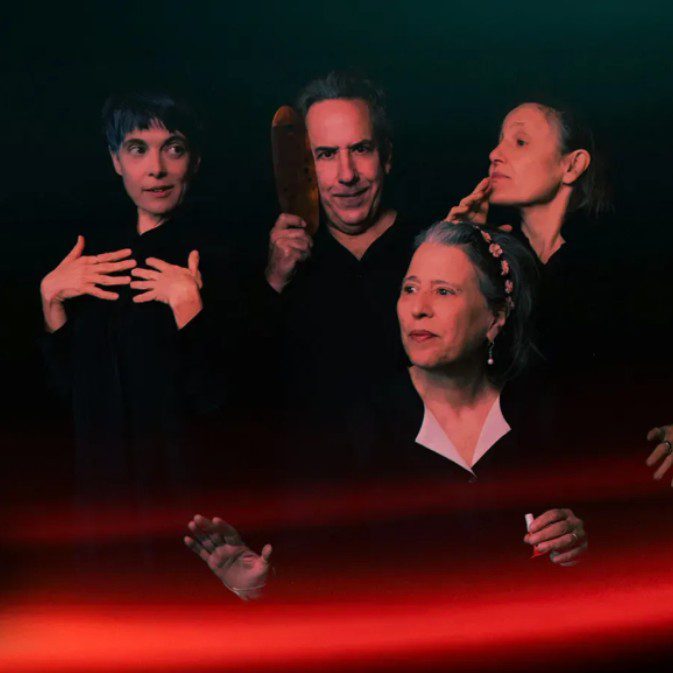
On March 14, as part of Semaine du Neuf, Jean Derome and Joane Hétu will present Au confluent des âmes, an improvisation event shared with dancers Sarah Bild and Susanna Hood.
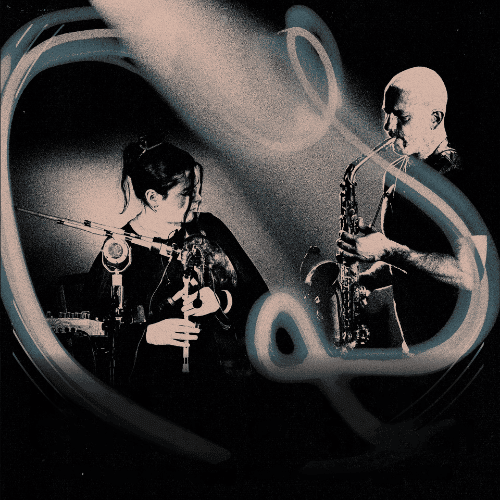
For decades, the two artists have explored the shifting territories of improvisation with their duo Nous perçons les oreilles. Two alto saxophones, two voices—but above all two forces that respond to one another, pursue each other, and blend together. On stage, breaths intersect, timbres rub against one another, objects creak, hiss, and resonate. Sonic gestures almost become creatures: gargoyles, satyrs, or mischievous spirits emerging from a sonic bestiary. Music loses its familiar contours and becomes a profane incantation, a hall of mirrors, and a feast of sounds.
In Au confluent des âmes, this symbiosis expands. Two moving bodies join the two musicians, creating a space where voices, objects, gestures, and presences meet in the moment.
PAN M 360: First of all, where does the title Au confluent des âmes come from?
Jean Derome: I think I proposed it. The concert will be an improvisation with two dancers. So we’ll be two musicians and two dancers. In free improvisation, I often feel that souls meet in a very transparent way. There is a blending of each person’s spirit. The title evokes that idea—like several rivers converging at a common point. In this case, that point is the performance.
Joane Hétu: We share the stage with Sarah Bild and Susanna Hood, who have a similar vision of improvisation. We live in the present moment. The gesture that happens there will not come back. We’re not trying to reproduce something. Each concert will be different. We interact in a way that may seem abstract, but is very real. The title fits well with the energy between the four of us.
Jean Derome: In improvisation, it’s mostly about accepting what happens without preparing anything. Some people use improvisation to find ideas that they later fix into a composed work. They improvise, identify interesting passages, and then structure them. That’s not our approach. We accept what improvisation generates without trying to reproduce it. Every time we begin again, we try to forget what happened before. Ideally, we start from a blank page. It’s paradoxical to say that, since I’ve been doing this for fifty-five years. But the idea remains not to rely on what we already know.
Joane Hétu : And you shouldn’t judge what’s happening while you’re doing it. If you start telling yourself a moment is good or bad, you step outside the experience. You simply have to stay present. A less successful passage can lead to something extraordinary. You have to accept the imperfections of the moment.
PAN M 360 : Can you sometimes come close to a perfect moment?
Jean Derome : Maybe, but when that happens we try to forget it. What matters is to make the gesture again—differently. The goal is to always remain fresh and honest.
PAN M 360 : You mentioned free improvisation, but your practice also seems to exist on the margins of certain musical traditions.
Jean Derome : Yes. We don’t really situate ourselves within contemporary music as it is usually understood. We identify more with musique actuelle. Even within improvisation, we situate ourselves beyond free jazz. Jazz is often the reference point for improvised music, but it’s not our starting point.
In this concert, we won’t use our usual instruments. Joane and I normally play the alto saxophone, and I also play the flute, but here we’ll only use objects: whistles, duck calls, aluminum plates, pieces of plastic used to wrap flowers—any object capable of producing a sound.
We stand behind a small table filled with objects. When we imagine a sound, we look for the object that can produce it. It’s very spontaneous, but with experience you develop a large palette. The possible combinations are immense.
PAN M 360 : How did you manage to integrate Sarah Bild and Susanna Hood into your creative process?
Joane Hétu : When we play just the two of us in Nous perçons les oreilles, the dynamic is different. Here there are bodies moving around us—a physical presence.
One might think the music accompanies the dance, but that’s not really the case. It’s a meeting between four practices. These dancers also have a long history together. They’ve developed a very strong relationship, almost theatrical. They speak, sing, and dance.
Jean and I remain behind our tables, but there is still interaction. It’s not a dance show with music, nor a concert with dance. It’s truly a project by the four of us together.
And there’s also the audience.
In improvised music, its presence strongly influences what happens. When the performance works, you feel that the stage and the room become one. That feeling of symbiosis is very powerful—and the audience feels it too.
PAN M 360 : How do you prepare for such an unpredictable moment? Do you rehearse with the dancers?
Jean Derome : We do some improvisations together and sometimes talk about what happened, but very little. In theory, we could almost present the concert without rehearsal. In this case, we rehearse mainly because the dancers need it more. Movement involves a physical relationship with space.
Joane Hétu : Yes. For dancers, the main instrument is the body. They need to rehearse a lot to integrate things physically. Dancers rehearse enormously—much more than musicians. We already thought there were many rehearsals. But for them, it’s necessary.
PAN M 360: How do the rehearsals unfold?
Joane Hétu : We tried improvisations of different lengths—five minutes, twenty minutes, forty minutes. Duration is a difficult aspect of improvisation. It’s interesting to feel what forty minutes represents, since that will be roughly the duration of the concert. We don’t work with a stopwatch. Everything happens by sensation. During the concert there may also be moments when we stop and then start again. The audience will understand that it’s not an ending, but rather a new chapter.
We also tried shorter exercises—for example, one dancer with one musician, then the reverse. But in the end these are mostly working processes. We don’t really retain those exercises.
Jean Derome : Maybe we retain something unconsciously, but never with the idea of saying, “That was good—we’ll do that again.” We simply try different situations: shorter formats, longer ones, different positions in space.
Joane Hétu : Yes, we did work on positioning in the room. At one point we found an arrangement that suited us and didn’t change it afterward. That’s the one we’ll use for the concert.
PAN M 360 : Is there any chance that it might change during the performance?
Joane Hétu : The general positioning will probably stay the same.
Jean Derome : But a musician might move into the audience space to play somewhere else. That’s possible.
Joane Hétu : And the dancers can also approach us.
Jean Derome : In any case, the concert will be presented in Montreal, then in Quebec City and Rimouski. So there will inevitably be three different versions. The venue and the audience always influence what happens.
PAN M 360 : Perhaps that’s the beauty of improvisation: a living music that transforms according to places and encounters. On March 14, at the heart of Semaine du Neuf, the Montreal audience will discover its first version.