Haydn’s The Creation is a remarkable oratorio written at the end of the composer’s life. The creation of The Creation (Die Schöpfung in German) took place in 1799. Last night, at the Place des Arts in Montreal, a very beautiful and inspiring choreographic vision, signed by Uwe Scholz (1958-2004) in 1991, was presented in an enriched version by the art of Quebec painter Jean-Paul Riopelle, a bold idea but, in the end, rewarding.
And then there was Light…
Very few stage props are required in this production. None, in fact, except for a structure supporting an armada of spotlights, used only for a few minutes at the beginning and end of the piece. Used ostentatiously, even, just a few minutes after the very beginning of the first movement, Introduction. The Representation of Chaos. Largo, the said spots were directed straight at the spectators, thus completely blinding us with the lighting. “And there was Light,” indeed, but perhaps stated a bit too strongly, let’s say. The spectators around me were laughing. That can’t be the goal, I imagine.
That said, it’s a detail that one ends up forgetting, because very beautiful moments are offered in this choreography, frequently performed all over the world because it “sounds” just right.
I will not pretend to be a dance specialist, just a humble lover of this art, particularly in relation to music. And since PanM360 aims to be a media outlet dedicated to music, I will write this review of the premiere of the ballet The Creation last night at the Wilfrid-Pelletier Hall through the relationship of the choreography to Joseph Haydn’s score.
Dance/Music symbiosis
In The Creation, Haydn constructs a narrative that is quite faithful to the mythical account of the creation of the world, in about thirty pieces that alternate between small formations and large ensembles, passages led by the soloists (a soprano, a tenor, and a bass) and impressive choral sections. Scholz respects these divisions while weaving his constructions into those of the music: solos, duets, and small ensembles adhere to the chamber passages of the music, while the choral parts, which aim to be monumental, are well supported by the entire body of the GBC.
The Creation presents the myth of Chaos giving way to Light, then to the World, to Nature, to Animals, and finally to Humans (Adam and Eve), under the impulse of God. Although the explicitness of Scholz’s conception leans more towards symbolism, one quickly understands the relationship between the gestures and the unfolding of the synopsis. At the beginning, the dancers are like “trapped” by the structure supporting the lighting equipment, and finally “freed” when it disappears.
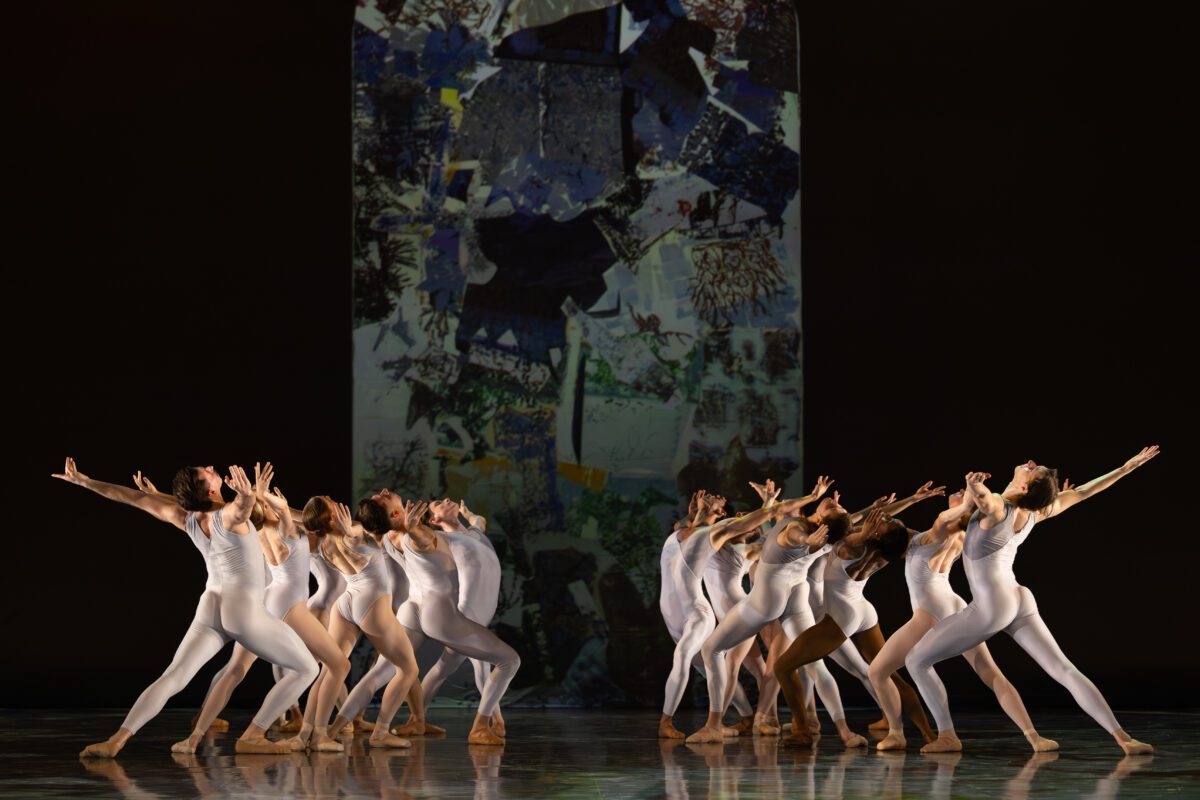
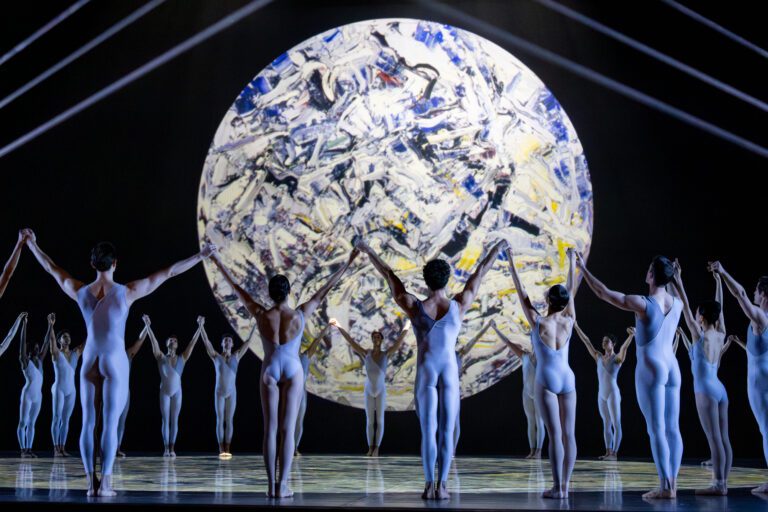
Next, the performances follow one another, offering a sensory, impressionistic interpretation of the arrival of the various elements of divine creation. The dancers are all dressed in white, effectively bringing their movements back to the idea of original light and purity.
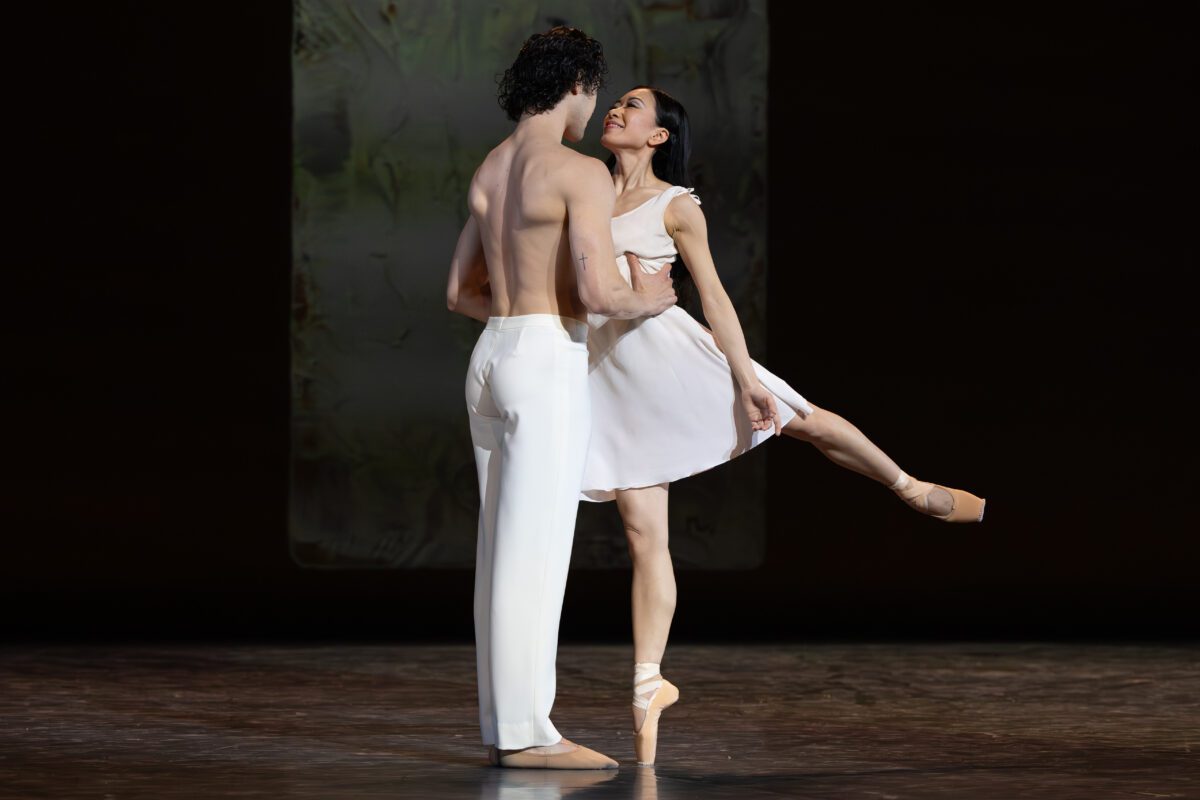
It is in the collective numbers that we are most touched by Scholz’s vision. The entire company moves with an almost aerial collective fluidity, in interweavings that intuitively evoke the counterpoint of Haydn’s choral fugues. Moments warmly applauded by the audience, rightly so. On the contrary, it is in the solo or duet episodes that some sluggishness is noticeable. The relationship between the visual and the musical is less apparent. An exception to note: the last pas de deux, on Holde Gattin… Der tauende Morgen (Dear wife… The morning dew), is of wonderful tenderness, and dressed in gentle sensuality.
Riopelle’s art looking over
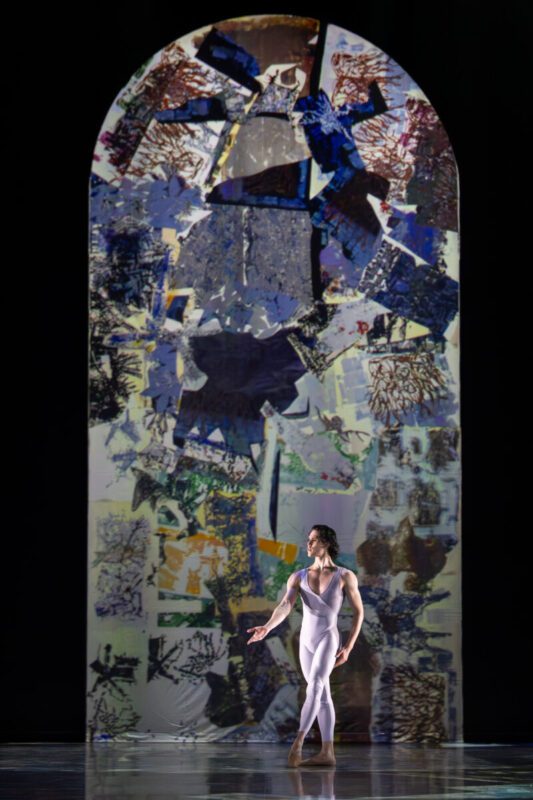
The addition of Jean-Paul Riopelle’s paintings projected at the back of the stage is a great idea. Ivan Cavallari the Ballets’ Director), as one can guess, was inspired by the character of the various abstract works of the Quebec painter. Without obstructing or imposing on the spirit of the numbers performed by the musicians and dancers, the paintings rather subtly accompany the expressive essence of the different movements. More or less “bright” or “dark,” loaded or stripped down, the paintings from the palette of the brilliant artist offer a kind of commentary on the stage action, while subtly and diffusely guiding the emotions of those who watch. Never did we feel that the exercise was artificially imposed. This is in itself a good point.
Convincing soloists
On a purely musical level, I highlight the beautiful performance of the three soloists, Andréanne Brisson-Paquin, soprano, Philippe Gagné, tenor, and Clayton Kennedy, bass, whose projection is unfortunately diminished by the hall itself. Now accustomed (and spoilt) by the Maison symphonique just next door, one easily forgets how much Wilfrid-Pelletier is an imperfect vehicle for this kind of music. Well, we are still able to recognise the interpretative beauty of the artists in the orchestra pit. Bravo, then, even if it doesn’t yet match (for me) a certain Gundula Janowitz, with Walter Berry and Fritz Wunderlich (with Karajan on DGG).
The orchestra of the Grands Ballets is very good, but suffers from sharpness in certain string passages, especially at the beginning of the evening. Once or twice, it was even out of tune. Elsewhere, some slight rhythmic discrepancies between the choir and the orchestra were heard. But the choir itself is very nice. In terms of sound texture, a bit of thinness is noticeable when compared to the best. It must be said that this music is not the usual bread and butter of the ensemble.
Despite these technical remarks, the overall performance is pleasant and will only refine over the course of future performances.
If only for the inspiring collective numbers, but also for the fine, almost ineffable relationship between Riopelle’s paintings and the spirit of this Haydn/Scholz Creation, I urge you to dive into the experience. The Creation continues until March 1st.