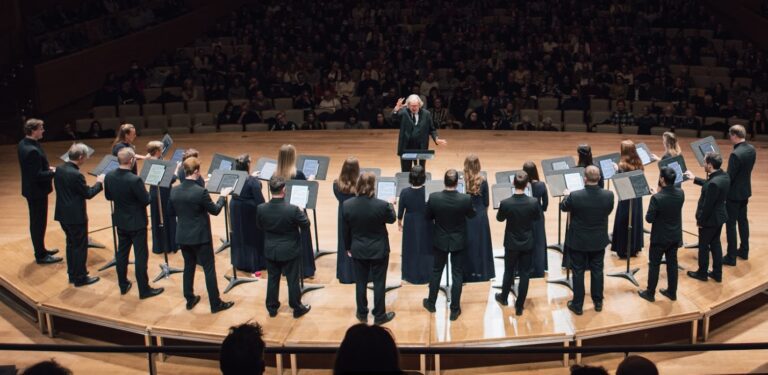
On Sunday, February 15th, at Maison symphonique, the Estonian Philharmonic Chamber Choir was highly anticipated, as this world-renowned ensemble had never before presented a recital of this scale in Montreal. Music lovers were not disappointed!
Under the direction of Tõnu Kaljuste, the Choir came to present what it does best: performing contemporary Estonian music with a program featuring composers Arvo Pärt, Veljo Tormis and Evelin Seppar, complemented by choral works by Luciano Berio and Philip Glass.
The first part was devoted to the most famous living composer of sacred music on this small planet, Arvo Pärt, who was discovered in the 80s, notably thanks to the flair of the famous producer and owner of the German label ECM, Manfred Eicher.
We were treated to Pärt’s Magnificat (1989), whose modern characteristics are not immediately apparent, yet which impresses with its restraint. From this perspective, we observe these 24 equally distributed female and male voices, pure lines, with little or no vibrato, serving works that are both rooted in a distant Christian past and in a contemporary world that led Arvo Pärt to a profound mystical introspection, culminating in fervent faith. And since faith can move mountains, it can certainly move musical scores as well, whatever one may think of that faith.
Women’s voices rise, men’s voices reply with bass notes, then the sexes merge in a celestial atmosphere.
Which Was the Son of…, the following piece, was composed in 2005, commissioned by the city of Reykjavik for the Voices of Europe program. This work seems to me the most predictable on the program, an ode to Christ performed in English, with very old-fashioned musical characteristics, based on the call and response mode between female and male sections.
Created in 2007, The Deer’s Cry is inspired by a text by Saint Patrick written in the 5th century. The 5-minute piece is based on the leitmotif “Christ with me,” around which the composer has conceived a mixed choral discourse overlaid by female voices. The restraint of the voices is striking; all that remains is to let oneself be carried away by this musical beauty, devoid of any apparent singularity, which culminates in a superb male-female dialogue.
Dopo la Vittoria, created in 2006, is a 12-minute work clearly more substantial than its predecessors. It’s no coincidence that the choir chose to place it before excerpts from Kanon pokajanen: Kondakion, Ikos, Prayor After the Kanon, a masterful work by Pärt released in 1997. The conceptual depth of these last two works is greater, the worlds explored are more diverse, and one senses a more pronounced touch of modernity—those dissonant lines that deviate from the rules of classical harmony without, however, distorting the traditional character of Arvo Pärt’s style. As my seatmate summarized, it was “perfect simplicity with a little crunch of modernity.”
The second part will be more contemporary. Also of mystical inspiration, The Bishop and the Pagan (1992) by Estonian composer Velijo Tormis (1930-2017) incorporates many more contemporary characteristics, superbly integrated into this ancient-inspired vocal polyphony. The bass parts, for example, employ modern 20th-century techniques.
In my opinion, the surprise work of this program was by Luciano Berio (1925-2003), full of surprises. Like a demonstration, it begins with a soprano singing through a megaphone, opens with textural, atonal, or noise-based interludes, all while following a consonant approach where soloists of all vocal ranges—soprano, alto, tenor, and bass—shine in turn. Powerful! This tells us even more about the vastness of this great Italian composer’s universe.
We will then move on to a work by the Estonian Evelyn Seppar, who will be 40 this year. Iris (2024) is a splendid polyphonic continuum; the orchestral discourse unfolds without interruption or break, undulating elegantly to achieve its goal: to uplift and nourish.
We will conclude with Father Death Blues (1985), an excerpt from Philip Glass’s chamber opera Hydrogen Jukebox. Constructed on the repetition of motifs and phrases akin to a prayer or mantra, this piece is certainly not a landmark in Glass’s oeuvre, but it fits well into this program, not unlike the praise heaped upon The Deer’s Cry and Which was the Son of… in the first half.
Coherence, cohesion, delight, in short, with the added bonus of two generous encores: The Rose of Love, a folk song from Denmark, as well as Innarta Anaanaga by Frederik Elsner.