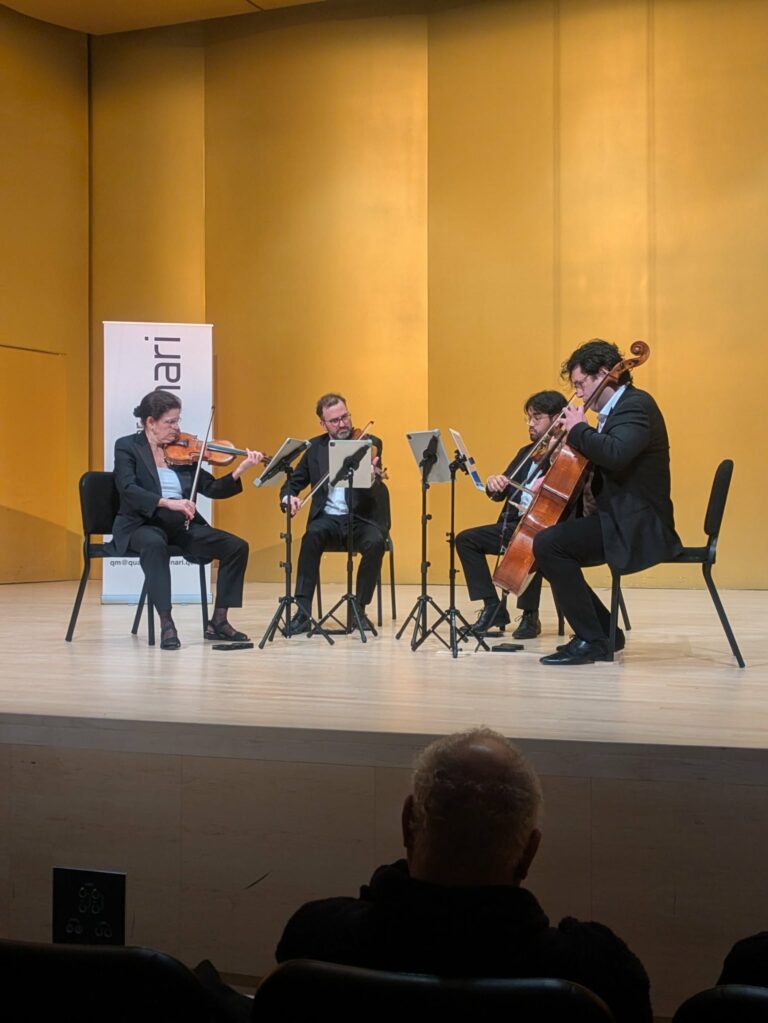
In a fairly full hall at the Montreal Conservatory, the aura of Philip Glass permeated the audience present. We were eager to be there to hear the last four quartets of the famous composer. All the more famous because he recently gave Donald Trump the cold shoulder by cancelling the premiere of his fifteenth symphony at the Kennedy Center in Washington. In reaction to the addition of the name ‘’Trump’’ before that of the former Democratic president. Bravo. Nothing more to say about that.
Unusual Glass
The last quartets by Glass are still quite recent and have rarely been played to date, at least here. The Molinari Quartet is preparing them for recording next August. They will be added to the others, already digitally recorded, and will form a complete set that we look forward to hear.
These latest quartets, from Glass’s chamber music perspective, are innovative, even often astonishing. You hear harmonies that were never really explored in the first five, better known ones. Melodies are sometimes distant from the sumptuous fullness of the usual Glass style, and architectural support is different from the repetitive cellular motivism to which the American composer has accustomed us (for example, in Quartet No. 9, King Lear. See further down).
They are, therefore, dangerous for interpreters because they are not “intuitive.” Traps are set everywhere, and it is easy to break their narrative and discursive strength. It often relies on very little, on tiny details that must be perfectly rendered, at the risk of seeing the entire structure crack.
The Beethoven effect
I dare to compare these quartets to Beethoven’s last ones. For Philip Glass, they might have this significance. Of course, not in terms of style and philosophical and spiritual aspirations, but certainly for the place they seem to give to the renewal of the master’s technical language. To the seeds planted for the next generation of Minimalists who will claim his school of thought.
The Bent Suite, taken from a film score, paints sober landscapes that accompany the story of the persecution of homosexuals under the Nazi regime. The score features several passages for solo, duo, and trio. A kind of intimacy of sounds, then. A refined aspect that requires careful control of sound projection, at the risk of sounding harsh. It happened a bit yesterday, in the fourth movement, for example.
Quartet Satz (Movement in German) was written for the Fifty for the Future project by the Kronos Quartet (for which Montrealer Nicole Lizée was also involved). It is a piece of barely 8 minutes, in the shape of an arch that starts in calm, swells with sound intensity before returning to tranquillity. Beautiful, effective, perfectly rendered by the Molinari.
Renewed Classicism
The String Quartet No. 8 is, they say, a “return to Glassian classicism.” My ears still tell me that it dares very unusual melodic detours for the composer. This quartet is a minefield that constantly tests the ensemble’s accuracy and the rhythmic cohesion of a group. On arpeggios with sharper lines and narrower note intervals, melodies or a dangerously chromatic counterpoint are superimposed. The final movement imposes exchanges of arpeggiated ascents and descents that are very difficult to coordinate between the instruments, at least to ensure the ideal fluidity. The Molinari came out of it with a few scrapes, but without losing its vitality, though.
A masterpiece and a legacy called Lear
The program concluded with the masterful String Quartet No. 9 King Lear. It was commissioned by Glass in 2022 to accompany a production of Shakespeare’s King Lear in New York. The composer delved deeply into the story of this mad king, who died in a storm with his daughters, to write a score that is divided into substantial pieces that return and metamorphose throughout the journey. Different from the usual method, then. In general, Glass reuses repeated motifs, short and almost atomic in their individual simplicity. Here, the arpeggios are certainly present, but embedded in larger musical pieces, each carrying its own personality, atmosphere, and character. These movements are reused alternately with others, then transformed. As if the Glassian architecture here were formed not from unique bricks, but from prefabricated blocks.
Above all, this quartet presents striking ideas, such as the rumbling cello, which seems to prepare for the final storm, or the strokes with the tip of the bow creating a frosty effect, like cracking ice. The King Lear Quartet is a masterpiece. If this were to prove to be Philip Glass’s musical testament for the quartet, it would be a memorable one that will be played often and for a long time.
The Molinari excelled here and mastered the deployment of this rich and very touching construction.
Coming next
There are still several months before the recording, which leaves enough time to make some adjustments and fine-tune everything. What is certain is that the emotional involvement is there, and so is the conviction.
Let’s note that the usual violist, Cynthia Blanchon, who just gave birth (congratulations!!), was replaced on short notice and superbly by Sebastian Gonzalez Mora, a musician with the Montreal symphony.
Upcoming concerts by the Molinari Quartet:
March 29, 2026 (Glass and others) – Molinari Foundation
May 28, 29, 30, 2026 (Shostakovich) – Conservatory Hall