Additional Information
In the context of its 60th anniversary season, a call for submissions from young soloists led the SMCQ to build a program consisting of contemporary concertos in order to highlight it through original music on the theme of Concerted Passion.
Percussionist Catherine Cherrier, oboist Élise Poulin, and violinist Bailey Wantuchs will perform in a program exclusively dedicated to concertos by composers Philippe Leroux (France-Quebec), Margareta Jerić (Croatia-Quebec), Martin Matalon (United States), and Kaija Saariaho (Finland-France). In addition to the soloists mentioned, the works will be performed by the SMCQ Ensemble under the direction of its conductor, Cristian Gort.
For this program presented on Friday, January 30th, at 7:30 pm, at the Salle Pierre-Mercure, PAN M 360 has chosen to focus on (d)Tourner. Ready for the diversion?
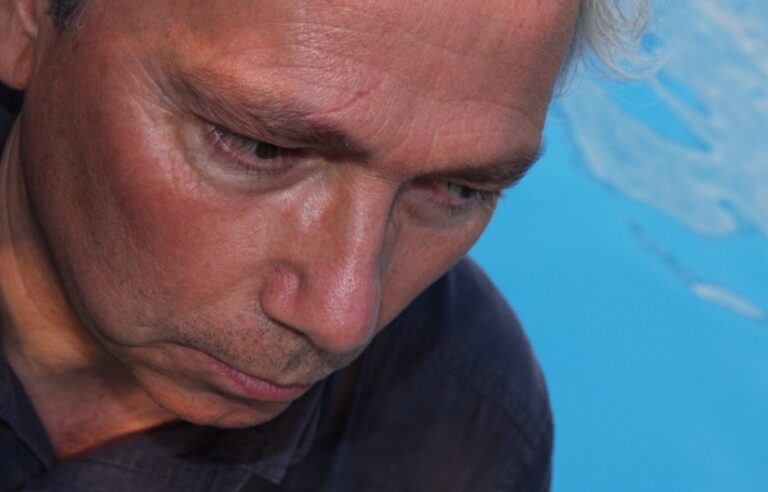
Here is the conversation between PAN M 360 and Philippe Leroux, a composer and educator who has made Montreal his home and who enjoyed “reversing” the notion of rotation, the driving principle of his concerto.
PAN M 360: Philippe Leroux, you are a composer, of French origin, a naturalized Canadian citizen. I am contacting you in Paris because your opera L’annonce faite à Marie is being performed at the Théâtre du Châtelet, but you normally live in Montreal.
Philippe Leroux : So, it happened like this. Actually, I had come to Montreal very often for concerts. The first time was at Domaine Forget with the Nouvel Ensemble Moderne and Louis Lavigueur’s youth ensemble. For several years, I came to Montreal for such projects.
PAN M 360: And you’ve put down roots in Montreal, obviously.
Philippe Leroux : One day, I received a call from someone at the University of Montreal who said, “We’d like to offer you a position as a composition professor at the university.” I liked the idea because I really loved Montreal and what was happening in Quebec. So, I said yes, and I came with my wife and two children.
PAN M 360: So you were living in Paris at the time?
Philippe Leroux : Yes, I was teaching in Paris. And then, what happened was that after two months, two years, I was still welcome as a visiting professor, but there was no longer any question of a permanent position, and I risked losing the positions I had in France. So, I said, oh well, I’ll go back to France, and then McGill University actually created a position specifically for me, which is truly a great honor. And then, I really love Quebec, I feel at home here, so I applied for Canadian citizenship. It’s true that a lot is happening in Paris. It’s a really big city. But there’s also a lot happening in Montreal. And since I travel a lot, that suits me very, very well.
PAN M 360: We won’t be discussing your entire work, but rather your piece entitled (d)Tourner, presented in the SMCQ’s Fougue concertante program. From the outset, Tourner involves solo percussion, flute, oboe, clarinet, horn, piano, two violins, a viola, and a cello. So, please explain the structure of this work.
Philippe Leroux : I tend to say “divert” but we should say “turn.” Indeed, it’s a piece that works extensively with the idea of rotation, circular movement on many levels.
PAN M 360: And how does this manifest itself in the work?
Philippe Leroux : For example, the instruments are arranged in an arc around an imaginary center. This allows the sound to circulate in the space on stage, passing from one instrument to another. So, that’s the spatial aspect. A second aspect would be the sound circulating within the physical space of the instruments. It’s the same on a melodic level; we have melodies that loop back and forth. And it’s the same on a timbral level, meaning that the changes in timbre are also cyclical. In fact, it’s not perfectly circular, because the movements gradually amplify; they are circles that distort, hence the distortion.
PAN M 360: Hence the d in parentheses in the title: (d)Turn.
Philippe Leroux : That’s the main idea. I’m working a lot like that at the moment, using “activity braids.” You have to imagine it a bit like a hair braid.
PAN M 360: In other words, musical discourses are interspersed within the same work, is that right?
Philippe Leroux : There you have it. Sometimes you hear one, sometimes you hear the other, sometimes you hear two at the same time, sometimes three at the same time, or four at the same time. And what I really like about this approach is that it’s both extremely continuous, since each strand of the braid is perfectly continuous, and also because the transformations are gradual. So there’s a sonic coherence, in any case. But since you don’t always hear all the strands, there are these sort of temporal short circuits when a strand is coming back to the foreground. And so, because you don’t always hear all the strands, there are really moments where, all of a sudden, you get surprises, contrasts. That’s what I like about this approach, because it’s something very coherent, since all the movements are continuous. But at the same time, we have something rich in contrasts and surprises, because the braids stop at times.
PAN M 360: Is this your first work of this kind based on this circularity?
Philippe Leroux : I would say yes. In any case, it’s the first piece where I’ve taken this idea this far. But actually, like all my pieces, it finds its source and roots in my previous works, in certain aspects of those pieces. But this time, it’s truly the central idea of the work; it’s several loops that keep coming.
PAN M 360: Now, why can we call this work a concerto? Generally, a concerto is for a soloist or soloists with an ensemble. In this case, what about it?
Philippe Leroux : Yes, you could say it’s a concerto, well, with some nuances. The word concerto comes from the Latin concertare, which means to compete, to struggle, also to consult with one another. That is to say, a true concerto can be seen as a battle between a soloist and a group. I see it more as a synergy between the soloist and the group.
PAN M 360: Don’t most composers see it that way?
Philippe Leroux : Yes, yes, absolutely. But in Baroque music, for example, you find pieces like Vivaldi’s famous concertos, pieces for solo violin and ensemble that are like fratricidal battles between a soloist and the musicians of an ensemble. In the work presented here, it’s a soloist, primarily a marimba. It’s extremely virtuosic, and you’ll see that the solo percussionist, Catherine Cherrier, is truly fantastic. So, it’s a solo marimba, but with a few extra touches: crotales, a bass drum, and so on. I can’t be at the concert, but I have rehearsed with her, and I can tell you that she plays magnificently.
PAN M 360: With two or four mallets?
Philippe Leroux : She plays with four people, and she even used extension cords because it involves a lot of work on the extreme low or high notes, in order to reach both at the same time.
PAN M 360: Regarding how you have approached notes, melodies, harmonies, or sounds in general, where do you stand?
Philippe Leroux :Generally speaking, I’m more in the spectral vein, meaning I work a lot from our perception of sound. So very often, I analyze sounds and use the data from the analysis as harmonic material.
PAN M 360: And from this analysis and the tools at your disposal, you imagine an extrapolation.
Philippe Leroux : That’s it, exactly. I start with a purely acoustic spectrum, a purely acoustic analysis of a sound, and then I build upon it. In this specific piece, I start with a gong sound that I transform. I create modulations from this basic material. Like all classical composers, I choose only certain areas of the harmonic spectrum, that is, certain chords, after which it’s a purely intuitive process.
PAN M 360: Of course. If it’s not intuitive, it’s not art.
Philippe Leroux : I completely agree.
PAN M 360: Since this is the theme of this program, how should we consider the concerted approach in 2026? Doesn’t this approach correspond to previous eras? What is the point of repeating it?
Philippe Leroux : Indeed, I also believe it’s a historically dated formula, both aesthetically and historically, of course. But if we look at this form in and of itself, and try to forget the history of the concerto, we come to realize that this form speaks of the relationship between the individual and the group. That’s exactly how I conceive of the concerto. Consequently, it evokes all human relationships—love, repulsion, and so on—between an individual and a group. So, it’s truly a work about the relationship between the individual and the group.
PAN M 360: Remind us of the creation of the work.
Philippe Leroux : It was commissioned by the Canada Council for the Arts for the Aventa ensemble in Victoria. And it has also been performed in New York, France and Switzerland, but never in Quebec.
PAN M 360: And you’re joined here during a rehearsal with the Ensemble Intercontemporain. So tell us briefly about your opera, since it’s not the main topic of this interview.
Philippe Leroux : L’Annonce faite à Marie was created in 2022 at the Nantes Opera, based on a play by Paul Claudel, one of the greatest French playwrights and poets of the 20th century. Claudel wrote four versions of the text over a period of 56 years, so it accompanied him throughout his life. It’s a text I love very much because it combines a very strong dramatic structure, incredibly coherent and powerful, with an extremely poetic language, rich in imagery.
Librettist Raphaèle Fleury did a fantastic job, drawing from all the versions of the text and creating a superb libretto; I see no flaws in the coherence of the dramaturgy. It’s all a great pleasure. From a musical point of view, it’s a mixed work, instrumental and electronic. The electronic part was created at IRCAM, and you can even hear recordings of Claudel himself. You can hear him responding to the singer, anticipating what the singers are doing, or reflecting as if he were writing his text.
PAN M 360: You really commute between Montreal and Paris, and you still have a lot of ties to France, since you spent a considerable part of your professional life there.
Philippe Leroux : In the current climate, now is not the time to start neglecting these achievements. We’re in a period in music history where contemporary music is still marginalized. I believe it’s important to develop an international network, not just a local one, because otherwise we’ll never get anywhere. So I’m working everywhere: several concerts in Japan this year, in China last year, recently in Germany, this winter in France… So, I think it’s important not to put all your eggs in one basket, as they say.
PAN M 360: We understand that it is impossible for you to attend Friday’s concert in Montreal!
Philippe Leroux : Wait, there are worse things. Well, there aren’t worse things, no, there aren’t worse things, but it’s the same thing. February 3rd is the last performance of my opera, and that evening I have a piece performed by the Radio France Choir. It’s a real traffic jam, but oh well, I’m not going to complain.
PAN M 360: Indeed, it’s quite a problem. The vast majority of artists are languishing in appalling economic insecurity and often give up.
Philippe Leroux : Yes, and I am fully aware of how lucky I am.
PAN M 360: Thank you Philippe!
Participants
- Ensemble de la SMCQ
- Catherine Cherrier, percussions
- Élise Poulin, oboe
- Bailey Wantuch, violin
- Cristian Gort, conductor
Program
- Les échos de l’Adriatique, 7:00Margareta Jerić flûte, clarinette, percussions, guitare électrique, piano, violoncelle, contrebasse, support et dispositif vidéoCommande: SMCQ
- (d)Tourner (2016-17), 21:00Philippe Leroux solo percussion, flute, oboe, clarinet, horn, percussion, piano, 2 violins, viola and cello
- Trame I (1997), 15:00Martín Matalon oboe, bassoon, horn, trumpet, percussion and double bass
- Concerto pour violon Graal Théâtre (1997)Kaija Saariaho violin, flute (piccolo), oboe, B-flat clarinet, bass clarinet, bassoon, 2 horns, trumpet, bass trombone, 2 percussion instruments, harp, piano, 2 violins, viola, cello and double bass