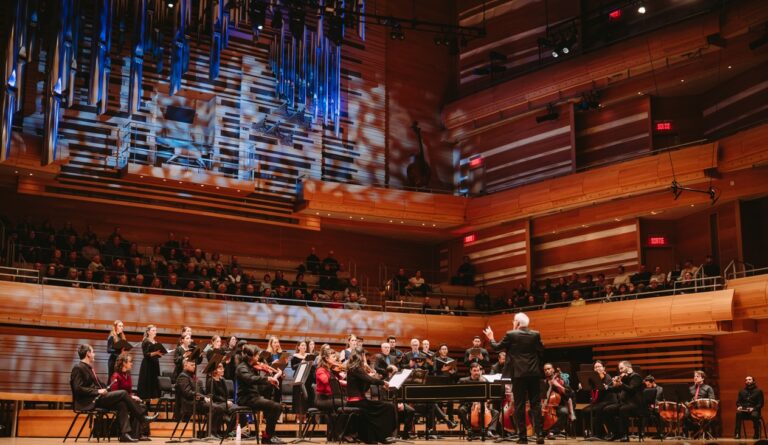
With the program Hallelujah!, presented on Thursday, December 4th at Maison symphonique, the Caprice and ArtChoral ensembles set the festive table. This was one of the first concerts in a long December series, where essential works are presented to audiences devoted to sacred and secular traditions. Matthias Maute is an excellent master of ceremonies in this regard; his humor and communication skills are on par with his musical abilities. The audience remains attentive throughout, and there are also plenty of opportunities to smile and laugh heartily.
From the outset, a work by the conductor himself is performed with the audience joining in. The songs and structure of Hallelujah are retro-nuovo in style, in that they respect the sacred spirit of the Baroque era, with a touch of the modern, as contemporary songs might employ similar techniques in their construction.
The rest of the program consisted of compelling excerpts from the two most emblematic works of the Baroque era, performed annually for the Nativity.
First, Cantata No. 1 from J.S. Bach’s Christmas Oratorio, a choral abundance magnified by the brass and woodwind sections of the orchestra. The nine movements of this cantata are undoubtedly mastered by ArtChoral and Caprice, led by a single conductor and artistic director. Matthias Maute, it should be noted, is a master of Baroque music with a Lutheran background, and therefore inclined towards grand choral works – he hails from southern Germany, in the greater Stuttgart area.
We are treated to compelling contributions from mezzo-soprano Florence Bourget, whose vocal range is not intended to demonstrate power but rather texture and precision in this context (parts 3 and 4). Tenor Emmanuel Hasler, whom our hockey commentators would call a “big guy,” expresses a high and firm voice in parts 2 and 6. In part 7, bass William Kraushaar struck me as a most eloquent soloist, both for his power and his stage presence. He shared the stage for a time with soprano Marianne Lambert, who offered an interesting complement to the main soloist in this section, while the reeds provided counterpoint. The bass then masterfully performed his role in part 8, before the chorale of part 9 brought the whole piece to a close.
George Frideric Handel was selected for the second half of the program. A justified choice, since Messiah is the most frequently performed work during Advent, even though it was originally composed to celebrate the resurrection of Christ. The luminous and sensual delivery of the sections entrusted to soprano Marianne Lambert (There were shepherds abiding in the fields and Rejoice, greatly, O daughter of Zion) were among the highlights of this performance. The Nativity, the first part of Messiah, was impeccably performed by the ensembles, supported by period instruments, and the soloists before the famous Hallelujah!, which normally concludes the second part of Messiah, was added as a final flourish. How could it have been otherwise?