Additional Information
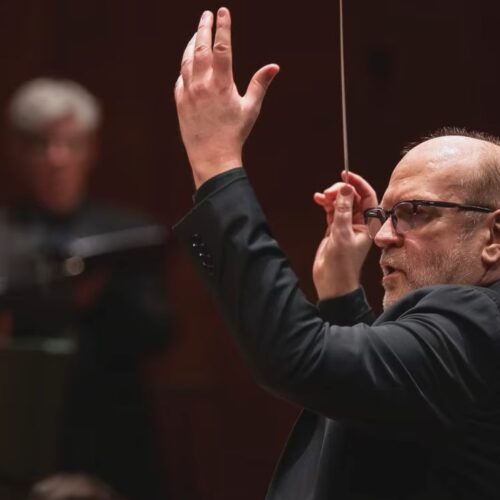
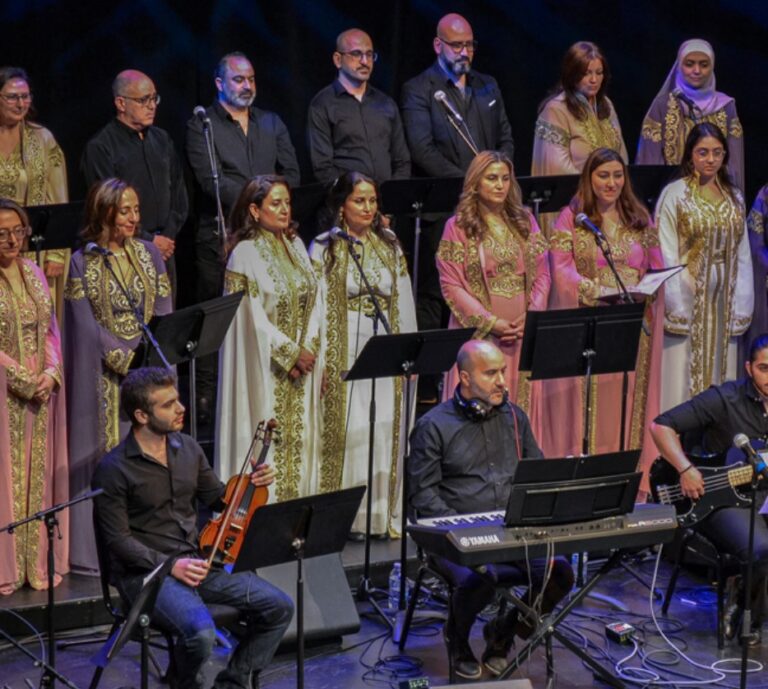
The program Songe d’une nuit andalouse (A Night in Andalusia) will be presented at the National on Saturday, November 15, as part of the Festival du Monde Arabe. It is a concert by the Asala Choir, conducted by Ghada Harb, a Syrian musician who moved to Ottawa two years ago. Michel Labrecque spoke with this seasoned artist about her career and the concert she will be conducting in Montreal.
PAN M 360: Hello Ghada, you are not well known outside Arab communities. Could you describe your musical journey in Syria?
Ghada Harb: I graduated in classical music from the Higher Institute of Music in Damascus. I then taught choral singing and opera, among other subjects, at this institute.
PAN M 360: When you talk about classical music, are you referring to Arabic classical music or Western classical music?
Ghada Harb: Absolutely Western. I have sung in many well-known operas in Syria and elsewhere. I am first and foremost a classical musician who later became interested in Arabic music.
PAN M 360: You also made a name for yourself in Syria by daring to do something: creating an all-female choir called the Gardenia Choir.
Ghada Harb: This choir has received numerous awards in the Arab world. We have sung at many festivals, including in Dubai, and have performed concerts for international organizations such as UNICEF.
We started out singing classical music, then evolved to sing Arabic music, as well as Abba and the Bee Gees, in addition to Sufi music.
PAN M 360:After that, you weren’t done with choirs!
Ghada Harb: I undertook a major choir project with the theme “peace through song.” The ensemble was called Harmony in Arabic. We had over 300 members from all over Syria. As the country was at war, we wanted to express our desire for peace and social cohesion. But it was very difficult to get everyone together.
PAN M 360: It must not have been easy to be an artist during those years of war in Syria?
Ghada Harb: It was indeed very difficult. And I ended up making the difficult decision to seek to emigrate. First and foremost for my children, my family. I was selected by Canada through an immigration program for artists. I had to leave behind my friends, fellow singers and musicians, my students, etc. And I arrived in Ottawa in 2023 to start a new life.
PAN M 360: And that’s how the Asawa Choir was born, which we’ll hear at the Arab World Festival.
Ghada Harb : Yes, Asala means “origins.” They are people from different Arab countries. Twenty people, men and women. We sing Mouachahat, songs based on classical Arabic poems from Andalusia (the southern part of Spain where the Moors lived for a long time). They are beautiful, complex melodies accompanied by percussion, keyboard, flutes, and oud. We have six musicians accompanying us.
PAN M 360: What will we hear this Saturday at the Arab World Festival?
Ghada Harb : You will hear Mouachahat, but also other mixes. We will also pay tribute to Ziad Rahbani, a great Lebanese composer who died in July. He is the son of Fayrouz, the famous Lebanese singer. You will hear Lebanese, Jordanian, and Palestinian music, among others. Andalusian music is a blend of European and Arabic music. It is so closely linked that it is inseparable.
PAN M 360: Now that Syria is changing and the war is over, would you consider returning there?
Ghada Harb: Not at all. I think the situation is still very unstable and that, for an artist, there is absolutely nothing certain. I have decided to rebuild my life here and I am gradually creating projects. We’ll see how it goes. But I always think of my friends in Syria and wish them all the best.
PAN M 360: Thank you very much and good luck to you!
https://www.facebook.com/festivaldumondearabe/videos/songe-dune-nuit-andalousechorale-asala-sous-la-direction-de-ghada-harb-samedi-15/782491578015281/