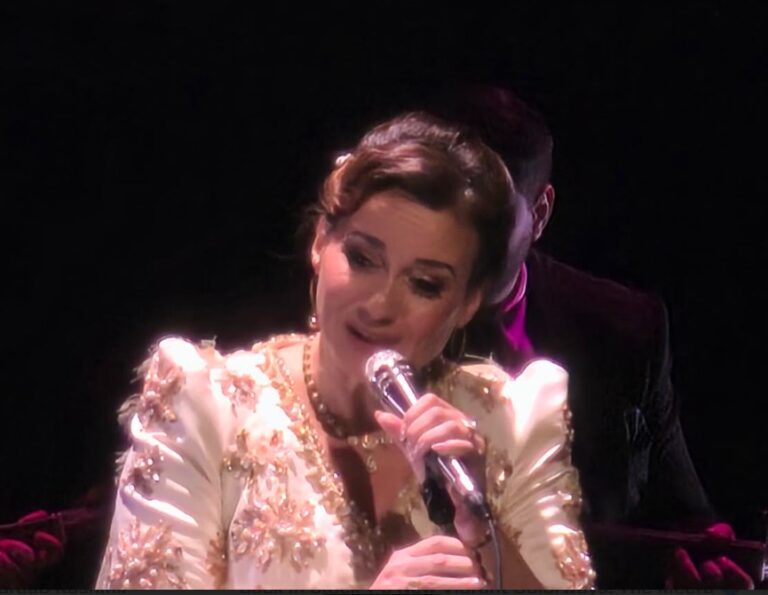
A singer of great talent, Lila Borsali explored the complexities of thought surrounding exile on Saturday. Her introductions to each song on the program evoked various states of exile through the melodies, rhythms, and lyrics of the artists who created them.
This time, she highlighted Ya Ghorbati, “a centuries-old song where the wounded memories of exile throb.” This refined repertoire also included a Kabyle component (Algerian Amazigh or Algerian Berber), an indigenous language that existed before the Arab invasions and colonization beginning in the 7th century. And which still exists today. Given that a large portion of Algerian-speaking Quebec is Kabyle, and many still speak their native language, one can understand the interest of the festival-goers who filled the 5th hall at Place des Arts this past Saturday, November 8th.
Originally from Tlemcen, Lila Benmansour adopted the name Borsali when she married Selim Borsali, from whom she has been widowed since 2013. A specialist in the Arab-Andalusian repertoire, she didn’t speak the Kabyle language, which she explored in depth for this program, she told us. Her musical director and oud player assisted her in mastering the pronunciation and stress patterns of the Amazigh language. We won’t comment on the results, but we can assure you that the audience thoroughly enjoyed it.
For any Westerner who only has a theoretical knowledge of this culture, the exoticism is complete: the (2) violins are played vertically, the qanun is a plucked string instrument requiring a complex technique, ney (traditional flute), two ouds (Arab lute) and two percussion instruments – darbuka, cymbals, frame drums, etc.
Of Arab and North African origin, the modal melodies of these Arab-Andalusian songs can lie on soft and silky accompaniments, but also involve real rhythmic impulses, strong pulses arousing hand clapping and even high-pitched ululations from galvanized spectators.
Two full hours, concluded without the euphoria generated by this excellent singer, whose timbre recalls voices with very different careers but united by their vocal texture and their mezzo-soprano tessitura – Joan Baez, Edith Butler, Nana Mouskouri.
Proud and very elegant in her traditional white dress adorned with oriental gold trim, Lila Borsali delighted the FMA audience, who were clearly already won over.